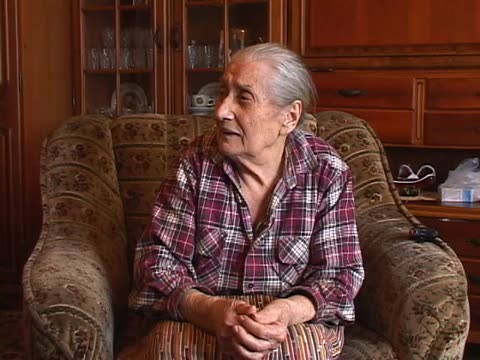
Lemster asks Shmid about a Yiddish word and about the 'good Jews', wonder-working rabbis who visited the village and whom people travelled to see. Kerler asks whether her father taught her Yiddish or prayer. She says no; she learned in Chișinău at her sister's, at a vocational school where Yiddish was taught but not Hebrew. Kerler then starts a question about a remedy against the evil eye.
Adds her schooling in Chișinău and the question about Hebrew.
Shmid recites a spoken charm against the evil eye, in which a woman going to the field meets Elijah the prophet. Kerler has her repeat it, notes the three spittings, and tries to get her to recall who meets Elijah. Others in the room help prompt, and she complains that she forgets with age. Lemster asks about a word and about quenching coals, and she explains the coal-heated iron and how the coals were put out.
The catalogue's 'anecdote' is a charm recited on request, and the passage also covers irons heated with coals.
Shmid recalls the coal-heated irons of her childhood home and her older sister's bakery in the city, which sent sacks of coals home. She names her sisters, says there were seven children, and says one brother went to America. She says she speaks Yiddish with her relatives. Lemster and Kerler then ask the meaning of 'dybbuk' and 'golem'; she knows the latter as a madman.
Adds the bakery, her sisters and brothers, and the 'dybbuk'/'golem' questions.
Asked about Purim, Shmid names baked goods such as hamantashen and baklava. She does not remember Purim songs or a Purim play, only masks worn by children. She describes the few Jewish families in her village and her father, who worked the land, took produce to the city and gave each of his seven children a dowry. Her mother came from Chișinău, could not speak Moldovan at first, and was later loved by her non-Jewish neighbours.
Adds the village's few Jewish families, her father's work and dowries, and her mother's move from the city.
Lemster asks about halutsim; Shmid understands another word and describes the village monastery and non-Jewish holidays in the middle of the village. She recalls going to school in the city after her sister's marriage. She tells how her brother left at eighteen on a ship ticket sent by an aunt, and how he came back twice and died after the second visit. Kerler asks whether this is the brother from America. At the end Gordin offers to talk about Purim.
The transcript points to America rather than Eretz Yisrael; it also covers the monastery and non-Jewish holidays.
Shmid recalls Purim gifts of food sent from her sister's bakery in Chișinău to the groom during her engagement. She describes Sabbath at home, where her mother blessed the candles and was somewhat religious. She speaks of her maternal grandfather, who was something like a lawyer, her parents' village and city origins, how they met at a wedding and her father sent a matchmaker, and Yiddish as the home language. Kerler and Lemster then discuss with each other what to ask Gordin, and she praises her son-in-law.
Adds her parents' origins and courtship, and the exchange about interviewing Gordin.
Kerler asks Shmid not to touch the microphone, then asks about her work. She finished a vocational school and worked after the war in a factory in Chișinău, perhaps a knitwear factory. Lemster again asks about a word, and she tries once more to recall the Elijah charm and what place the woman was going to, and Kerler suggests the cemetery. She complains of forgetting, praises her son-in-law, and apologises that she has no baking to offer her guests.
Adds the factory work and vocational school, and the retried charm.
The formal interview with Gordin begins. He talks about his family, as well as prewar Purim and Passover celebrations. Gordin's two brothers made aliyah.
Gordin begins his interview. He says his mother died in 1947 and that two of his brothers went to Eretz Yisrael. A cousin and an aunt helped him, and he explains how relatives from Bălți (?) and Florești sent Purim gifts. He recalls carrying Purim gifts as a small child with his father and being given money, then Passover customs: kosher dishes, matzo latkes, potato dishes and poppy-seed latkes. Kerler asks about the name of Purim.
Adds the relatives who helped him and the Passover food customs.
Gordin gives his birth year, 1936, and says he was born in Florești and lived there until the war. He describes Simchat Torah lanterns made from pumpkins. His father worked as a loader on the Florești railway and his mother, Leike, did not work. Of five children three survived. Both parents came from Kisnitsa in Yampil raion and moved to Florești around 1919–20, where his mother's sister lived.
Adds Gordin's birth year, his parents' names and origins, and the Simchat Torah lanterns.
Gordin tells of the war years. In 1941 his father was drafted and the family fled to Kisnitsa to his grandparents, then on to Kryzhopil and Zabokrych. There the Germans arrived and Jews were rounded up and killed. They ended up in Myskivka (?), where a ghetto under Romanian administration held them for the rest of the war. His father worked at an oil press and later on forced labor building a bridge. Kerler asks who ran the ghetto.
Adds the flight route, the killings at Zabokrych, the ghetto at Myskivka, and his father's forced labor.
Gordin speaks about his life after the war. He states that his mother died during the Hunger of 1946/47. He graduated from school in 1955 and then joined the Red Army. Gordin studied chemistry in Vladivostok, Russia, and then Chișinău. He worked as chemical engineer at a furniture factory.
Gordin says his mother died in 1947, in the hunger years, after the family returned to Moldova. He tells of finishing school, failing to enter an institute in Leningrad, serving in the army, and studying chemistry in Vladivostok. He then returned to Chișinău and worked a year in a village before taking factory work. Kerler asks what he studied. The year he finished school is unclear in the transcript.
Adds that Jews were hard to get into the Chișinău institute; the transcript does not confirm 1955 or the furniture factory.
Asked about singing in the ghetto, Gordin recalls a Jewish musician who played for the Romanians, and says Bessarabian Jews were driven from Myskivka to Kryzhopil while his father bought them a place. He recalls ghetto life with its killings, singing and dancing, but no camp song. He names the ghetto elder, Anshl, and his two daughters, whom he married off to men from Mărculești. Kerler asks whether people prayed there.
Gordin talks about prewar religious life in Florești. He then addresses his return to Florești after the war. He was married in 1965 and raised a son, who lives in Israel. Gordin then talks about his family.
Gordin says his father prayed only on holidays, with tallit and tefillin, in the synagogue where the women sat upstairs, and that Florești had a shoykhet before and after the war. After the war the family returned to Florești and found their house wrecked. He was married in 1965 and has a son in Ashdod, who knows Hebrew and English and some Yiddish. He travelled to his grandson's bar mitzvah.
Adds his father's prayer habits, the shoykhet, his marriage, and his son and grandson in Israel.