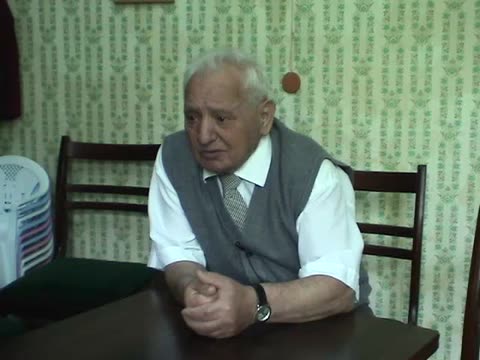
Dunaevskij provides personal information and talks about his family. His father, who was also born in Tighina, worked as an egg tester and passed away in 1945. His brother was buried at the Soviet War Memorial in Treptower Park, Berlin. He grew up with two brothers and one sister. Dunaevskij raised a daugther, who lives in Israel, as well as a son. His mother worked odd jobs to support the family.
From the machine transcript
Dunaevskij gives his Yiddish name and birth year and talks about his family. His father, born in Bender, worked as an egg tester (klerer) and died in 1945 after returning wounded from the war. His mother Feyge died in 1967. A brother is buried at Treptower Park in Berlin, another brother died in Israel, and a sister and children are mentioned, including a daughter in Israel. He also recalls his paternal grandmother, who told him Yiddish stories.
Also covers his mother's name and work, his grandmother Yente Rive, and a cousin relationship with Eliyahu Luksmal (?).
Dunaevskij recalls how his grandmother told him stories about life and the Ştefăneşti rebbe. He then returns to talking about his family and his life before the war. His family lived in Ştefăneşti, Romania, from 1928 to 1940, and Dunaevskij attended a religious school (cheder). He then addresses prewar Jewish life in Ştefăneşti.
From the machine transcript
Dunaevskij explains that his grandmother told tales, including about the Ştefăneşti rebbe, and returns to family background. His family lived in Ştefăneşti for some years before 1940, and he attended cheder there. He comments on the local Yiddish, which resembled Bessarabian Yiddish with many Russian words. He describes Ştefăneşti as a largely Jewish town with several synagogues and no factories, whose Jews were mainly traders. The rebbe's funeral drew a delegation from America.
Also includes talk about Yiddish in Ştefăneşti and the number of Jews and synagogues in the town.
Dunaevskij recalls the burial of the Ştefăneşti rebbe in 1933 and discusses the rebbe's work.
From the machine transcript
Dunaevskij recalls the Ştefăneşti rebbe: his good advice, his authority, and his sparing, measured speech. He recalls that when the rebbe died in 1937 (?) the whole town mourned and Romanians and Jews both attended. He also begins to mention the Jewish school and its director Feinstein.
The year of the rebbe's death sounds like 1937 rather than 1933 as the catalogue gives; the transcript is not fully clear.
Dunaevskij talks about the Romanian Jewish school in prewar Ştefăneşti, which he attended for four years. He also talks about the Yiddish literature he learned at school.
From the machine transcript
Dunaevskij talks about the Jewish school in Ştefăneşti, where subjects were taught in Romanian and Hebrew was also spoken, and poor children were given food and clothes. All Jewish children attended it up to the fourth grade. He recalls learning to write Yiddish, reading short Yiddish books, and one by Sholem Aleichem about an orphan. Kerler shows him the book and he recognises it.
Also covers Hebrew spoken at school, learning to write Yiddish, and the Sholem Aleichem book Motl Peyse dem khazns.
Dunaevskij talks about prewar religious life in Ştefăneşti and his family. He recalls how he learned prayers in cheder.
From the machine transcript
Dunaevskij and Kerler discuss the book Motl Peyse dem khazns, which Dunaevskij read as a child, and a remark on coincidence and planning. Dunaevskij speaks about his maternal grandparents, whom he hardly knew. He says he learned the Modeh Ani prayer in cheder. Kerler then asks how the holidays were kept.
Dunaevskij discusses holiday celebration at home and his life after the war. Dunaevskij worked in construction after the war, before studied at a technological institute. He works as the chief engineer at the state-owned shoe factory in Tighina.
From the machine transcript
Dunaevskij describes keeping the holidays at home, with his father conducting the Passover seder. He recalls cheder in Ştefăneşti followed by Feinstein's school. After the war he worked as a builder, then studied in Moscow and qualified at a technological institute, and was chief engineer at the factory in Bender until today.
The sequence includes Dunaevskij's Moscow studies and his engineering career.
Dunaevskij talks about his life during the war. He fought in the Red Army and explains that he attained eighteen ranks. He fought near Stalingrad, Rostov, Caucasus and Warsaw. During the war, he also returned home and worked as translator. Dunaevskij was released from his services in 1947.
From the machine transcript
Dunaevskij talks about his Red Army service on the front. He names Stalingrad, the Caucasus and an area near Warsaw, and says he worked as an interpreter from German in a camp. He was demobilised in 1947. Kerler then returns to the holidays.
Adds his work as a German interpreter and the 1947 demobilisation.
Dunaevskij discusses holiday celebration at home before the war. In particular, he addresses Purim celebrations.
From the machine transcript
Dunaevskij describes how holidays were kept at home before the war, including Passover with its seder, four cups of wine and children asking the questions, and dairy foods on Shavuot. He says he now prays in synagogue from a Russian-language prayer book. Asked about Purim in Ştefăneşti, he recalls Purim plays by the school, visiting, and his mother telling the story of Esther. Kerler asks about the reading of the megillah, and Dunaevskij speaks of a pious man who taught the children.
Dunaevskij talks about his family, particularly addressing his father's observance. He remembers snippets from Purim shpiels.
From the machine transcript
Dunaevskij talks about his father's religious observance, who worked on the Sabbath out of necessity but kept to Jewishness and sent his sons to cheder. He recalls a family acquaintance, Eliyahu's father, a pious man who worked alongside his father, and Uncle Motl, who lived in Rivne (?). He explains what a Purim play is: children with masks went from house to house for small payment and sang. Kerler recites a few lines of a Purim song.
Adds Eliyahu's father and Uncle Motl, and Kerler's recitation of a Purim song.
Dunaevskij discusses prewar holiday celebration, in particular Sukkoth and Hanukkah.
From the machine transcript
Dunaevskij answers questions about Sukkot, saying the family built a booth, ate there and sometimes slept there, and about the cheder teacher, whose name he forgot. On Hanukkah he recalls Hanukkah money, fruit and sweets, doughnuts (pontshkes) and potato latkes. Kerler asks about the custom of throwing things at Tishah be-Av, which he only vaguely remembers. Kerler then asks about non-Jews who spoke Yiddish in Ştefăneşti.
Dunaevskij talks about prewar life and recalls non-Jews who spoke Yiddish. He then recalls Jewish press before the war.
From the machine transcript
Dunaevskij recalls that many non-Jews in Ştefăneşti spoke Yiddish, among them a Turk who spoke it like a Jew, and that German children also spoke it. He says non-Jews went to the Ştefăneşti rebbe. He recalls Yiddish newspapers, one of them in Hebrew, and that rich Jews ran businesses in the town. Kerler then asks about political parties.
Adds Jewish newspapers, one in Hebrew, and non-Jews visiting the rebbe.
Dunaevskij talks about prewar political and social life, including Zionist groups. He then addresses Jewish occupations and a Yiddish library in prewar Ştefăneşti.
From the machine transcript
Dunaevskij answers questions about prewar political and social life in Ştefăneşti. There were Zionists, and Kerler suggests Revisionists. There was a fire brigade and a Maccabi sports club. He lists Jewish trades such as tailors, shoemakers, tinsmiths, carpenters and bookbinders. He says there was a Yiddish library from which his father borrowed books, while his mother had no inclination to read.
Adds the fire brigade, the Maccabi club, and the library borrowing habits of his parents.
Dunaevskij recalls Sabbath celebrations at home, including food customs.
From the machine transcript
Dunaevskij recalls Sabbath at home: his mother lit the candles and made the blessing, baked challah every week, and prepared sweet gefilte fish, made with horseradish and tomato and ground with a hand grinder. Kerler then asks about Yiddish cinema.
Dunaevskij addresses prewar cultural life, in particular Yiddish theater. He then answers questions about cultural terminology.
From the machine transcript
Dunaevskij says that a Yiddish theater came from Iași and that films were shown. He answers questions about cultural terminology: the Ştefăneşti rebbe's followers, a Litvak (a Jew from Latvia), and a tsadik. Kerler then asks the Yiddish word for tomatoes and for peppers, and Dunaevskij gives terms for red and blue vegetables.
Adds questions about the terms Litvak and tsadik, and the word for tomatoes and peppers.
Dunaevskij talks about prewar traditional weddings, and then consuming alcohol.
From the machine transcript
Dunaevskij describes Jewish weddings in Ştefăneşti: the chuppah, dancing, and Jewish klezmer musicians, and a badkhn named Motl who entertained the guests. He says people drank wine rather than spirits, and his father made cherry wine. He says too much time has passed to remember details.
Adds the badkhn Motl, klezmer musicians, and drinking customs.
Dunaevskij addresses folk customs, in particular averting the evil eye, before he answers questions about cultural terminology.
From the machine transcript
Dunaevskij answers questions on folk beliefs: tying a red string or ribbon on a child against the evil eye, and the practice of whispering charms to remove it, though he does not know the words. He is also asked about pouring wax, quenching coals, a dybbuk (a possessed person) and the golem.
Adds questions about the dybbuk and the golem.
Dunaevskij talks about his life during the war. In particular, he addresses his fighting near Stalingrad and the march toward Caucasus.
From the machine transcript
Asked to tell more about the war, Dunaevskij recounts episodes from his service as a sergeant near Stalingrad. A Soviet tank commander ordered him to blow up a station, and his group escaped German troops by wading through marshland. He recounts the march in the Caucasus, where he survived an avalanche on a narrow mountain road. He says God helped him survive.
Adds the escape through the marsh and the avalanche in the Caucasus.
Dunaevskij talks about his life after the war. In particular, he addresses his return home when he encountered a German soldier. Dunaevskij then discusses his life in the immediate postwar period.
From the machine transcript
Dunaevskij tells an episode near the end of the war, when he and a comrade now in Israel came upon German soldiers near a village and a shoot-out followed, with three Germans dead. He says that every day brought a different story. After the war he returned to find the town destroyed and helped rebuild. In the 1950s he worked in the Bender shoe factory for long working days.
Adds the factory work in the 1950s.
Dunaevskij talks about postwar religious life in privately rented spaces.
From the machine transcript
Dunaevskij says observant Jews remained after the war and prayed in a synagogue until it was closed in the 1950s. After that they prayed in privately rented rooms, where the authorities criticised them. He calls it a hard life.
Dunaevskij talks about his family, in particular his daughter.
From the machine transcript
Dunaevskij says his daughter knows some Yiddish from home, as does his son. He gives their birth years, apparently 1945 or 1948 for the daughter and 1952 for the son, although the transcript is unclear.
Dunaevskij answers dialectological questions from the AHEYM Yiddish linguistic questionnaire.
From the machine transcript
Kerler asks Dunaevskij how various Russian words and phrases are said in Yiddish: greetings, please, thank you, a small mouse, luck, and a few other everyday words including Romanian loanwords. Dunaevskij gives his Yiddish equivalents.