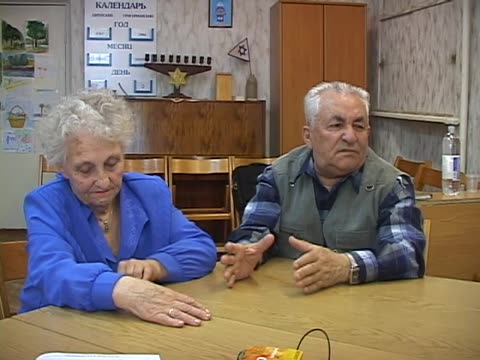
Goldshteyn recalls his neighbor, a priest whose son studied with him at the Romanian school. The priest knew Hebrew well, and the families exchanged holiday food, with Jews sending matzo and gefilte fish. A short exchange follows about speaking Yiddish and Russian with a neighbor.
Adds the exchange of holiday food between the families and the Yiddish-versus-Russian talk at the end.
Goldshteyn addresses prewar Jewish life and halutzim. He recalls his uncle who prepared for aliyah. He then discusses the different occuaptional structure between Jews and Christians.
Goldshteyn answers Lemster's questions on Jewish organizations in the village. There was a cheder and a synagogue but no Zionist or Communist organization and no halutzim. A relative went to Palestine (Haifa) after learning the carpentry trade in Chernivtsi and Khotyn. He contrasts the occupations of Jews and Christians: Christians did the farm labor and Jews paid them. He also mentions about sixty or seventy Jewish families, Christian vineyards and wine-making.
Adds Jewish family numbers, Christian vineyards and wine-making, and a note that the Zionists and halutzim were absent.
Goldshteyn recalls that books were available in the cheder building and that Yiddish theater troupes visited the village. A performer is discussed, with Lemster supplying that she died in Chernivtsi, and her later years in Chisinau are mentioned. The name Sidi Tal is recalled as a singer at weddings.
Goldshteyn talks about preware religious life, in particular his bar mitzvah. They then answer questions about cultural terminology, specifically "a guter yid" (a good Jew).
Goldshteyn says there was no rabbi in the village, only in Bălți; there he and his brother obtained tefillin at thirteen, learned the blessings, and had a bar mitzvah with a tallis and kippah. Lemster then asks about the term 'a gutter yid'. Both informants explain it as an honest man who helps the poor and also as a rebbe visited by Hasidim. The talk turns to terms such as 'Litvak', 'Galitsianer' and 'Bessarabian Jew'.
Adds questions on 'Litvak' and other regional-identity terms, and a rebbe's visit to a 'good Jew' in Ștefănești.
Goldshteyn and Luminskaia answer Lemster's questions on Jewish weddings. They recall the chuppah and its escorts, the food (strudel, lekach), the music and the weeping of the parents. Luminskaia then sings a wedding song in which a mother-in-law is asked to look after the bride. They discuss the groom buying out the bride and whether this was a Jewish or a Moldovan custom.
Adds descriptions of wedding food and music, and the debate over Jewish versus Moldovan customs.
Luminskaia recalls a traditional wedding carried out in secret at her uncle's home in the prewar Soviet period. Goldshteyn recalls gypsies performing at Jewish weddings. Luminskaia then describes a typical wedding she attended.
Luminskaia recalls a chuppah held secretly at home in Soviet times, with the groom and bride brought separately and glasses broken. Lemster presses on the difference between Jewish and Moldovan weddings. Goldshteyn recalls musicians, including Gypsies, who played Yiddish music at weddings. Luminskaia describes a wedding, mentioning the klezmer instruments and the seating. Goldshteyn speaks of wine rather than brandy in Moldova.
Adds the debate over Moldovan versus Jewish customs and the contrast of wine with brandy.
Goldshteyn discusses folk customs. Luminskaia then recalls how her grandfather applied healing customs to her, when she fell sick as a young girl. He then addresses the custom to avert the evil eye in his hometown.
Goldshteyn answers Lemster's questions about folk customs for averting the evil eye; he recalls charms and a non-Jewish woman who performed them. Luminskaia recalls that when she fell ill at the age of four, her grandfather covered her with a black prayer shawl and healed her, with a local healer also mentioned. She describes her affection for him. Goldshteyn then returns to the custom of dispelling the evil eye.
Goldshteyn and Luminskaia answer questions on terms for a person: dybbuk, golem, a blessing at the cemetery and a curse (a wish that evil be kept away). They have not heard of the golem, and recall the other terms with difficulty. The passage ends with a question on whether other forms of the formula were used.
Goldshteyn and Luminskaia answer the dialectological questionnaire, with Lemster often prompting in Russian and Kerler occasionally adding. Items include greetings, thanks and 'please', 'mouse', 'belly', house, window and glass, groats and colors, building and adjectives, and sentences with 'also' and 'everything'. Further items cover time and comparatives, 'to love', 'to flee from the Germans', 'honest', 'cross', 'convert', 'apostate', 'grandmother', headscarf and flowers.