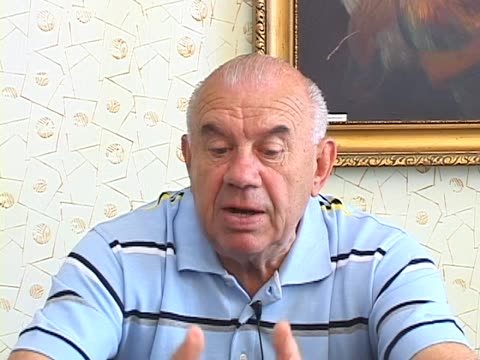
David talks about his education at a Talmud Torah school (Jewish primary school) and a Romanian school after the war. He recalls his teacher Lebovich who taught Yiddish at the Romanian school.
David talks about his schooling: a Talmud Torah before the war, where the rebbi (named Levi) taught Humash, and Romanian state school, where Yiddish was also taught for a few hours a week. He is asked about Yiddish writing and about a teacher at the Romanian school (the name Lebovich is unclear in the transcript). Kerler works out which years he studied after the war.
Also names the Talmud Torah rebbi, Levi, and the Yiddish-writing lessons.
David speaks about singing Hanukkah songs with children at the synagogue today. He says there are no antisemitism problems in Botoșani and that the synagogue has not been vandalised. He also mentions money received through the federation to repair the synagogue roof, and ends by telling how little the community needs. Kerler then asks about the Botoșani rebbe.
Adds the absence of antisemitism and the federation's roof-repair money.
David speaks about the prewar great rabbi Burshtein, whose son Motele later lived in Israel, and about a shoykhet. Lemster asks about the Stefanesti rebbe; David knows him only by hearsay from childhood. He mentions Hasidim and tsadikim, the prayer houses and monuments in the cemetery area where people go to pray, and cantors who came for the High Holidays.
Also covers the Stefanesti rebbe, the shoykhet, tsadikim's graves and cantors.
David speaks about contemporary Jewish life: a 75-year-old man he helps who reads the prayers, and the few men who come to the synagogue. He tells of a recent visit to Debrecen, where he found Jews who could not speak Yiddish and met a large community with a committee and a celebration.
David answers questions about the two prewar mikvas in Botoșani and the bathhouse, which Jews used first and non-Jews later. He tells how his father and brother took him to the baths and mentions a brother in Israel. He then turns to people who come from Israel to the synagogue and a Romanian Jew's gift of money.
Adds a bathhouse and a visiting-from-Israel passage.
David describes Purim customs in his childhood home, especially the Purim treats his mother made and sent with him to relatives, and discusses the terms for them (shalakhmones, Purim sweets) with Kerler. He recalls bringing Friday food through snow and past dogs to his grandparents for Sabbath. He also mentions Hanukkah money for children and that Yiddish is now less spoken than Romanian.
Adds the Purim treats and the terms for them, Hanukkah money, and the shift to Romanian.
David talks briefly about Jews remaining in Botoșani today and who can still help in the community. Kerler asks what it means to go to visit a good (righteous) Jew and then moves on to Jewish weddings after the war.
David answers Kerler's questions about Jewish weddings after the war, klezmer musicians who knew Jewish pieces, and the intellectual level of the Jewish musicians. Lemster asks for Yiddish words for colours and for vodka. David says Jews drank a little wine or brandy with fish, that vodka came from Russians, and that he himself does not drink or smoke.
Adds the colour terms and the vodka and brandy words.
David describes healing the evil eye with coals and a bowl, as his paternal grandmother did. Kerler asks about the meaning of dybbuk, golem and related words. David tells of a sick man he tried to bring to hospital and of the possible old-age home in Bucharest. He also talks about his life today, his friends and relatives in Israel and his visit there at 83, and says he is tired after the overnight train from Debrecen.
Adds the dybbuk and golem terms, the trip to Israel and the sick man.
David states that about 19,000 Jews lived in Botoșani before the war, in whole quarters, owning the shops and working as tailors, carpenters and other craftsmen. He says about 92 Jews remain today, and Kerler and Lemster ask about conversion and mixed couples. David and Lemster then discuss Jewish youth, the Joint, camps for children and the communities in Oradea and elsewhere, partly in Romanian. Kerler ends by asking about a local bread type.
Adds the current figure of about 92 Jews, mixed families and the Joint's youth camps.
David answers a long dialectological questionnaire, mostly posed by Lemster with Kerler. The items cover verbs of liking and fleeing, adjectives (sick, honest, simple, tasty, cold), body parts, everyday phrases and greetings (good morning, good day), words for street, shop, bridge, ceiling and attic, comparatives and time words, and prepositional constructions (at my father's, at table). The recording is poor and many answers are unclear.
Kerler asks David for a closing message about remembering the Jews of Botoșani. David speaks of the many intellectual Jews who left for Israel and of those who remain keeping up Jewishness as far as they can. He wishes all Jews health and unity, and Kerler ends with Amen.