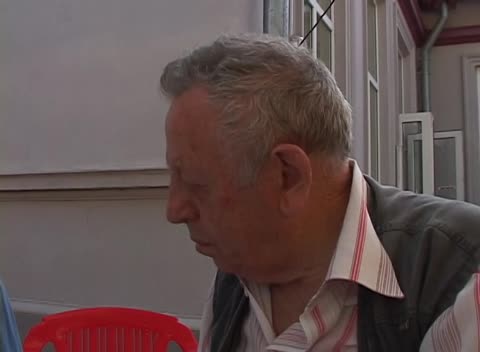
Yankev speaks contemporary Jewish life in the region.
From the machine transcript
Conversation among the community head, Kerler, Lemster and another person about contacts: Yiddish-speaking people in the region who might be interviewed, a woman named Maria (?) and a telephone number. The community head also mentions a work schedule for the days to come.
The talk is about contacts, Yiddish speakers and telephone numbers rather than a survey of contemporary Jewish life.
Yankev speaks about food customs and they talk about contemporary Jewish life.
From the machine transcript
Talk about practical contacts: a man from Chernivtsi who lives in Siret, telephone and email arrangements, and the project, which Kerler says documents rather than makes films. A dish served with sour cream is mentioned briefly, and Lemster raises the Jewish community in Suceava.
The passage is mostly arrangements of contacts, addresses and the project's aims, with only a passing food mention.
Yankev briefly speaks about his life during World War II. He was imprisoned in the Mohyliv-Podilskyy ghetto. He then turns to life today.
From the machine transcript
The speaker says he was in Transnistria and Mohyliv, then the group discusses exchanging addresses and telephone numbers and plans to meet in the evening. A Russian remark about travel distance is heard from another person.
The transcript shows only a mention of Mohyliv and Transnistria, with no account of imprisonment in a ghetto.
Yankev speaks about food customs and they talk about contemporary Jewish life.
From the machine transcript
Brief exchange in which something is offered or handed over, and the community head says he wants to show photographs of Dorohoi Jewish householders.
Yankev speaks about the Dorohoi community and contemporary memorialization.
From the machine transcript
The community head talks about books on Dorohoi Jews and an annual June gathering of Dorohoi Jews near Jerusalem, with a monument there. The speakers also settle dates, addresses and telephone numbers for meeting contacts, including a rabbi and a man in Israel.
The passage covers books and a June gathering near Jerusalem, plus arrangements to meet people, not just local memorialization.
The team concludes the interview with Yankev.
From the machine transcript
The visitors and the community head close the interview with thanks and arrangements about driving and meeting; the talk is partly garbled.
The camera collects synagogue footage and the team informally chats with community members.
From the machine transcript
Informal chat in or near the synagogue between the interviewers and community members about whom they want to talk to: the interviewers say they want ordinary Jews, and Romanian speakers are mentioned. The passage is largely repetitive and garbled.
The formal interview with Meir begins. He provides personal information and talks about his family. His parents died of typhus in the Sharhorod ghetto in 1942 and Meir was imprisoned there for two years. He was a forced laborer in road construction in Tulchyn, Meir explains.
From the machine transcript
Kerler opens the formal interview with Meir, giving the date, 1 June 2007, and the place, Dorohoi. Meir gives his name and his parents' names; they died in Sharhorod in Transnistria, where he was held for two years and worked in Tulchyn. He says he was born in Burdusani, near Suceava and Siret, and gives his birth date in January 1927.
Meir discusses his childhood memories of Burduşani. His father was a cobbler. Meir explains that his father did not have many jobs and thus moved to Dumbrăveni with his family, where also three of his brothers, who owned shops, lived. There, Meir continues, his father opened a shop and Meir himself went to live with his maternal aunt in Dorohoi in 1932.
From the machine transcript
Meir says he remembers nothing of Burdusani. His father was a shoemaker without a livelihood and moved to the village of Dumbrăveni, where three of his brothers had small shops and the father opened one too. At about five Meir was sent to live with a maternal aunt in Dorohoi and attended cheder. Asked about Yiddish, he says only Yiddish was spoken in Dorohoi, and he states the town's Jewish population before deportation.
Meir talks about prewar Jewish life in Dorohoi. According to him, 8,000 Jews lived in town. He then talks about his life during World War II, in particular his train journeys toward Sharhorod, via Chernivtsi and Mohyliv-Podilskyy. He then addresses his family's life in the Sharhorod ghetto. After his parents died, Meir, his three siblings and aunt were sent to the village Kapostarnye 23:16, twenty kilometers from Sharhorod. He explains how Ukrainians welcomed them into their houses until they were taken to forced labor in the summer. Meir then talks about his work as forced laborer in Tulchyn. Meir states that he worked with 2,000 fellow Jews in construction. Meir returned to Dorohoi in December 1943.
From the machine transcript
Meir describes the 1941 deportation from Dorohoi in cattle cars via Chernivtsi to Mohyliv and Sharhorod. Both parents fell ill with typhus and died there; they lie in a mass grave. He and his siblings were sent with an aunt to a village about twenty kilometers away, where Ukrainians took them in. He was then taken to forced labor at a peat site near Tulchyn with about two thousand Jews. The family returned to Dorohoi in December 1943. Kerler asks what the word for a work site means.
Meir talks about his family. His three brothers moved to Israel in 1947.
From the machine transcript
Meir names his aunt and his three brothers and says which ones have died and which ones went to Israel. One of them lives in Rehovot and has been placed in an old people's home; Meir has visited Israel.
The aunt and each brother are named, and one brother is in an old people's home.
Meir discusses his childhood memories of Dorohoi. He attended a religious school (cheder) for two years and then a Jewish school for four years, before starting an apprenticeship as dyer and launder. He worked in this profession for eight years. Meir recalls how he sang Hebrew songs at the Romanian Jewish school.
From the machine transcript
Meir recalls going to cheder for two years and then studying four years at the Jewish school, followed by an eight-year apprenticeship as a dyer and cleaner. He says Romanian was spoken at his aunt's home before the war, mixed with Yiddish. At the school, Hebrew and Romanian were the languages of instruction. He recalls singing Hebrew songs there, including Hatikvah.
Meir addresses prewar Purim celebrations and his family's life before the war. He explains how his parents supported him and his three brothers with food, while they lived at their aunt's house in Dorohoi. His mother was born in Dorohoi and his father in Dumbrăveni.
From the machine transcript
Meir talks about Purim and singing in school, then about his parents and brothers. The four boys lived at their widowed aunt's, and their parents brought food from the village. His father was a shoemaker, with brothers in the village. Lemster asks about his grandparents: a grandfather who was a shoemaker or similar tradesman and a grandmother who helped, and a maternal grandfather who was a tailor. Meir does not know what became of them after 1941.
Meir talks about his work before and after the war. Meir became the director of a Dorhoi syndicate in 1948. He worked 46 years before retirement. Meir states that he frequently attended religious services after the war, but stopped as soon as he joined the Party; and continued after his retirement.
From the machine transcript
Meir says he trained as a dyer and cleaner and after the war became president of a trade cooperative in Dorohoi in 1948, leading about five hundred workers and apprentices. Later he held other posts and worked 46 years. Asked about religion, he says he kept attending synagogue during his working years and returned after retirement.
The passage does not clearly show that he stopped attending services on joining the Party.
Meir addresses prewar religious life in Dorohoi, including synagogues. He then talks about his family. He got married in 1951 and raised two son, who live in Israel and Iaşi. Meir maintains that his sons were circumcised by a local mohel. Meir then addresses postwar Jewish life in Dorohoi.
From the machine transcript
Meir says there were many prayer houses in Dorohoi before the war. He married in 1951 a woman from Dorohoi, a tailor, whose parents died after returning from Transnistria. They have two sons, one in Israel and one in Iași. The sons had bar mitzvahs. Kerler asks about Jewish life after the war and Meir gives population figures for Dorohoi before and after. His brothers left for Israel in 1947. Kerler asks about a word meaning 'died', and Meir explains that it is Yiddish.
Meir talks about his work and boss Horovitz before the war. He then addresses prewar Jewish life, as well as contemporary Jewish life.
From the machine transcript
Meir talks about his employer before the war, Dudl Horovitz, a pious man who did not work on Sabbath. Lemster asks about the Ștefănești rebbe, whom Meir did not visit though older people did, and about rabbis, ritual slaughterers and cantors in Dorohoi. Meir says only a few dozen Jews live in Dorohoi today.
Meir answers questions about cultural terminolog and answers linguistic questions from the AHEYM Yiddish questionnaire. He also talks about his wife.
From the machine transcript
Meir answers questions on Yiddish terms: golem, dybbuk, attic, the tile stove ledge, bridge, and words for potatoes, storehouse, tradesmen, a non-Jew and a peasant. Kerler and Lemster also ask about his region and he mentions a doctor from Chișinău. He talks about his wife's illness, her operations and her piety, and says he uses Romanian outside the home and his sons know Yiddish.
The passage also covers his wife's illness and the languages spoken at home and outside.
Meir sings the beginnings of a Yiddish song and addresses his experiences in the Sharhorod ghetto. He recalls how non-Jews helped him out with food.
From the machine transcript
Meir sings the first lines of a Yiddish song, partly forgotten. Kerler asks whether people sang in the Transnistrian ghetto. Meir says in the first winter at Sharhorod the children went begging in villages for potatoes and flour, and Ukrainians helped. He also talks about the Jewish houses found empty and about the prayer houses.
Meir talks about prewar life, in particular non-Jews who knew Yiddish words. He then speaks about traditional weddings before the war. Meir maintains that non-Jews attended Jewish weddings and vice versa.
From the machine transcript
Meir answers Kerler's questions about prewar Dorohoi. Some non-Jews were decent, some hid Jewish families, and non-Jews who knew Yiddish words. He and Lemster discuss Jewish weddings: the canopy in the synagogue, the hall, music and dancing, and non-Jewish guests. They discuss a wedding entertainer and a Romanian word for jokes.
Meir talks about his family and the team concludes the interview with Meir.
From the machine transcript
Meir mentions his brothers; one served as a tank soldier and went as far as Cairo. Lemster asks whether he spoke Yiddish. The team closes the interview.
The transcript shows only a brother with a tank role who reached Cairo.