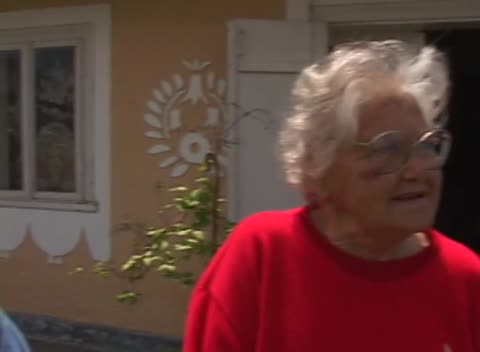
Chirilau talks about pensions and the hard lives of the poor today. She answers Kerler and Lemster's questions on how Yiddish speakers named Romanian towns and places, such as Rădăuți, Dorohoi, Siret, Hârlău, Botoșani, Iași and Seghet. She also mentions Hungarians and Poles in some of them. The team chats about sending photographs, a daughter who also speaks with the team, and the last Jew in Siret. The interview ends with farewells.
Adds the Yiddish versus Romanian place-name questions and the last Jew in Siret.
Town footage leaving Mihăileni, then the team at a Jewish cemetery. Kerler and Lemster read gravestone inscriptions and Hebrew dates in Yiddish and Russian, including one mentioning deportation to Transnistria and one for a woman who gave money. They talk about the cemetery's condition and who might know its history.
Adds the reading of the inscriptions, the Transnistria mention and the cemetery's condition.
Arrival in Dorohoi with footage of the synagogue and a building under construction. Talk in the car is partly in Russian, and a speaker wants to see the façade.
The team meets Isidor and chats informally. They discuss distances and the route onward, staying the night, and a man in Cluj named Miller who speaks Yiddish and could be contacted.
The talk is largely garbled and mixes Yiddish with Romanian. It covers a visiting delegation from England, a former teacher of Romanian, a banquet of teachers and the search for a telephone number. Kerler explains the project and the 800 hours recorded with older speakers about prewar life and Yiddish. Isidor's own words about his family are not clear in the transcript.
Adds the English delegation and the project explanation, and shows the school-teacher passage is hard to follow.
The speaker tells of prewar Dorohoi: a rabbi chosen at 21, mostly mocked by older rabbis. He describes the Jewish town with 24 synagogues organised by trade, and recalls their closing or becoming a museum. The rest is practical talk about visiting relatives in Cluj and Săveni, a Yiddish-speaking couple, a telephone, and being called Tuvye.
Adds the Jewish town with 24 trade-based synagogues, the Săveni relatives and the Tuvye name.
Mentions summer visitors who speak Yiddish, many from Israel, and phone arrangements. Then recalls prewar business: a handshake sealed a deal, and a dispute went to a rabbi or dayan. A story about his mother and a commercial matter begins.
Adds the handshake business custom, the dayan as court and the summer visitors.
A business story about a Jew named Mikhail, a fur dealer, and Tuvye's dealings with him, in which a non-Jewish buyer takes many furs. The dispute is settled on Sabbath in the synagogue courtyard, with the culprit made to pay and give kiddush for four Sabbaths. It ends with a question about what year this was, answered as early 1970s (?), when several synagogues still stood.