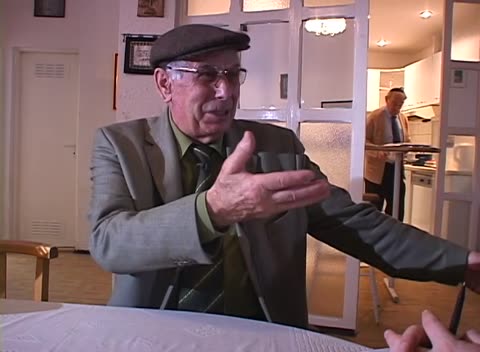
Weinberger talks about emigres in Israel. He also addresses a meeting with Russian Jews in 1965, when he also attended a concert of the Barry Sisters.
From the machine transcript
Weinberger talks about Jewish émigrés from Lithuania and Russia who became prominent in Israel, and Kerler comments on Litvak Yiddish dialects. He recalls meeting Jews from Leningrad and Moscow on a visit to Sochi, where a fellow Jew warned him about a suspicious stranger. He also recalls a concert by the Barry Sisters there.
Also covers a discussion of Litvak Yiddish and Israeli leaders' origins.
Weinberger discusses his childhood memories and prewar Jewish life in Stropkov. He then speaks about his life during the war. Weinberger states that he used "Christian" documents and worked as coachman in Stropkov, before he was taken to the Sered' ghetto in 1942. Weinberger then explains how he fled to Pest, Hungary, via Snina and Stakcín during the winter. He maintains that because deportations to forced labor camps stopped in 1942, he decided to escape to Hungary in 1943/44 to avoid death. In Stakcín, he continues, Weinberger stayed at a cemetery overnight, before he stayed in his driver's coop. Weinberger describes the rest of the journey on a sleigh to Ubla and then on foot to Bereznyi, Ukraine, before taking a car to Uzhhorod, Ukraine. In Uzhhorod, Weinberger explains, he stayed at a full-functioning yeshiva, before taking the train to Pest, Hungary. He then describes the train journey and his encounter with a generous man, as well as the arrival in Pest.
From the machine transcript
Weinberger describes Jewish life in Stropkov, where about half the Jews were pious and the rest less so. During the war he lived on false papers as a coachman for a Slovak employer. When transports resumed and he was due to be taken to a labor camp (Sered'), he fled across the Hungarian border in winter via Snina and Stakčín. He describes a night in a military cemetery, a night hidden among chickens in a poor man's shed, going on foot to Bereznyi and on to Uzhhorod, where he stayed in the Jewish community. He then tells of the train to Budapest and a stranger who shared food and gave him money. Kerler asks about words such as kuchtsher and the Slovak for Yom Kippur.
Beyond the flight to Pest, adds the prewar pious/less-pious split, school languages and Kerler's word questions.
Weinberger talks about his family. His father was born in Krosno, Poland. Weinberger's father, ne Kirshner, took on his mother's name because he did not have Slovakian citizenship. He then returns to his arrival and life in Pest, where he stayed at a chapel with other Jewish refugees. In Pest, Weinberger explains, he went to see the Polish Committee. Weinberger, alias Yosef Chibotsky 25:46, describes the meeting, where he received documents and financial support. Until Weinberger received his documents, he worked in the fields. He then recalls his daily life and addresses again his arrival at the Pest railway station.
From the machine transcript
Weinberger names his father, Leyzer Kirshner of Krosno, who was a Polish citizen and so gave his Slovak-born son no citizenship. On arrival in Budapest he stayed in a prayer house with Jewish refugees, learned a little Polish and went to the Polish Committee under the Polish name Yosef Chibotsky (spelled Przybycki in the catalogue). He received papers, money and food, worked in the fields and a bakery, attended services and received meal vouchers from the Jewish community. Kerler also asks about the date of the crossing, which he gives as late December 1943, and about the arrival at the Budapest station. Weinberger also mentions the deportation of Jews from Subcarpathian Rus.
Also covers the date of the crossing, Budapest work, vouchers and Hungarian Jews.
Weinberger talks about Jewish life in the region during the war, as well as how Jewish history was treated after the war.
From the machine transcript
Weinberger and Kerler discuss the fate of Jews in the region during the war. Kerler's family is mentioned: his parents served in the Red Army and his mother's relatives were murdered. Weinberger recalls the Babi Yar massacre and a book on it by Kuznetsov, which he read in Slovak. He says that after the war the Soviet authorities did not allow the killing of the Jews to be spoken of openly.
Adds Babi Yar, the Kuznetsov book and Kerler's own family.
Weinberger talks about his life in Pest and encounter with local Jews during the war. He then describes the occupation of Hungary by Germany in 1944. Weinberger changed his name again from Chibotsky to Panko due to the persecution of Poles. Weinberger depicts his return to Slovakia and his encounter with the Gestapo. Weinberger maintains that he was the only one from his group who evaded persecution at a hotel due to his Russian name Panko. Weinberger then explains how he decided to return to Pest and managed to get on a train. Eventually, Weinberger managed to cross the border to Slovakia and took arranged transportation home. In Slovakia, Weinberger continues, he was taken to the forced labor camp Zemianske Sady, near Sered'. Weinberger also mentions how Polish Jews in Pest underwent surgery to reattach the prepuce.
From the machine transcript
Weinberger talks about life in Budapest, where he spoke Yiddish mainly with Polish Jews and kept apart from the Hungarian Jews. He tells of the German occupation in March 1944, when the Polish Committee was seized and Poles were persecuted. Under a new name, Yosef Panko, he used false papers as a Subcarpathian Rusyn. He recalls going back to Slovakia, being arrested by the Gestapo with a group but released because of his Russian name, jumping on a train in Levice, and a second border crossing. Kerler asks about words such as advent and about money. He also mentions Polish Jews who had surgery to restore the foreskin.
Adds the Gestapo arrest, the train episode, partisans, and prepuce surgery.
Weinberger talks about his liberation by the Red Army on April 2, 1945 near Hlohovec. He was a forced laborer at a brick factory and then, after an injury, he watched apple trees, before working with oxen in the field. Weinberger then explains, how he survived escaping the Germans between September 1944 and April 1945.
From the machine transcript
Weinberger tells of his liberation by the Red Army in April 1945 near Hlohovec in Slovakia. He recalls working in a brick factory, being injured, being assigned to guard apple trees and then to work with oxen. After the Slovak uprising of September 1944 he fled when Germans surrounded the village and spent months hiding in cellars and barns, begging for food. Kerler asks about words such as stodola and a word for wandering. He ends with the first meeting with Soviet soldiers.
Adds hiding in cellars from September 1944, the injury and Kerler's word questions.