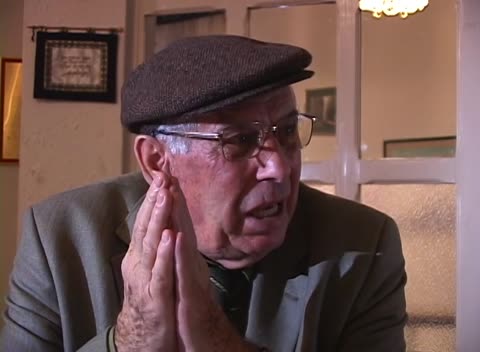
Weinberger recalls the end of the war, when he met Soviet soldiers and a Jewish army doctor who spoke Yiddish and came from Ukraine. A Jewish officer also spoke Yiddish with him, gave him chocolate and explained the front situation. Kerler asks whether they held a Passover seder together, and Weinberger describes his return home and his relief.
The doctor's Ukrainian origin, the officer's chat in Yiddish and Kerler's Passover seder question.
Weinberger talks about his life before the war and his family. His father worked in the field. Weinberger attended a religious school (cheder) in Stropkov for eight years. His uncle lived in Stropkov. He also attended a Slovakian school. Weinberger supported his uncle feeding the animals in the mornings.
Answering Kerler's questions about the prewar years, Weinberger describes a simple village family. His father worked in the fields and his mother stayed at home. He then lived with his father's brother, Mordechai Kirshner (?), in Stropkov, where he attended cheder and the Slovak school and fed the cow in the early morning. The uncle suffered from asthma, and Weinberger affirms that he went to cheder.
The uncle's name and illness and the Slovak school.
Weinberger answers Kerler's questions about his cheder years. He had three teachers in turn, and for his bar mitzvah preparation he went to a German-speaking teacher named Landesmann (?). He says his father also came to Stropkov, around the 1940s, after the family could no longer live in the village, and the brother went to cheder as well. He recalls that Yiddish and Hebrew were learned there, and the passage ends with a half-remembered reference to Rachel's grave.
The three cheder teachers, the bar mitzvah teacher and the dating of his father's move.
Weinberger addresses holiday celebration, in particular Purim, during his childhood. He recalls how the mailman dressed up and an anecdote about matchmaking from his childhood. He then recites a funny Purim shpiel.
In answer to Kerler's questions, Weinberger recalls Purim in Stropkov. The mailman dressed up, he himself delivered shalachmones to the rebbe, and he tells a matchmaking anecdote about a rebbe's payments and a groom who would not work. Kerler also asks about the Purim greeting, and Weinberger repeats it and tells jokes about a Purim rabbi's rulings. He says that about ten percent of the town's Jews were rich and many were poor.
The shalachmones episode, the greeting and the jokes about Purim rabbis' rulings.
Weinberger describes the occupational and economic structure of Jewish Stropkov before the war. He mentions shopkeepers, tailors, and the many families who could barely earn a living, with a small rich minority. He then tells of a stigmatised group of families called kitchers (?), said to descend from a Roma man, whom others would not marry, and of how they were killed in the war. Near the end he begins on Simchat Torah memories.
Weinberger speaks about Simchat Torah celebrations and discusses his childhood memories, including theater performances by students. He also remembers his friends and teachers in cheder.
Answering Kerler, Weinberger recalls Simchat Torah and Tisha B'Av sweets in his childhood, delivering milk to local candy makers, and a prank by a taxi driver. He describes the Slovak school and its Jewish teachers and the cheder, including a teacher who beat a pupil, and the teacher Jeger, a German-speaking Jew. He says he does not remember performances well but mentions the songs children knew.
The candy makers, the beating in cheder and the teacher Jeger.
Weinberger speaks about prewar Jewish life in Stropkov and Košice. He then addresses food customs and answers dialectological questions from the AHEYM Yiddish linguistic questionnaire.
Weinberger compares Stropkov with Košice, where Jews studied at universities and became professionals, and says which languages Jews spoke in Stropkov and in the Spiš area. He then answers Kerler's questions about the Yiddish and Slovak words used at home for vegetables, wall and floor, and 'dove'. Kerler tries to draw him back to the songs he sang earlier.
A comparison of Košice and Stropkov and the languages Jews spoke, and the word questions.
Weinberger recalls songs learned in cheder, including a verse about Rachel's grave that he sang as a child, and describes how the cheders and teachers varied in learning. The talk turns to folk remedies for the evil eye using coals, to Sabbath rules about milking and electricity, and to opinions on modern religious practice.
The coals remedy and the discussion of electricity and Sabbath.
Weinberger recalls Passover, when as a boy he asked the four questions and invented jokes about his father. He tells jokes about Passover customs, including snuff tobacco and a Purim rabbi's ruling. Kerler then raises Hanukkah and a few terms, and mentions a local man from Košice who still speaks good Yiddish and whom Kerler might contact.
Jokes and the suggestion of another Yiddish speaker in Košice.
Kerler asks about the usage of 'or who' and related forms, and Weinberger comments on which are possible in Yiddish. Weinberger then speaks about Isaac Bashevis Singer and his Nobel Prize speech, and about Yiddish and Hebrew and its prospects among Hasidim. He recalls Yiddish songs from Polish records and Kerler asks about his mother's songs.
Singer and the Nobel Prize and the comments on Yiddish's future.
Weinberger addresses prewar cultural performances in Stropkov. He then talks about the best moments with his family on Sabbath during his childhood. Weinberger recalls how he walked with his family to a mikhvah on Sabbath. He then addresses food customs on Sabbath, including wine.
Weinberger describes visiting Yiddish performers in Stropkov, among them singers with a harmonica and a Russian-Yiddish singer whose photograph he holds. He names the happiest time as Sabbath and holidays with his family, and describes walking to a mikveh and minyan from his uncle's village. He describes Sabbath and festival food, including fish, cholent and kishke, and says that a drink of schnapps and honey cake was a delight. He also mentions drinking and the preparation of schnapps.
Weinberger describes local Hasidic rebbes and wonder-workers around Stropkov, mostly from Poland, and who visited them. He talks about a baal shem and a dybbuk, and the kitchers, whose lack of marriage prospects he mentions. He tells a story about a child in cheder, and says he read from the Torah at his bar mitzvah. He notes that his family was not very observant.
Weinberger speaks about his father's observance and a Polish Jew from Kurtshin (?) who fled to Slovakia in the First World War and settled there. Kerler then asks questions about farewell formulas and a verb 'pour', and Weinberger answers. The passage ends with Kerler thanking him.
The Polish refugee story and the farewell formulas.