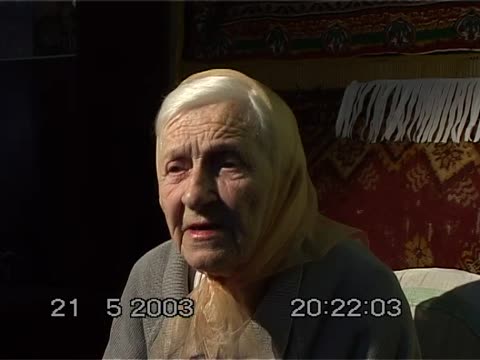
Chukh gives the date and place of the interview and says the Berdychiv tsadik's grave is a pilgrimage site for visitors. She says she was born in Berdychiv, as were her parents, and was evacuated to the Caucasus during the war. Trained as a nurse, she wanted to go to the front but was kept at hospital work because she had a small child. She worked as an operating-room nurse and was later recognised as a war participant. She names her parents (father Yosl/Iosif, a sieve-maker from a place in Poland whose name is unclear; mother Tsirl, a quilt-maker) and her brothers, one in Germany. She describes her Jewish school (school no. 13, seven grades), her later nursing school and her long postwar nursing career in a Berdychiv hospital. She recalls childhood games, dolls she makes today from broken ones, and home life with Yiddish-speaking parents. She tells of the hungry early 1930s, when her mother sewed quilts to feed the children and the school later fed them. She remembers Soviet-era closing of synagogues, the synagogues of Berdychiv, the Hasidic rebbe's prayer house and holiday observance at home but not in school. Chukh also recalls Yiddish literature and press, a large library, visiting Yiddish theaters, the seltzer seller Itsik, and about 60,000 Jews in the town. She describes weddings with music and a rhymester, and Sabbath and holiday foods. She then answers Kerler's dialectological questionnaire: translating Russian words and sentences into Yiddish (greetings, household words, animals, colours, adverbs, body and illness terms), plus words like dybbuk and golem.
The transcript shows the interview opening with the tsadik's grave, family and siblings, and a long Russian-to-Yiddish word-list elicitation, which the bare label does not say.