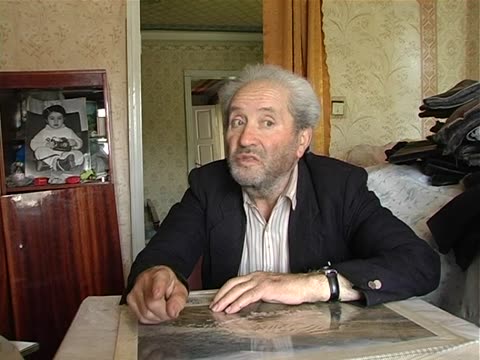
Opening exchange with Lemster, then Gvinter tells of a trip from Israel on which the driver fell asleep, and of phone calls with a daughter (called Natasha?) afterwards. Kerler asks when the accident happened. Gvinter mentions his brothers and a shoemaker father, and talks about his back trouble and massages.
The transcript shows a story about a trip from Israel and an accident, and health complaints, rather than a plain account of family; the father is a shoemaker, not a tailor.
Gvinter talks about his work during the Soviet period. He worked in a sewing factory. He then talks about his life today and provides personal information.
Gvinter talks about his forty years in a small sewing workshop whose staff were three Jews and two women. He mentions prices of bread and goods, and a wish for peace in Israel, America, Ukraine and every synagogue. He says he was born on 5 August (1936), with a forelock, so that his mother thought he was a girl, and begins to speak of his brother Yuzia.
Birth date and the wish for peace are in the transcript; the family and life-today content is thin.
Gvinter talks about his family, particularly his brother Yuzek (Sara Yankelevna Gvinter's husband). He was a cobbler. Gvinter grew up with four brothers and his two sons live in Israel. Gvinter also raised a daughter.
Gvinter talks about his late brother Yuzia, the best shoemaker, and describes in detail how he made and repaired shoes. He speaks of Yuzia's wife and daughters and of his own two sons in Israel. One son drives fuel around the country and the other works in a plastics factory. A daughter who is a nurse and the grandchildren's names are mentioned, and he says his father was a shoemaker. Details of who is who are unclear.
The transcript centres on Yuzia's shoemaking trade and on the sons' work in Israel, with a daughter and grandchildren also named.
Gvinter talks about his family, specifically his parents. His father was a cobbler and also born in Bershad. Gvinter's mother was also born in Bershad and was a milliner. He also describes his mother's and wife's cooking.
Kerler asks about his parents. Gvinter names his father Moshe, a shoemaker born around 1890, and his mother Khasia (Khaye), born around 1892, who was a seamstress. He mentions her relatives in Chernivtsi and her death in 1987 after hospital visits in Vinnytsia. He then describes his wife Nekhama and her mother, who baked bread and prepared fish for weddings, and recalls working in a sewing workshop alongside his mother.
Beyond the parents, the transcript shows his wife Nekhama and her mother's wedding catering, and a workshop where mother and son worked together.
Gvinter talks about his life and work during the postwar Soviet period. He served in the Red Army from 1955 through 1958. Gvinter then describes his military training in Samarkand, Uzbekistan. Gvinter left the army with the rank of sergeant. Gvinter then talks about his family and visits to Israel.
Gvinter recalls his army service from October 1955 to 1958, including training in a regimental school in Samarkand, Uzbekistan, and a long train journey home on leave. He says his future wife waited for him through his service, and he mentions Party membership. He then talks about visits to Israel, his younger son's wedding in September, and the taxi crash on the way there, followed by anxious phone calls. Kerler ends by asking a Yiddish word.
The transcript adds the Party membership, the train trip and the long taxi-accident story from the Israel visit.
Gvinter speaks about his life and neighbors today, as well as his family. He then addresses his childhood memories and family in prewar Bershad. Gvinter describes his father's work.
Kerler asks the Yiddish word for an apple tree. Gvinter then recalls early childhood: he was five years old when the war began. He remembers neighbour boys and a Russian neighbour woman who lived next to his brother Yuzia. His father repaired shoes in the villages and shared bread among the five boys. He mentions an older brother taken into the army and his mother working at the back of the synagogue.
The transcript begins with a one-word vocabulary question, and the neighbours and the father's repair work are covered.
Gvinter speaks about his family, as well as prewar Jewish life in Bershad. He recalls how his mother baked bread in a local synagogue. Gvinter then talks about contemporary commemoration and religious life. He also addresses prayer customs today.
Gvinter describes his mother baking bread at the warm synagogue, and the farewell when an older brother was called up for the army in 1944. He then talks about his own prayer today: he attended on Sabbath and was chairman of the religious community. He prays from a prayer book with Russian transliteration, and Kerler asks how he pronounces the blessings.
The transcript shows prayer from a transliterated prayer book and Kerler's questions on blessing pronunciation; commemoration is not clearly present.
Gvinter speaks about prewar holiday celebration. He recalls his mother and grandmother attending holiday services. Gvinter also addresses holiday food customs. He then talks about religious life in Bershad during the postwar Soviet period. In particular, Gvinter shares an episode about a local official who checked in on the community.
Gvinter describes his mother and grandmother attending synagogue, with the women sitting upstairs. He recalls Passover bread and Sabbath meat. He then tells of a Soviet-period episode in Bershad' involving a local official who visited and checked on the household after a letter to the authorities about his brother at the front. The details are hard to follow.
The official-visit episode is hard to follow and appears to involve housing and a letter about the brother.
Kerler asks about the Purim holiday as Gvinter remembers it. Gvinter describes baked goods his mother and mother-in-law made, with poppy seed and cream, bagels for Sukkot, and the honey cake on the eve of Yom Kippur before the fast.
Gvinter speaks about his life during World War II. He was imprisoned in the Bershad ghetto. Gvinter remembers fellow inmates and recalls his liberation. He then talks about his life after the war. Gvinter addresses his work at a sewing factory. He graduated from a Russian school after ten years.
Lemster asks about the war years, and Gvinter says he was in the Bershad' ghetto. Kerler asks about a man who carried the dead on a cart, and Gvinter recalls Germans dragging a corpse behind a motorcycle and a neighbour now living in Israel. The ghetto was liberated in March 1944 and the war ended in May 1945. After the war he worked in a sewing workshop and went to school from first grade, finishing ten classes. Kerler ends by asking whether people sang in the ghetto.
The transcript adds the man who carried the dead in the ghetto, Germans dragging a body, and Kerler's question about singing.
Gvinter addresses his life in the Bershad ghetto. He specifically shares an episode when his mother prepared food. Gvinter also remembers how his family hid a Jewish partisan, before he talks about his family's life after the war.
Gvinter says that in the Bershad' ghetto speaking Yiddish was forbidden and prisoners were beaten and made to clean toilets. His mother made food for him, and Romanian and German soldiers passed through. He tells how a Jewish partisan from Chernivtsi was hidden by neighbours. He then speaks of his wife Nekhama, who died in 1993 (?), and of the difficulty of getting passports for the family; Kerler and Lemster ask what happened to her.
The transcript adds the hidden Jewish partisan and the wife's death in 1993 with passport troubles.
Gvinter talks about his brothers. One died, another worked as a loader and died after an operation, and a third emigrated to America from near Odessa and was killed by a car after three years. Asked why he does not move to Israel, he says it is hard for him. He recalls his forty years in the sewing workshop and mentions that his grandchildren speak Hebrew.
The transcript shows what became of the brothers, one of whom emigrated to America, and the grandchildren's Hebrew.
Lemster asks about Gvinter's wedding, which took place in 1958 at his wife's house with a huppah, about ten years after the war. Gvinter mentions the shoykhet Azik making kiddush at weddings. Kerler asks about a blessing in the ghetto at the end.