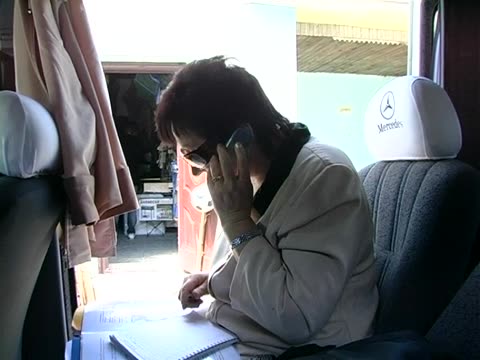
Footage from the van while the team drives through town and looks for street names and a market. They discuss directions in Russian, then phone to locate Efim Vigodner. They tell the person called that Kerler is a professor of Yiddish who collects interviews. They drive on toward a synagogue.
Shows phone calls to find Vigodner and the driving, not only town footage.
At the closed Bershad' synagogue, the local guide explains that it is the only surviving mud-brick (clay) synagogue in the world, that it was called the grandmother's synagogue, and that Soviet authorities never closed it. He recalls a rabbi in the 1950s, perhaps named Lipman. He also describes the Jewish gymnasium building (begun 1916) and the later schools in it. He estimates that only about 30–40 real Jews remain and discusses possible Yiddish speakers. He explains his family link to the Oystrakh family and to a Gvinter woman who died in Israel. He recalls childhood Sabbath visits to the synagogue and the Jewish population in the 1979 census. Kerler asks about his birthplace.
Adds the Oystrakh family connection, the gymnasium, the 1979 census figures and potential speakers, beyond the synagogue and its Soviet-era history.
Town footage as the van drives around Bershad'. Kerler asks the guide whether there is a legend explaining why the Bershad' synagogue was never closed, and a passenger comments on the lack of Jews in the district leadership. They stop by a house said to have been where the Gvinters and Oystrakhs lived.
Kerler talks with a local man, mostly unclear in the transcript. The man says in Russian that people passing by wished him a good meal, and he greets the team in Yiddish.
Gvinter greets the team in Yiddish and Russian and gives his name as Nukhim. He talks about his three children, two sons and a daughter, four grandchildren, and nine visits to Israel. He tells how his older brother Yosef and his wife, who lived in Bershad', died in Israel, and about another brother who went to the front. He mentions his late wife. Kerler asks him about speaking Yiddish, and there is talk about going into the synagogue with a key.
Adds that Gvinter names his children, his siblings and his visits to Israel.
Kerler and Gvinter talk about who in Bershad' still knows Yiddish, naming Efim Vigodner (Mikhailovich) as a good Yiddish speaker. Gvinter discusses in Russian a younger woman whose first language is Yiddish and says whether she can come. They settle whether to film in the synagogue, for which he would fetch the key, or in the flat.
Adds the plan to film in the synagogue or the flat.