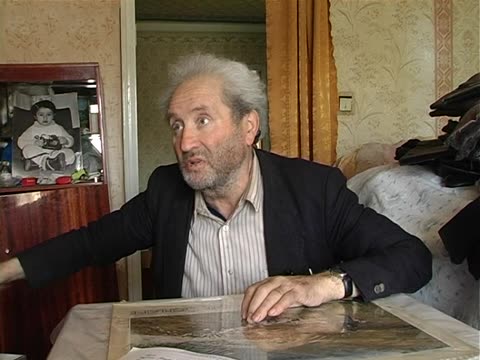
Interviewee Nukhim Gvinter Recorded 13 May 1903, Bershad'
Kind interview
Related tapes MDV 377 , MDV 380 , MDV 741
Identifiers and copies
Tape MDV 378 · record
8g84n812b · Ukraine, Vinnytsya, Bershadʹ, Odesa, Teplyk
Media Collections Online (Indiana University — the archival copy)
Not yet on YouTube or archive.org.
Cite this moment
Nukhim Gvinter, interviewed by the AHEYM team, Bershad', 13 May 1903. AHEYM (Archives of Historical and Ethnographic Yiddish Memories), Indiana University, tape MDV 378, at 0:00 . https://media.dlib.indiana.edu/media_objects/8g84n812b/section/vd66wn22k?t=0
Copy
Catalogue introduction
May 13, 1903. Ukraine, Vinnyts'ka Oblast', Bershad'. This recording is a continuation of an interview with Nukhim Gvinter. (Part 3 of 4. See MDV 377, MDV 380, and Accession # 09-010.54-F MDV 741) Gvinter discusses life and politics today and remembers the song "Lomir forn keyn Palestine" (let's go to Palestine) sung in the Bershad ghetto. They then talk about the city Bela Tserkov (Bila Tserkva) and he answers a few questions about Yiddish cultural terminology. Gvinter discusses life in the Bershad’ ghetto during World War II. Gvinter mentions how people from other regions ("griner") were shot at the stadium. The conversation turns to life before the war and non-Jews who spoke a few words in Yiddish. The conversation moves to life today and Yiddish songs. Gvinter had to sell his shoe store and the difficulties he encountered with neighbors. He then returns to talking about life today and his best moment in life when he returned from the army and married 1958. His mother-in-law provided an apartment for the newly weds. His three children were born in 1959, 1963, and 1970. The conversation moves to his family, in particular his siblings. He talks about Jewish life in Bershad’ after the war, and about the closing of synagogues. Gvinter remembers how they left open one synagogue during the postwar Soviet period. The Great Synagogue was turned into a cinema. The tape concludes with a discussion of life today. He remembers his friend Velvl, whose house Gvinter was supposed to sell after he passed away.
From the machine transcript
Part 3 of 4 of an interview with Nukhim Gvinter in Bershad', Vinnytsia oblast (the catalogue's date of 1903 is evidently an error; the interviewer's remark at about 13:46 places the recording in 2005). Kerler and Lemster interview him in Yiddish. The tape opens with songs about going to Palestine and goes on to Bela Tserkov and questionnaire items on terms for non-Jews and for bad or foolish people. It then covers the Bershad' ghetto and prisoners shot at the stadium, non-Jews who knew a little Yiddish, and his own life: the sale of the shoe shop, his marriage, his children and his siblings. It closes with the Soviet-era closing of synagogues and a long account of the building he was asked to sell. The transcript is heavily garbled, so many details are uncertain.
Speakers, as the transcript identifies them
Nukhim Gvinter informant Dov-Ber Kerler interviewer Moisei Lemster interviewer UNK other Languages heard
Yiddish 26.5 min; Russian 0.5 min
Where catalogue and transcript differ The catalogue date "1903" is evidently an error. The transcript is heavily garbled and the recogniser produced many nonsense strings. Many names and the order of events are uncertain. A short Russian passage near 11:55 is a quoted saying. The catalogue summary mentions a friend Velvl and a house to be sold; the transcript only partly supports this.
A paraphrase of a machine reading: the topics can be trusted; names, numbers and family relations are to be heard before they are cited. How this layer was made.