0:00
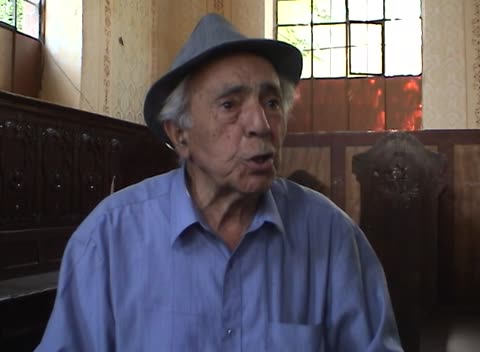
Berkovich provides personal information.
From the machine transcript
Lemster asks Berkovich for his name and address. He gives his first name, Efraim, his surname, Berkovich, and a street name that is unclear in the transcript.
The division was proposed from the catalogue's descriptions and the machine transcript, not stated by the catalogue (how).
Berkovich provides personal information.
Lemster asks Berkovich for his name and address. He gives his first name, Efraim, his surname, Berkovich, and a street name that is unclear in the transcript.
Berkovich provides personal information and speaks about his family. His father was a carpenter.
Berkovich gives his birth year, 1921, and talks about his parents. His father, who died in Auschwitz, was a carpenter. His mother, née Shteyner (?), did not work outside the home and had a large family. He did not know his grandfathers and barely remembers one grandmother, Betty. He is reluctant to say much more.
names his parents and a grandmother
Berkovich talks about his father's observance. He also addresses prewar Passover and Sabbath celebrations, including food customs, at home.
Berkovich describes his father as a very pious man and talks about Passover at home, the seder and the youngest asking the questions. Asked about Sabbath, he mentions kosher meat, fish, and his mother lighting candles and baking challah herself.
Berkovich speaks about his family. He grew up with five brothers and one sister.
Berkovich says there were seven children, himself the youngest, and names his brothers and sisters. He says all are dead: one died in the war, his sister Miriam in Auschwitz, one in Israel and one in America, as did his parents in Auschwitz.
Berkovich talks about his life before the war. He worked as a carpenter before and after the war. He then addresses his life during World War II. Berkovich was imprisoned in several forced labor camps, in Buchenwald, Mauthausen.
Berkovich says he worked as a carpenter before and after the war. During the war he spent three years in forced labor camps in many places, including Germany, naming Buchenwald and Mauthausen.
Berkovich speaks about his prewar education. He attended a religious school (cheder) until his bar mitzvah. Berkovich then joined his father in the carpenter profession. Berkovich then speaks about his cheder, including the teachers. Berkovich states that he also attended a Talmud Torah school for approximately three years before his the age of thirteen.
Berkovich talks about his childhood schooling. He attended cheder until bar mitzvah, with a new teacher every half year, and studied Hebrew, Rashi and a little Gemara, in a room of about twenty children. He also attended a Talmud Torah for two or three years, in all about ten to thirteen years of study, then worked with his father as a carpenter. At the end Lemster mentions that he works in Jerusalem.
Berkovich addresses prewar Jewish life in Berehove. According to him, 7,000 Jews lived there. Berkovich joined the Zionist organization Hashomer Hatzair. He speaks about its youth activities. Berkovich also addresses prewar cultural life.
Berkovich describes Berehove as a different kind of town with Hasidim, Orthodox Jews and about seven thousand Jews. He belonged to the Zionist Hashomer Hatzair, whose meetings included singing and dancing. Asked about Yiddish, he did not read it but learned a little Hebrew in cheder. He does not recall using a Jewish library.
adds his language and reading habits and the library
Berkovich speaks about his life after the war. He was married in 1945. According to him, three hundred Jewish families returned to Berehove. Berkovich also addresses traditional weddings.
Lemster asks about the war years, but Berkovich says everyone knows what happened. He married in 1945 after returning home to Berehove, where he says a few hundred Jewish families came back. He talks about a modest postwar Jewish wedding and remembers klezmers at prewar weddings, though he was too young to follow them.
Berkovich talks about his mother's cooking. He then speaks about his family. Berkovich raised a son, who was circumcised by a kosher butcher.
Berkovich says that what his mother cooked on Sabbath included fish and a potato soup. He says his parents were very pious. He has a son, born in Berehove and circumcised there by a shochet.
Berkovich speaks about postwar religious life. He states that he built the synagogue door. Berkovich then speaks about his life before the war. Berkovich's parents spoke Hungarian at home.
Berkovich says he prays in the synagogue today, and that after the war he built its door, about fifty years ago. He says Hungarian was spoken at home, though his father spoke good Yiddish; he spoke Hungarian with his wife, his son speaks Yiddish and English, and his son attended a Hungarian school. Lemster explains the archive's purpose and urges him to tell his story in Yiddish.
adds the language spoken at home
Berkovich talks about prewar religious life, including synagogue and communal structure, as well as his family. Berkovich recalls how his father visited the Spinka rebbe in Săpânţa, Romania.
Berkovich reflects that few are interested in Auschwitz and the camps, then describes Berehove as a Jewish town with some seven thousand Jews among about twenty thousand residents, and many synagogues, including the great synagogue. Asked about rebbes, he says his father was very pious and traveled to the Spinka rebbe, a wise tsadik, to ask questions, though Berkovich does not know the result of the visits. A Berehove rabbi is also mentioned.
adds a general account of Jewish life in Berehove, with its synagogues
Berkovich answers questions about cultural terminology and speaks about the local occupational structure.
Berkovich answers questions about terms, including his mother tongue (Hungarian) and the Yiddish for 'cemetery', which he has forgotten. Asked about the town's trades, he lists carpenters, tailors, shoemakers, barbers and wigmakers, and says some Hasidim sold lemonade and ice cream.
adds the trades and the terminology questions
Berkovich dialectological questions from the AHEYM Yiddish linguistic questionnaire.
Lemster takes Berkovich through a short word list: thank you, belly, window, glass, sour, cold, high, quick, near, goes, honest and believing, tooth, vodka and brandy. Berkovich often gives Yiddish or German forms and sometimes says he has forgotten them. Kerler and a second man speak at the end.
Hodinger joins the conversation and they discuss visits of the Spinka rebbe before the war. Berkovich shares an episode when he met the Spinka rebbe's son in America. Berkovich then talks about his family and his life today.
A second man (Hodinger, per the catalogue) joins and talks with Berkovich and Lemster about the Spinka rebbe. He says a tsadik whom people visited from Hungary for the festivals, with a gabbai and written petitions. Berkovich says he met a son of the rebbe in America, who asked whether he put on tefillin. He also mentions that his son lives in New Jersey, that he lives here with his seriously ill wife, and that he has been here for three years.
adds the meeting with the rebbe's son in America and his life today
Berkovich speaks about his life today and why he returned to Berehove. He also talks about his family. Berkovich then addresses his life in America, where he worked as constructor for thirty-five years.
Berkovich says he lives with his wife, who is ill and about eighty, while he is eighty-five (?). His son helps, and a sister lives nearby, also elderly. In America he worked thirty-five years in New Jersey as a builder on multi-story buildings. Lemster then brings the interview toward a close.
adds his work in America
Berkovich talks about his work after the war, including his travel to Kyiv and Moscow. He also speaks about his life today.
Berkovich says he was once in Kyiv in Russia, where he worked as a carpenter for an exhibition. He mentions Jewish and non-Jewish colleagues. Lemster says he lives in Israel and mentions Russian-speaking help at home, a woman from Moldova. Berkovich talks about who pays, partly the Hesed. Kerler and the second man ask about the number of synagogues.
adds his travel to Kyiv and his helper from Moldova
Hodinger joins the conversation and they discuss prewar religious life in Berehove.
A second man (Hodinger, per the catalogue) talks about prewar religious life in Berehove, including going to the Spinka rebbe on festivals and the Sabbath, and the father writing a petition for the gabbai. The recording is hard to follow, Kerler pauses to take notes, and the interview with Berkovich closes.
The formal interview with Pustilnik begins. She speaks about her family. Pustilnik raised a son and a daughter. He lives in Israel. Pustilnik's father was also born in Yampil and her mother was born in Yaruga (Yiddish: Yara). Pustilnik grew up with a half-sister.
Kerler begins interviewing Pustilnik. She says she has a daughter and a son, who lives in Israel with five children, and names grandchildren. Her father, Moshe Vaysberg, was born in Yampil; her mother, Ester, née Pleyder, came from Yaruga, where Pustilnik says she still has a house. A half-sister, a woman who works as a kolkhoz chairwoman, is mentioned. Kerler says his wife's family is also from Yaruga.
names the grandchildren and her mother's birthplace
Pustilnik talks about prewar Jewish life in Yaruga. Her mother worked on the local kolkhoz. She then talks about her family's life during the war. They were imprisoned in the Sharapanivka ghetto and then deported to the Pechera concentration camp.
Pustilnik says Yaruga had many Jews and a Jewish kolkhoz, where her mother worked and later received a pension. She says her mother told her of the war, when they were held in the Sharapanivka ghetto and then in Pechora, a camp where many were burned.
Pustilnik provides personal information. She then talks about prewar Jewish life on the kolkhoz in Yaruga, as she remembers it from her mother's stories. Pustilnik explains that the kolkhoz was divided into a Jewish and a non-Jewish one. The kolkhoz was called Petrovsk and then Lenin. Pustilnik then describes the farm production, including wine and fruit production. She also briefly addresses food customs.
Pustilnik gives her birth year, 1939 (?), and says she was born in Yampil. She recounts, as her mother told it, prewar life in Yaruga: not kosher, everyone working on the kolkhoz, a Jewish kolkhoz within a non-Jewish one, called Petrovsk and later Lenin. She describes its vineyards, wine, apples and peaches, and sunflower oil, wheat and bread. Kerler asks about a food, and she says she likes it.