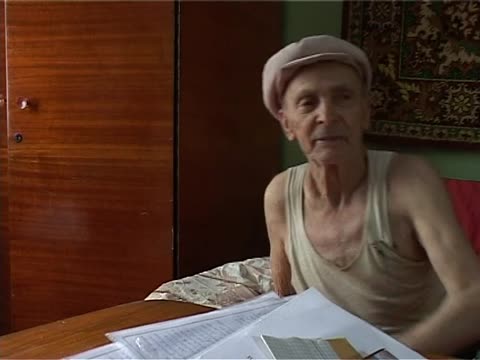
Kupershmidt talks about his life during the war, in particular the moment when he evaded massacres. He then briefly talks about life in Bratslav before the war, including the relationship between Jews and non-Jews. Kupershmidt then discusses his family. His father was a coach man.
Kupershmidt recalls surviving the grave, then answers Kerler's question about non-Jews who spoke Yiddish and says Jews and non-Jews lived together well before the war. He describes his father's work with horses and a cart, hauling loads, and gives his father's death as 1952 (as heard from INF2).
Adds the question of non-Jews speaking Yiddish and the father's death date.
Kupershmidt gives personal and family details. He was named after someone from Bratslav, his mother was a housewife who kept a cow, and he gives the names of his brothers and sister. Of six children, four grew up, and the family had lived in the town for generations.
Adds the naming of the siblings and that the family lived in the town for generations.
Kupershmidt addresses prewar Jewish life in Bratslav, including Hasidic visitors from Uman. He attended a Yiddish school for four years. Kupershmidt also addresse holiday celebration in town.
Kupershmidt remembers prewar Bratslav in answer to Kerler's questions. He lists the matchmakers, rabbis, study house, kloyz and synagogue, and says he attended Yiddish school for four years. He describes who prayed where, notes Hasidim in the kloyz, and says Hasidim came from Uman.
Adds the question of who prayed in the synagogue, kloyz and study house.
Kupershmidt says no Hasidim were left after the war; the last shochet was in a camp and his sons were killed. Many who returned from Russia died or emigrated, and he has not heard of mitnagdim. He then says his eldest brother was a Zionist who had Zionist friends, and that the authorities jailed Zionists.
Adds the shochet's fate and the arrest of Zionists.
Kupershmidt talks about prewar Sabbath at home, with his mother's blessing and the cholent kept warm. The conversation turns to Kerler's own background and where he and the others live, and Kupershmidt says Poles also killed Jews and speaks of the ghetto. The passage ends on an apology that is not clearly explained in the transcript.
Adds the chat about where the interviewers live and the remark about Poles and the ghetto.
Kupershmidt describes the current mood towards Jews in Ukraine as calm for now, but says Jewish graves in the fields have been desecrated. He says only about five Jewish families remain in Bratslav and that many Jews live with non-Jews, and he speaks of conflict among Jews. He also mentions a Hasidic man in Vinnytsia who runs a Jewish school and an old rabbi hidden in the area.
Adds the Jewish population today and the Hasidic school in Vinnytsia.
Kupershmidt and Kerler talk about a non-Jewish helper who understands Yiddish, and Kerler asks how to say that someone is a believing person. The interviewers explain the project, and Kerler begins questions with a Russian prompt. Kupershmidt chats about where the visitors are from and about the town of Medzhybizh.
Adds the explanation of the AHEYM project and the discussion of Medzhybizh.
Kupershmidt and Rakhil answer Kerler's dialectological questionnaire, with Katz asking for repetitions. Items include water, a later hour, near and nearer, cold, to run away, luck, and the words for a non-Jew and for breathing. Others include a book, a ship, a deaf person, fast, back, and a face. Kupershmidt also gives the local phrase for a stingy person (from Nemyriv rather than Haivoron).
Rakhil provides personal information and talks about her family's fate during World War II. She grew up with two sisters. She then briefly talks about her life during the war when she evacuated to Kyrgyzstan. Rakhil then discusses her childhood memories of Jewish Bratslav, as well as her home. She attended a Ukrainian school. Rakhil also speaks about ther family and her father's religious teachings.
Rakhil, born 1919, speaks of her family's fate in the war. Her mother and two sisters were in a camp and her mother brought them back, her father was shot, and she herself was evacuated to Kyrgyzstan. She remembers prewar Bratslav, its streets, her Ukrainian school, and her father, a learned man who taught her Hebrew words.
Adds the wartime fate of her parents and sisters, her evacuation to Kyrgyzstan, and her father's Hebrew teaching.
Rakhil answers questions about how holidays were celebrated before the war. Sabbath was a day of rest on which cooking was forbidden. She recalls the Passover seder at the house of her uncle, a rabbi, and the opening of the door for Elijah. The passage includes some confusion between speakers and a Russian-language stretch.
Adds the Sabbath rest and the detail of the open door at the seder.
Kupershmidt recites the morning prayer "modeh ani." He then speaks about his journalist activities for the local Jewish newspaper; before answering dialectological questions from the AHEYM Yiddish linguistic questionnaire.
Kupershmidt tries to recite the morning prayer at Kerler's request and recalls only a few words. He says he reads Yiddish a little and subscribes to a Jewish newspaper, and Kerler puts a few more terminology questions. Kerler asks to be shown the graves of the tsadikim, and Kupershmidt agrees but worries about the road.
Adds the request to be shown the graves of the tsadikim.