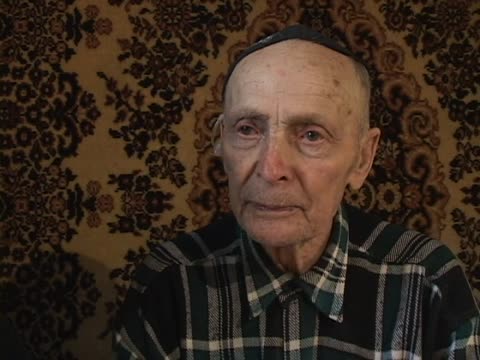
Kupershmidt relays what a former neighbour told him about the children of a prewar Jewish orphanage in Bratslav. The Germans threw the younger ones, about two hundred (?), into the river, and the neighbour wept when she told it. He adds that he cannot understand how he himself survived the Germans.
Also his remark that he cannot understand how he survived.
Kupershmidt talks about his life and work during World War II. Kupershmidt then speaks about the moment when he was imprisoned in the Zhytomyr ghetto and picked as a driver for German officers. He also mentions that someone informed on him to the German army.
Kupershmidt tells how he was denounced as a Jew and how he was taken in a column of prisoners near Zhytomyr. German soldiers stopped them and asked who was a driver, and he was picked for a lorry. A German soldier told him to say nothing, but another man pointed him out. Details of the order of events are unclear in the transcript.
The transcript shows the capture on the road and the driver selection more than a ghetto.
Kupershmidt talks about his imprisonment in the Zhytomyr ghetto, from where he was deported for execution. Kupershmidt also shares episodes of his time in hiding, as well as work as chauffeur.
Kupershmidt describes being held in a column near Zhytomyr, being stripped, a night alarm and how he hid in an attic. He says Jews were shot and carried off on carts. He then recounts signing up for a work gang, a former acquaintance who knew him, getting passes, and walking to Nemyriv and home. A woman he met there gave a harrowing account of the ghetto, and he mentions a Volksdeutsche family and a policeman.
Adds the attic hiding, the work gang, the return trip and the Volksdeutsche family.
Kupershmidt addresses Jewish life in Bratslav during the Great Hunger in 1932 and 33. Kupershmidt traveled to Odesa to earn money. In 1935, Kupershmidt explains, he practiced driving in Odesa. Kupershmidt returned to Bratslav in 1936 and worked as driving instructor. Kupershmidt states that was already married and his child was born in 1940.
Asked about prewar life in Bratslav, Kupershmidt says it was already bad by 1933, with bandits killing Jews, and the famine hit non-Jews harder. In 1933 he went to Odesa to earn money and was given bread rations. In 1935 he trained as a driver and in 1936 came to Vossatov (?) and became an instructor. He was already married and had a child in 1940.
Adds work as an instructor and the family details.
Kupershmidt was drafted into the Red Army in 1940 in Khmelnytskyy and trained to fix military vehicles. He then describes his military service, during which he drove to Finland through Poland.
Kupershmidt recounts being called up in Khmelnytskyi and learning to repair military vehicles. He then drove a lorry through Poland to the Finnish war, and later the Germans came. He says it would take two weeks to tell it all.
Kupershmidt addresses religious customs at home and briefly recites prayers. He then talks about his family and life during the postwar Soviet period. In particular, Kupershmdit addresses a family conflict regarding circumcision.
Kerler asks about Kupershmidt's birth year and what he remembers of prayers, and he recalls only the start of the Shema. He tells of a family dispute: his wife worked at a newspaper editorial office and he refused to have their son circumcised in 1953 (?). A circumcision took place later, in wartime, and the child was raised in Mohyliv (?). Kerler asks about the night-before-circumcision custom.
Includes his prayer recall and birth-year question.
Kupershmidt speaks about prewar religious customs in Bratslav, including circumcision celebrations. He then speaks about his family. Kupershmidt raised two children.
Kerler asks about the circumcision custom in prewar Bratslav. Kupershmidt says it was done by a shoykhet, and Kerler corrects this to mohel. He describes the evening reading of Shema with sweet cakes handed out to neighbours' children, nothing special for a girl but a name given in the synagogue, and mentions that he has two children.
Kupershmidt addresses prewar religious life in the late 1930s, including synagogue structure. He then answers questions about Hebrew terminology, before talking about life today.
Kupershmidt says there were four synagogues in Bratslav before the war, including the big one with two floors. His father believed in a rebbe whose name sounds like Proyke (?). He says the late 1930s were better. Kerler then asks Hebrew-derived words such as bread, water, meat and apples, and Kupershmidt supplies a few. He closes on the dwindling Jewish community and intermarriage in America.
The catalogue's 'life today' is also shown by remarks on intermarriage in America.
Kupershmidt recalls Passover at home, including how as the youngest child he asked his father the Four Questions. He gives his parents' names and a grandfather's, and then they discuss relatives in Canada and Brooklyn.
Kupershmidt recalls snippets from a Yiddish song from the camp. He returns to his life during the war and also addresses Nazi propaganda. Kupershmidt then remembers a Polish Jewish soldier.
Asked about songs, Kupershmidt recalls fragments of a camp song about children. He returns to the ghetto period and the German 'Judenaktion', and to anti-Jewish propaganda posters. He tells of a Polish Jewish officer who was mistreated by the police, and of a boy he rescued. The officer's later fate is unclear.
Adds the roundups, propaganda and a Polish officer.
Kupershmidt shows photographs, mainly of his son Naftali (Tolya), newspaper clippings and letters from abroad, and a self-published book about the Pechera camp. Kerler and he discuss its title and how to find it. Russian and garbled stretches mean much of the detail is unclear.