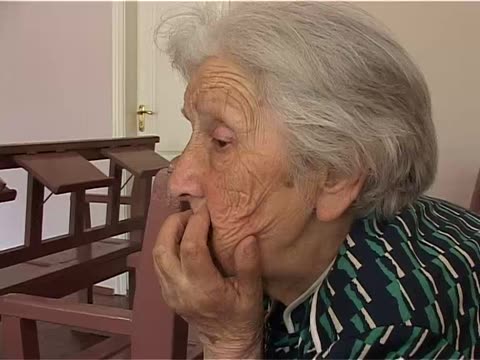
Bielaia answers dialectological questions: words for coming closer, being asleep or tired, pious and honest, seeing poorly, and the plural of a noun for rows or beds (?). Kerler asks how a word was said in Nizhyn. She then says she was one of eight children and that her father and grandmother perished in the war. Her husband did not return. She came back to Chernihiv with no flat or belongings, spent three days in a wagon, and began life alone. Kerler confirms her surname, Bielaia.
The return story comes with details of the loss of her husband, parents and home, and the questions include her number of siblings.
Brief informal exchange as Khavin, outside, agrees to show the team the former Jewish streets of Chernihiv and everyone gets into the van. Kerler speaks Russian with the driver.
In the van Khavin talks about the Jewish community today and its prayer. He mentions people who come only to make trouble, or who do not come, and one man, Zusia, described as having changed. He says the congregation prays while the rest sit and wait, and that a man named Krichevsky speaks some Yiddish. Kerler also speaks Russian with the driver about the route to the cemetery.
The passage turns to individual community members, a man who makes trouble and Krichevsky, and to minyan attendance.
Khavin explains that the Jewish cemetery of Chernihiv could not be used for burials for about 25 years and was overgrown. Recently the community, with money from donors and from its rabbi, hired three men to clean it. Kerler identifies the rabbi as the young man the team met; Khavin says he is self-driven and has opened a school.
Adds the funding of the clean-up and the rabbi's role and school.
At the cemetery Khavin distinguishes the old holy place from the newer part and says the cemetery is about 150 years old. Kerler asks to see the oldest section, and Khavin first leads toward his mother's grave. The group reads old gravestones, including dates and the name of a woman, Rashe bas Binyamin, with Katz and Kerler helping, and discusses what some inscriptions mean. Some of the exchange is garbled.
Adds the reading of gravestones and the discussion of dates and names.
Khavin recites a prayer for the dead at the graves, ending with an Amen. Katz asks about Kaddish, and Khavin explains that in Chernihiv Kaddish is said only when there is a minyan. He then begins to speak of his parents, saying his mother died in 1957 (?) and his father earlier, in 1947 (?), and mentions a severe frost in December.
Khavin tells how a fire broke out at his family's house in severe winter frost, and his mother was affected, fell ill and died. He then talks about a grandson's birth date, the yahrzeit and years that have passed. Finally he complains that community money is being spent without results; the details are not clear.
Khavin talks about the lack of work and the pain it causes him. Standing among the stones, Kerler and Khavin read gravestones, including one for Malka, and Kerler explains the formula of name and father's name. Khavin says some of those buried here did not get to live because of Hitler.
Adds the reading of the gravestone inscriptions and explanation of the names.
Footage from the van while Khavin describes how the town has changed. He says a street here was built up after the war on what had been a field, that there is a big canal and a bridge, and that the district is now an entire new raion (Desnianskyi, name approximate). Kerler comments on the changes; the driver's Russian directions interrupt. The Yiddish is often unclear.
At a memorial Kerler and Khavin read the inscription asking passers-by to stop and bow to the memory of fellow citizens. Khavin says that 7,500 people are commemorated, but that the plaque says only Soviet citizens and does not name the Jews; he says the authorities did not want to show this. Kerler asks whether a new plaque is possible now, and Khavin says it needs to be redone. As they get back into the van he points out his technical school.
Adds Khavin's explanation of why the Jews are not named and the question of a new plaque.
Footage in the van while Khavin shows his technical school, which he attended in the early 1950s, and answers Katz's questions about it, partly in Russian. He points out districts where there were barracks before the war and large buildings and a factory built after it. The explanations are partly garbled.
At the mass-grave site Khavin says the community gathers each year in September to pray, say the memorial prayer and Kaddish, since the Jews were killed in September (1941). Kerler and Katz read the monuments: one erected after the war names only Soviet citizens, and a separate community stone gives a number of Jews, which Khavin puts at about fifteen hundred and Kerler reads as 800. The number is unclear in the transcript. Khavin also jokes about money and pensions.
Adds the annual September commemoration and the differing counts on the inscriptions.
Khavin tells of Maksim (surname not recalled), who wanted to become a Jew. He studied Torah, kept kosher and prayed with the minyan. The community sent him to learn in Moscow, but he was refused conversion by the rabbi. A neighbour called the militia, and a policeman shot him, about three years ago. The community buried him and put up a gravestone. Khavin says Krichevsky knew him well and that Krichevsky's grandson studies in a yeshiva in Bucharest (?). He then proposes to show the Jewish street and the Great Synagogue.
Walking on foot, Khavin shows a former Jewish street whose houses were inhabited only by Jews and were burned after the war; a kindergarten later went up on his father's house plot, and he says he did not give up the land. Kerler asks about terms, among them a Yiddish expression about a Jew. Khavin then describes the Great Synagogue and the New Market synagogue, including round halls and women's galleries with small windows, and mentions the tailors' synagogue. A Russian aside about the Polish town of Katowice and other places is included.
Adds a streetwalk with the burning of Jewish houses and synagogue architecture