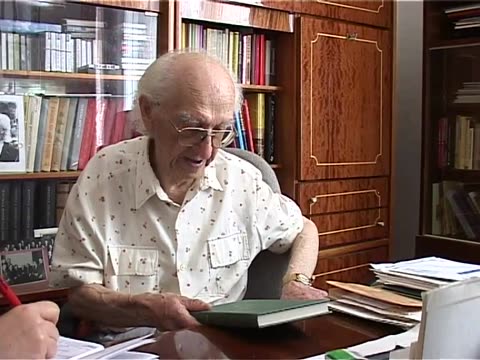
The team greets Burg outside his apartment and then sets up the formal interview with him. Burg talks about his distinctions he received from the Austrian and German government. He is also honorary citizen of Chernivtsi.
The team greets Burg and Kerler introduces the crew members, who include a Polish filmmaker. Burg and Kerler chat about the filming, and Kerler gives him a book as a gift. Burg then says he has received decorations from the Austrian government and from the German president, and mentions that he is nearly 91. They also talk briefly about a Munich professor who sends greetings, and the crew arranges lighting.
Kerler introduces the crew and gives Burg a book; they also talk about a Munich professor.
Burg talks about his home town Vyzhnytsya. According to Burg, 92% of the 6,800 inhabitants were Jewish before World War II. Burg explains contemporary efforts to memorialize prewar Jewish life of Vyzhnytsya. He then talks about contemporary and postwar Jewish life in Chernivtsi with a population of roughly 2000 today, according to Burg. After the war, Burg states approximately 93,000 Jews lived in Chernivtsi. Burg then talks about his activities, giving lectures and publications at Israeli universities in the 1990s.
Burg talks about Vyzhnytsya, where nearly all of the roughly 6,800 inhabitants were Jewish before the war. He mentions the Vyzhnytsya Hasidic dynasty and a Jewish doctor who revived a small community there. He then discusses the Jewish population of Chernivtsi before the war, after the war and today, the census figures, and the decline in emigration-era readership of the Chernivtsi newsletter. He mentions his honors as honorary citizen of Chernivtsi and as a writer, his small pension, and his lecturing and publishing in Germany and Israel. He also mentions his visits to Israel and several recent books and friends who helped with them.
Beyond Vyzhnytsya and Chernivtsi, he discusses his pension, his lectures at German universities, and his visits to Israel.
Burg shows several of his publications: “A farshpetikter ekho” (A belated echo), published in 1990; “Frayndshaft” (friendship), published in 2002; “Tsvey veltn” (Two worlds), published in 1997, “Okruchy” (Polish, crumbs). The last bilingual book ("Shedra Osyen;” lavish autumn) was published in Russian and German to honor Burg’s life and works. It includes a cover of his birth house. Burg explains that the street name was changed to honor him. He then discusses articles that have been published about him.
Burg shows and discusses several of his books, including a Polish edition and a recent volume, and a street in Vyzhnytsya that now bears his name. He mentions a collection of articles about him and press coverage in the United States, Israel, Germany and Ukraine. He also mentions the former synagogue that now houses a culture house, a New York Times article about him, and his wish to be remembered as the last Yiddish writer.
Also discusses the newspaper coverage in several countries and the New York Times article.
Burg talks about his life as a Yiddish writer and his contemporary activities in promoting Yiddish culture in schools for instance. He talks about the difficulties setting up Yiddish language classes at a Jewish school. Burg then talks about contemporary Hasidic life, before he talks about his family.
Burg describes his role as chairman of the Steinbarg Jewish cultural society and his efforts since 1990 to start a Jewish school with Yiddish teaching in Chernivtsi. He recounts how a Yiddish-language curriculum was undermined by pressure to teach Hebrew and by funding from Israel. He mentions the small attendance at weekly prayers, the Yiddish instruction in Kyiv and the Chabad school. A discussion of who counts as Jewish follows, in which Burg describes his daughter and granddaughter's status. Kerler also mentions the role of Hasidic communities in keeping Yiddish alive.
Also covers the discussion of who counts as Jewish and Burg's own daughter and granddaughter.
Burg describes a story of his about teaching Yiddish at German universities and mentions a Hamburg scholar who studied with Kerler. He also mentions donations that helped publish a book. He then recalls Eliezer Steinbarg, whose colonies he attended as a child, and recounts writing a poem for him and his advice on being a writer. He says that after the war Chernivtsi still had twelve Yiddish writers.
Besides his studies with Steinbarg, he talks about a Hamburg scholar and donations for his book.
Burg addresses Jewish intellectual life in postwar Chernivtsi. Burg lived in Russia during the war and returned to Chernivtsi in 1963. According to Burg, twelve Yiddish writers lived there. He remembers several encounters with the Yiddish poet Yoysef Kerler. Burg taught at the Ivanovo State Pedagogical Institute, after he finished his graduate studies of West-European literature in Moscow in 1947. Burg studied with Yitskhok Nusinov. Burg briefly discusses Nusinov’s works, before he mentions the encounters with Yiddish writers, such as Perets Markish, Itsik Fefer, and Dovid Bergelson. Burg then discusses recent Yiddish publications and talks remembers an episodes regarding Fefer, who came from a prison in Crimea, and attended ? 58:53’s show in Moscow in 1948.
Burg addresses Jewish writers in postwar Chernivtsi and his own return from Russia, where he had spent the war. He recalls attending the funeral of Mikhoels in Moscow, the anti-Jewish campaign of 1948 and his graduate studies in Moscow. He worked at a pedagogical institute and studied with Nusinov. He mentions Moscow Yiddish writers he knew, including Markish, Bergelson and Fefer, and discusses a few present-day Yiddish writers. He ends with an account of Fefer being brought from prison to meet Paul Robeson in Moscow and not telling him what had happened.
Adds his studies in Moscow, Nusinov, the 1948 campaign and present-day Yiddish writers such as those in Odesa.