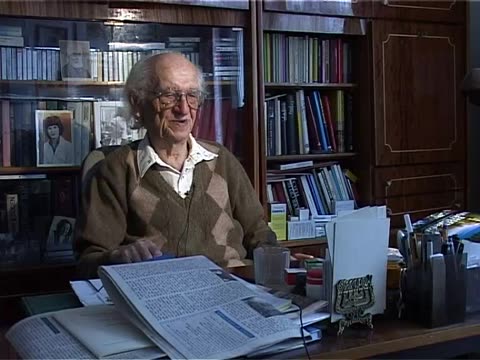
Burg recalls his encounters with Ful beShames*, who taught medieval Russian literature. Burg tells a story how Shames invited him to hear a Russian-speaking woman Nina recite a poem by Shmuel Halkin in Yiddish. She later was to become Burg’s wife. He then talks about his first time leaving the Soviet Union in 1989, traveling to Austria. He was invited by the Austrian ministry for culture. Burg then talks about his wife, who studied with Shames and then worked as a teacher. Burg taught his wife Yiddish.
After a brief exchange on addresses and contacts, Burg recalls Shames (Ful beShames), a docent of old Russian literature in Ivanovo who loved Yiddish. Shames invited him to hear a Russian-speaking student read a Yiddish poem by Halkin; she became his wife Nina. Burg describes her Obolensky family background and her father, a former tsarist officer who became a peasant after the revolution and later an accountant at a textile factory. He recounts his first trip abroad, to Austria in 1989, where he met an émigré count at a dinner and the family's Russian aristocratic connection became apparent. He says his wife was a teacher, studied with Shames, and learned Yiddish from him.
Adds Nina's family background (Obolensky) and the dinner in Austria with an émigré count.
Burg returns to talking about his work during the Soviet period. After he graduated from the Ivanovo State Pedagogical Institute Burg in 1947, he received a working assignment to teach at the Pyatigorsk institute for four years. He then moved to the Stalingrad region to work as a teacher for another four years. He taught German literature and his wife Russian literature. He then returned to Chernivtsi. Burg then talks about his reputation as a Yiddish writer.
Burg recalls leaving Ivanovo when it became dangerous and going to Moscow, then taking a posting at the Pyatigorsk institute in the Caucasus for about four years. He then spent four years in a Cossack village in the Stalingrad region, he teaching German and his wife Russian literature, before returning to Chernivtsi, where a daughter was born. He speaks of his standing as an honored figure and writer in Chernivtsi, his vice-presidency of the Israel–Ukraine association, his readings in German-speaking countries and elsewhere, and the tourists who now visit him. Kerler then asks which writers influenced him most.
Adds his home and daughter in Germany, current honors and income from tourists.
Burg explains how Russian and Yiddish writers influenced him intellectually. He then talks about his encounter with Israeli, Austrian, and German ambassadors. Burg remembers the encounter with Yosef Burg in Zurich, Switzerland; and talks about other meeting with Jewish intellectuals. He then talks about his family, in particular his parents. His mother was born in Lăpușna, Moldova.
Burg names the Russian prose writers (Bunin, Paustovsky) and Yiddish writers (Peretz) who influenced him and recalls his father calling Yiddish a golden language. He describes greeting the ambassadors at his jubilee, his meetings with Dr Yosef Burg of Jerusalem in Vienna and Zurich, and the confusion between the two Yosef Burgs. He discusses growing up with four languages. Then he talks about his parents: his father, who read German and Yiddish and died in 1938, and his mother, from a Carpathian village, who could not read. Burg adds an account of saying Kaddish and praying before the amud in Chelyabinsk during the war.
Adds the father's death and Kaddish in Chelyabinsk, plus language upbringing and the Vyzhnytsia anecdotes.
Burg briefly recites prayers. He then answers a number of dialectological questions from the AHEYM Yiddish questionnaire. He also discusses prewar political Jewish life and family.
Burg answers dialectological questions from Kerler, about words for 'back' and 'ten people at the table' and the use of terms for Hebrew and the holy tongue. He answers that Bund and Zionists in Chernivtsi were not hostile and that much of the Jewish youth was communist; his brother fell in Spain. They look at a photograph of his daughter and discuss his granddaughter, who writes in Russian. Kerler then asks him to read another short story.
Adds the exchange about Bund and Zionists and the photograph of his daughter and granddaughter.
Burg reads aloud his own short Yiddish story "Eykho", about a train journey on which the narrator meets a Warsaw ghetto survivor who fought as a partisan. The reading turns to memories of the Warsaw ghetto uprising on the first day of Passover.
The team closes the interview with talk in Burg's apartment, with the camera on paintings and photographs. Burg mentions the conference building and the Jewish house in Chernivtsi, gives directions for finding the house near the theater, and Kerler thanks him and speaks of his plans. Russian and Yiddish talk between the others follows about travel in the coming months.