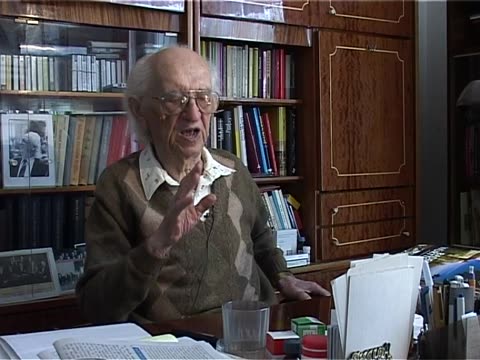
Burg discusses prewar Jewish life in Chernivtsi. He then talks about his travels to Zurich, Switzerland, when he spent time at a reform community there. He recounts the differences in religious service. Burg then discusses the modernization of Jewish life during the Enlightenment period.
Burg discusses assimilated Jewish intelligentsia in prewar Chernivtsi and the progressive Temple, now a cinema-theater. He describes a visit to a liberal (Reform) congregation in Zurich, where he was invited to give a lecture. He describes the service there, with prayer in German, a young cantor and mixed seating, and his disagreement with the rabbi, who is the son of a poet (the name is unclear in the transcript). He then turns to Moses Mendelssohn and the German Haskalah, and to his grave, memorial and sculpture.
Adds the Zurich Reform service and the rabbi's views, and the talk about Mendelssohn's grave and statue.
Burg mentions his schooling at a Romanian school in Chernivtsi, as well as his cheder education with the teacher (melamed) Shloyme Hersh. From his childhood, Burg recalls different stories told by Eliezer Steinberg, with whom Burg studied at the Teacher’s Seminary.
Burg recalls attending a Romanian state school until age thirteen and the cheder in Vyzhnytsya in the afternoon and evening. He names the melamed Shloyme Hersh and describes his discipline. He then recalls Eliezer Steinberg's children's stories and summer colony, and retells a tale about the Baal Shem Tov meeting a Hutsul leader in the Carpathians. The passage ends with a brief aside about women wearing bracelets.
Adds the Baal Shem Tov legend told by Steinberg and Burg's Romanian-language schooling, which the catalogue mentions only briefly.
Burg briefly talks about prewar Jewish life in Vyzhnytsya and discusses the connotation of “geyen in bod arayn.” He then talks about Eliezer Steinberg and the stories Burg remembers him telling. Burg then discusses his young adult life. He was a member of the youth organization Hashomer Hatzair. He then joined the “Yiddisher Shulfarayn” (Yiddish School Union), headed by Steinberg. He recalls various Yiddish writers, such as Itzik Manger, Shloyme Bikl, and Moyshe Altman, who would attend evening events. He then talks about contemporary academic events in Chernivtsi, before Burg discusses prewar Yiddish culture and theater, as well as cultural events organized by the Yiddish School Union. In particular, Burg talks about the second Czernowitz Yiddish conference, held in 1928, and publication of the Czernowitzer Bleter. The publication was closed down in 1938. Burg remembers the well-attended funeral of Eliezer Steinberg in 1932.
Burg discusses the bathhouse and mikveh in Vyzhnytsya and the expression about being led into the bathhouse ("geyen in bod arayn"). He retells animal stories attributed to Eliezer Steinberg, including a sailor and a lioness, and describes Steinberg's fables and children's books. He talks about his own youth: Hashomer Hatzair, the Yiddish School Union, and evenings with writers and artists such as Itzik Manger and Shloyme Bikl. He discusses the Czernowitz language conference, with an exchange with Kerler about a commemorative conference planned for the hundredth anniversary, as well as the Yiddish theater and the Bund. He also describes the Czernowitzer Bleter of the 1930s and the writers who published in it, and the death and funeral of Steinberg in 1932.
Adds Burg's folk-etymology of the bathhouse expression, the animal tale told by Steinberg, and the talk about the planned centenary conference.
Burg talks about Yiddish culture after Perestroika and the founding of the “Yidishe kultkurgezelshaft Eliezer Steinberg” (Yiddish Cultural Association), which republished the Czernowitzer Bleter based on the prewar format, upon Burg’s initiative. Burg remembers that during Stalin’s terror after the war and the persecution of Jewish intellectuals, Jewish cultural activists burned any traces of Yiddish press, especially the entire Czernowitzer Bleter. Burg then shows a copy of the contemporary Czernowitzer Bleter.
Burg explains how, after perestroika, the Yiddish cultural society named for Eliezer Steinberg was founded and the Czernowitzer Bleter revived in the old format. He recounts that the prewar run could not be found in the Chernivtsi archive because Yiddish papers had been burned after the war during the anti-cosmopolitan campaign, and that a photocopy came from Bucharest. He shows the current issue, with pages in Yiddish and in Russian/Ukrainian, speaks of funding from the Joint, and says he has given his archive to Vienna.
Adds the funding by the Joint, the transfer of his archive to Vienna, and the format change to a bilingual paper.
Burg talks about his career and recognition as Yiddish writer, inspired and professionalized during the “zumer kolone” (summer camp) ran by Eliezer Steinberg.
Burg recalls how he began to write, going back to Steinberg's summer colony, and the discouraging response to his first poem. He printed his first story in the Czernowitzer Bleter at age twenty-two, in 1934, and he names the years of his published books. He also talks about reviews and recognition, including a German newspaper article and a Yiddish paper in New York, disagreements with a journalist, and an Austrian medal.
Adds Burg's account of his reception and awards, including a disputed article and an Austrian medal.
Burg talks about his life as a Yiddish writer after the war, during Soviet rule. He lived in Chelyabinsk, Russia during evacuation. According to him, he did not have many opportunities to get his work published. Burg came to Moscow in 1945 to talk to the editor of Eynikayt, who encouraged him to write for the newspaper. Burg was not allowed to return to Chernivtsi and sent to study at the Ivanovo State Pedagogical Institute instead. Burg then talks about his studies at the institute, whose director was Levin. Burg met Dovid Hofshteyn, who published a children’s book together with Ful beShames* at the Russian center, which was part of the institute.
Prompted by Kerler to discuss the Soviet period, Burg says he came to the Soviet Union already a writer. In evacuation in Chelyabinsk he wrote an article on Jews in industry, which he sent to Eynikayt, and he met its editor in Moscow in 1945. He learned from a reply that his mother and sister had been deported to Vinnytsia oblast and shot, so he did not return to Chernivtsi; he was sent to the pedagogical institute in Ivanovo, where Levin was prorector and he befriended a docent connected to Dovid Hofshteyn.
Adds the fate of Burg's mother and sister, the Romanian emigration option, and that he did not return to Chernivtsi.