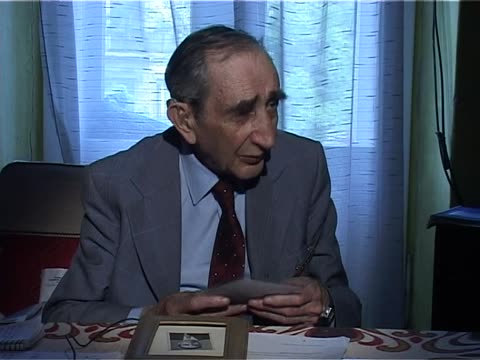
The first part of the tape is a continuation of a formal interview with Mosei Leonovich Weiss. Weiss discusses childhood memories and talks about his family. His father worked as a merchant. His mother helped out in the pastry shop, owned by his grandmother, before she helped out with his father’s business. He has relatives in America. Weiss shows a picture of his paternal grandmother and a book about Jewish life in prewar Drohobych. He then talks about Jewish political life before the war. He was the administrator of the local youth Zionist organization, HaNoar Hatzioni and describes the organization with 150 boys and girls. Weiss lists other political organizations, including Hashomer Hatzair, Betar, and Bund.
Weiss talks about his two grandmothers: one on his father's side, whose name is given as Chaya Adel Weiss from Boryslav (the name is discussed at length), and another, Rozhe Hershdorfer. He shows a photograph of his paternal grandmother and the book on Jewish Drohobych, and mentions cousins in America. He says his father was a merchant and his mother helped in the grandmother's confectionery shop, and he names a rabbi on his mother's side. He then describes being administrator of the Zionist youth organization (about 150 members) and lists the other youth organizations (Betar, Hashomer Hatzair, Bund), all of which met in Polish and had no contact with each other.
Also gives the language of the youth organizations (Polish) and their lack of contact with one another, and the names of the grandmothers.
Weiss recalls holiday celebrations and Jewish life in general before the war. He went to the Shpandorf synagogue with his father on every holiday. He then mentions his religious education. Weiss received his religious education from a private tutor when he was twelve years old. The mayor of Drohobych was Tetlboym.
Weiss recalls going to the Spandorf synagogue with his father on holidays. He answers questions about words for Sabbath and about whom he studied with as a small child: a melamed, plus Hebrew classes from a general Zionist organization. He says Jews mostly spoke Polish, with Yiddish used by older people and in the synagogue. Spandorf, the wealthy chairman of the synagogue, and the prewar mayor Tetlboym (name as heard) are mentioned.
Includes the language of Jews in town (Polish rather than Yiddish) and discussion of the term for Sabbath.
Weiss talks about food customs on Sabbath and prewar holiday celebrations, including Passover and Purim. He then discusses prewar Yiddish culture. Weiss recalls an itinerant Yiddish theater troupe.
Weiss describes the Sabbath table at his father's house, with gefilte fish, challah and wine, and answers questions about the taste of the fish and about singing zmires. He recalls holiday customs: Simchat Torah, Passover preparations and the seder (his younger brother asked the questions, his brother Edmund found the afikoman), Purim masqueraders and Hanukkah menorahs. He says there was no local Yiddish theater, although a traveling troupe once came and he rarely went to the theater.
Adds Hanukkah and Simchat Torah customs, the seder with his brothers, and the question whether Purim plays were performed.
Weiss talks about his education and the teachers at a Polish school. Weiss earned extra money as a private instructor to finance his school education. He then talks about the relationship between Jews and non-Jews before the war, including visible antisemitism in Lviv. Weiss then talks about his teacher and well-known Polish-Jewish writer Bruno Schulz. He also recalls his cousin’s hidings and survival of concentration camps.
Weiss talks about his Polish gymnasium: strict teachers, Latin, Ukrainian and German lessons, a favorite mathematics teacher whose name is given, and the German teacher. He earned money by tutoring. He recalls antisemitism, mostly in Lviv and also visible in Drohobych, alongside friendships with non-Jewish classmates. He then answers questions about Bruno Schulz, his drawing teacher, and tells about a cousin, Regina Hershdorfer, who was hidden, sent to camps and returned to Drohobych, where she died in 1990.
Adds the languages taught in the gymnasium, friendships with non-Jews, and Schulz as a teacher shown via a photograph.
Weiss speaks mostly Russian, partly garbled in the transcript, about the history and sites of Jewish Drohobych: the old Jewish district, the destroyed Jewish cemetery whose tombstones were reused, the synagogue, a Jewish orphanage and a hospital. He also mentions the oil-field history of nearby Boryslav and the Pushkin monument. Kerler thanks him at the end.
Names the Jewish district, cemetery, synagogue, orphanage and hospital; the content is mostly known from Russian lines.
The second part of the tape includes a formal interview with Evgeniia (Shayndele) Izrailovna Shekhovich, born 1919 in Sambor. The team greets Shekhovich, nee Kamerman, outside her home and sets up the interview with her.
The interview team enters Shekhovich's home and Kerler introduces them. She says she was born in Sambor. She is reluctant to be interviewed, saying she is very old and that few from those times remain, while Kerler explains that the project records Jewish life in Ukraine and persuades her to sit down.
Shows that Shekhovich resists being interviewed and the team explains the project.