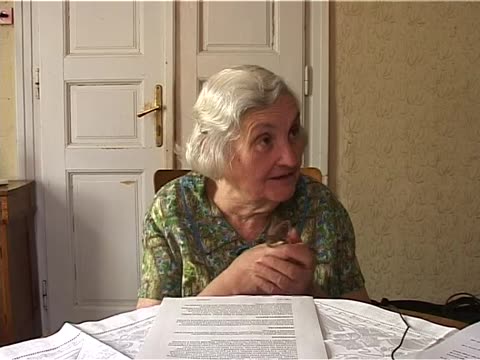
Shekhovich says that few of 'our Jews' remain in Drohobych, only 'Russian Jews' whom she regards as a different people, and contrasts Polish-Jewish culture with theirs. She is bitter about Jews emigrating to Germany after what the Germans did to her family. Kerler explains the university project and, at the end, begins to put the formal opening questions on record, asking her name and the date and place of the interview.
Also covers her views on emigration to Germany and Kerler's description of the university project.
The formal part of the interview begins. Shekhovich provides personal information and talks about her family. She raised one daughter. Her father, a merchant, was born in Sambor. Her mother was also born in Sambor and raised seven children. Shekhovich’s siblings, parents, and grandparents were killed during World War II.
The formal interview begins: Shekhovich gives her first name and Yiddish name Sheindele, her patronymic, her maiden name Kamerman, her street and her telephone number. She was born in Sambor. Her father Israel (Srul) was a merchant, with his own father named Nakhum; her mother Mina/Mirl was also from Sambor. She names the seven children, her maternal and paternal grandparents, and says all her relatives were killed by the Germans. In between Kerler explains why the memories are being recorded.
Gives the full list of siblings and grandparents, her address, and Kerler's account of his own parents' war service.
Shekhovich talks about her education. She attended a Polish school for ten years and in the afternoons a religious school (cheder). Shekhovich then discusses her childhood memories. She frequently attended a Jewish organization and recalls singing and dancing there. Shekhovich also addresses the relationship between Jews and non-Jews, as well as the arrival of the “Russian Jews” in 1939.
Shekhovich attended a Polish school for ten years and, besides it, cheder; she remembers little about the rabbi or the lessons. Polish was spoken at home as well as Yiddish, and she took part in a Jewish youth organization with singing and dancing. She says she felt no antisemitism before the war, since she moved among Polish children. She talks about an assimilated Drohobych acquaintance (Shreyer, whom she names) who knows no Yiddish, about Bruno Schulz, and again about the 'Russian Jews' who came in 1939 and were seen as a different people, with Kerler and a second voice asking questions about Poles, Lithuanian and Vilna Jews.
Also covers Bruno Schulz, an assimilated Drohobych acquaintance and distinctions between Polish, Lithuanian and Vilna Jews.
Shekhovich talks about prewar Sambor, with Jews as the majority population according to her. Shekhovich briefly addresses childhood memories. She then talks about prewar Jewish life there, before addressing Jewish life in Drohobych.
Shekhovich describes prewar Sambor, a smaller town than Drohobych with a Jewish majority, its centre with the town hall and many shops, and the large synagogue of which only the walls remain. She cannot say much about prayer houses or the bathhouse and river, and mentions older children going bathing. In the second half Kerler urges her to speak Yiddish rather than Polish, and the talk turns to who still speaks Yiddish and to a local man who answered Kerler in German.
Adds the Drohobych synagogue talk, the bathhouse questions, and Kerler's discussion of language and Yiddish today.
Kerler asks about religious customs. Shekhovich recalls that only her mother and grandmothers blessed the candles, and she remembers little of the Sabbath songs (zemirot) or kiddush. She talks about synagogue-going on Yom Kippur and Rosh Hashanah, about Hasidim and yeshiva boys in Sambor, and about the Sambor rebbe, a 'good Jew' (tsadik) to whom the sick and childless would go, though she is skeptical.
Adds Rosh Hashanah and Yom Kippur customs and the Sambor rebbe and healing beliefs.
Shekhovich talks about games with the children in school and says there was also a Jewish school where Yiddish was taught; Kerler explains the difference between written and printed Yiddish. Asked about blessings, she tries to say the blessings for thunder and for lightning, with some confusion and Kerler's repeated requests; at the end Kerler turns to the Shavuot question.
Kerler asks about Shavuot, Hanukkah, Yom Kippur and Passover food and customs; Shekhovich remembers little, saying that her parents spoke Yiddish but the children Polish, that her family was not so religious, though Yom Kippur was fasted and Passover had a seder without bread. She says her daughter makes gefilte fish very well, but declines to give a recipe, calling it women's business. Later there is talk of Polish and Ukrainian language, her birth year (probably 1919), and her views on Israel and troubles there.
Adds gefilte fish and the recipe discussion, language talk, and her views on Israel.