0:00
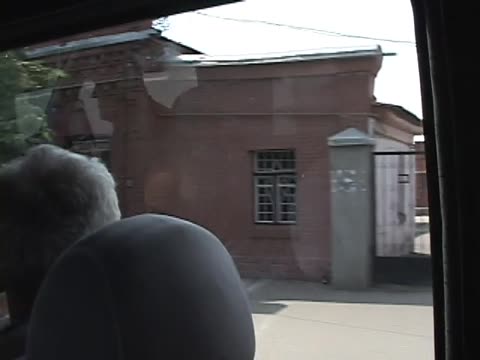
This tape begins with silent scenes of Khmel’nyts’kyy from the research team’s car.
One conversation with Naum (Nekhemye) Samoilovich Gaiviker; Sonya (Sosye) Volkovna Gaiviker, continuing over MDV 465, MDV 466.
This tape begins with silent scenes of Khmel’nyts’kyy from the research team’s car.
The tape cuts to an administrative office belonging to Hesed (elderly welfare organization) and/or Chabad.
In the Hesed office, Lemster and staff look at a portrait on the wall and try to work out who it depicts, perhaps a rabbi; the exchange is brief and mixes Yiddish and Russian.
The tape then cuts to Liudmila Makedonskaya, a Hesed administrative assistant, singing "Itsik hot shoyn khasene gehat". She reports that although she cannot speak in Yiddish, she understands everything. She sings a fragment of “Lekhayem briderlekh.” She also directs researchers to other informants and to the local synagogue.
A Hesed staff woman is asked to sing and says she cannot speak Yiddish but understands it; a song about a wedding is mentioned, and a fragment of another is attempted. Kerler explains that the team wants older songs from grandmothers, not popular ones. The staff suggest other people to visit and discuss how far the synagogue is.
Names a singing fragment and the staff's suggestions of other informants and the synagogue location.
The tape cuts to Professor Kerler singing and then speaking Yiddish with Dr. Lemster at the request of another Hesed employee. Liudmila Makedonskaya returns and talks about her grandmother. She also mentions that her grandson learns Hebrew in the local Jewish school and comments on the linguistic and demographic composition of the contemporary community. Yiddish was once taught in the town’s Jewish school, but in Cyrillic characters. The woman states that she has three children and seven grandchildren, some of whom live in Israel. There is a debate among the employees as to who speaks Yiddish in the town and to whom to send the team. Dr. Lemster suggests that there may be Jews in the town unconnected to Hesed, but Liudmilia assures him that those who are not connected to Hesed are likewise unconnected to Jewishness [evreistvo].
Kerler and Lemster talk with Hesed staff about who in town still knows Yiddish and where to go next. The woman says that her grandson studies Hebrew, not Yiddish, in the Jewish school, and that Yiddish was once taught in Russian letters. She has three children and seven grandchildren, some of them in Israel. A teacher and other elderly speakers are named as possible informants, and Lemster asks whether some Jews have no tie to Hesed. Kerler briefly explains the Yiddish letters.
Adds a recipe question, a Yiddish alphabet explanation and Kerler's search for the oldest speakers.
The social worker reads the Yiddish poem “Yidn redn yidish.” by Mani Leib which was reprinted in a recent local paper.
A Hesed social worker reads aloud a Yiddish poem about Jews speaking Yiddish all over the world, apparently reprinted in a local paper. She and the others discuss its author (the transcript is unclear) and recall an aunt who wrote letters from America in Yiddish.
Adds the discussion of the poem's author and the aunt's letters from America.
The tape cuts to a formal interview with Naum (Nekhemye) Samoilovich Gaiviker (b. 1912), who immediately begins telling stories of his experiences on the front during the war.
The formal interview begins with Gaiviker, aged 95, saying that he speaks Yiddish, Russian and Ukrainian. He lists battles he took part in from the first day of the war, among them Stalingrad, Kursk and Kharkiv, and says he was demobilized from Königsberg. He describes service with aviation ground crews and bombings, and the death of many comrades; Kerler insists the interview be in Yiddish.
Adds Gaiviker's own wartime account and Kerler's request for Yiddish only.
Gaiviker worked for sixty-plus years as a barber, like his father before him. He has been retired for thirty-plus years and lives with his wife Sonya Volkovna Gaiviker (née Sosne). Gaiviker received a traditional “kheyder” (religious school for boys) education, but no longer remembers how to pray properly.
Gaiviker says his father was a barber and that he himself worked for more than sixty years as one, mostly in a central barbershop, and has been home for twenty-odd years. He mentions his wife of sixty-two years, a good cheder education including Rashi, a daughter and grandchildren in Israel. Sonya adds that a daughter lives in Russia. Kerler explains the project's aim of interviewing older Yiddish speakers about prewar history, and asks about the town's earlier name.
Adds Kerler's explanation of the project and the question about the town's former name.
Gaiviker shares basic biographical information about himself and his family. He was named after his grandfather Nekhemye, who served in the Tsarist army as a cantonist. His parents were named Shmil and Sosye. His mother died when he was six years old. Gaiviker also discusses his contemporary economic and health troubles.
Gaiviker gives his name, Naum Samoilovich, and his Yiddish name Nekhemye, after his grandfather taken into the tsarist army. His parents were Shmuel and Sosye; he lost his mother at six. Born in 1912, on the 27th of September, and he speaks of a jubilee this year. He talks about his hard life today, invalid status, and the loss of comrades.
Gaiviker studied in two “kheyder” schools with his teachers Motl der Shvartser (Motl the Black), and Khayim Mezhibuzher (Khayim from Medzhibozh). In his youth, Gaiviker would go to synagogue every day with his father, then eat and then go off to work and/or study. His father re-married and had several more children. Gaiviker’s step-mother was good and kind, but Gaiviker himself admits that he was a wild youth, who loved to party and listen to music, especially jazz.
Gaiviker recalls cheder with the teachers Motl the Black and Khayim from Medzhibozh, and attending prayer with his father. He mentions his stepmother and half-siblings, his youthful mischief, love of music and jazz, and bands passing through Proskuriv in the civil war years. He then complains about the hardship of old age and says he was hospitalized several times.
In 1930, Gaiviker reports, he was a brave young man [“a smeler yot”] and wanted to move to a big city, and so he left for Moscow. He was frightened when he arrived, but he had no ticket back home, so he stayed and worked in various barbershops.
In 1930 (?) Gaiviker, as a bold young man, took a train to Moscow wanting to live in a big city. He was frightened on arrival, had no ticket home and stayed, working in barbershops; he was later sent to Berdychiv and drafted in 1934.
Gaiviker describes the hardships of military life and service before the Great Patriotic War.
Gaiviker talks about the severity of peacetime army service in the 1930s: early rising, men who ran away or maimed themselves and were punished, and scarce food.
In Moscow, Gaiviker was arrested after a quarrel with his boss, but received a lighter sentence because the prison warden was also Jewish. During the famine in 1933, Gaiviker, along with other ex-convicts, were kicked out of Moscow. When Gaiviker returned to Khmel’nyts’kyy, there was no work to be found, only hunger.
Gaiviker tells of living in Moscow, a fight at work and being jailed; he says the Jewish official in charge treated him more leniently. In 1933 he and others were sent out of Moscow under the passport regime. Back in Proskuriv he found no work and hunger, and he sold his possessions.
Sonya Gaiviker also speaks about her husband’s youth, telling the story of a pogrom he lived through when he was six years old. Gaiviker adds that anti-Semitic violence was pervasive in his youth.
Sonya tells of her husband's childhood: at the age of six he lived through the pogrom in the street where Jews lived. Her account describes hiding in the attic, bandits demanding gold, and the killed Jews found outside. Gaiviker adds that later the Poles came and took his father away for a time.
Adds Sonya's narration, the street where they lived and the later arrival of Poles.
Gaiviker reminisces about his childhood years in kheyder, speaking about his teachers and their families, the forms of discipline used when he would misbehave, and the pranks pulled on the teachers by the students. Gaiviker also shares his memories of the famous cantors who visited the town when he was younger.
Gaiviker recalls cheder: the teachers Motl and Khayim of Medzhibozh, a teacher's wife, the whip, and a prank of tying a sleeping teacher's beard to the table. He says he studied the siddur and Humash but remembers little. He remembers visiting cantors, among them Shulman and Borskii (?), and singing next to the cantor as a boy. He adds his fear of horses in the cavalry.
Gaiviker also speaks about his years in the cavalry and the hardships of waking up early in the winter cold and taking care of the horses.
Gaiviker describes his cavalry service in the mid-1930s: waking at six in freezing cold, feeding and grooming horses, and how he did not desert because a Jew should not. He then returned to work.
Gaiviker briefly describes celebrations and observances of Jewish holidays in his childhood home.
Asked about Jewish holidays in the shtetl, Gaiviker mentions Yom Kippur fasting, Rosh Hashanah and Shavuot. He recalls his father keeping the Sabbath and visiting cantors on holidays. Kerler then proposes a break and a switch to interviewing his wife.
The researchers begin an interview with Sonya (Sosye) Volkovna Gaiviker (née Sosne) who was born in 1920 in Khmel’nyts’kyy. She contrasts her youth with that of her husband’s, stating that she had a rich family with many animals and a big courtyard. They had plenty of food, experienced no famine and helped others in need. Her father, Volf, was killed in 1942 with her entire family in Khmel’nyts’kyy. Before the war, her father worked with horses. Her mother, Khone (b. Khmel’nyts’kyy, 1883) would bake twice a week in their oven. On holidays the whole family would come together.
Sonya gives her name, her maiden name Sosne and her birth year, 1920, and says her father was Volk. She contrasts her family's comfortable life with her husband's: a horse, a cow, a large courtyard, plenty of food and helping others. Her parents, a brother and the whole family were killed by the Germans in 1942; her father worked with horses, her mother Khane baked twice a week, and the whole family met on holidays.
Adds the Yiddish word for a teamster being asked and the killing site.
Sonya Gaiviker describes how her family collectively prepared the house for peysekh (Passover) and descirbes the “kusher” (kosher) home in which she grew up.
Sonya describes how her family baked matzo at home, with her old grandfather at the oven and the five children helping, and how the family waited for the father at the seder. The home was strictly kosher, and she learned cooking and baking from her mother.
Her mother taught her how to cook and bake, and she shares a recipe for “eysik fleysh” (sweet and sour meat).
Sonya explains how she makes sweet-and-sour meat and says that her great-grandchildren in kindergarten asked why the teachers did not cook like their grandmother.
She shares her recipe for “gefilte fish” as well as how to prepare other foods, including meat with plums, and cookies. According to Sonya, everyone loves her food, especially her great-grandchildren.
Sonya describes how she makes gefilte fish, removing bones, chopping and adding onion, eggs, pepper and matzo meal. Kerler asks whether the fish is sweet or salted and what it is called, and she describes meat with plums and cookies with raisins. Everyone, including her great-grandchildren and a Christian son-in-law, loves her food. She then mentions the family's hard life today, her husband's invalid pension and small payments.
Adds the terminology questions about fish and the turn to pensions at the end.
She briefly discusses contemporary poltical and economic problems in Ukraine.
Sonya briefly continues about pensions for war invalids and the president in Kyiv, and says that the amounts remain small.
Sonya states that she completed ten years of Yiddish-language education before the war.Cities and towns mentioned on this tape: Khmel’nyts’kyy (Proskurov), Medzhibozh, Stalingrad, Kharkiv, Kaliningrad, Moscow.
Sonya says she studied for ten years in a Yiddish school, from beginning to end, before it was closed before the war. Lemster and Kerler ask about books, and the passage ends with talk of opening a window.
Adds that the school closed before the war.