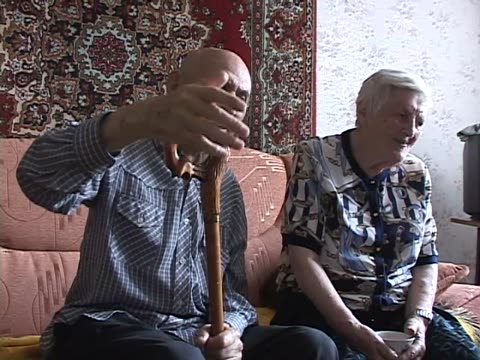
This tape is a continuation of a formal interview with Naum Samoilovich Gaiviker and his wife Sonya Volkovna.
From the machine transcript
Talk about the streets where the couple lived, with Sonya naming the street names. Kerler and Lemster then ask whether Gaiviker remembers Yiddish songs from earlier times; he answers that times have changed and mentions Jewish artists who came to perform.
Gaiviker shares his memories of Yiddish theater in Khmel’nyts’kyy and Moscow. He also talks about other performances he attended of Polish-Jewish jazz and other performances, and his youth of dancing, playing, gambling and sneaking into events for which he could not pay.
From the machine transcript
Gaiviker says he no longer remembers the old songs and speaks of Yiddish theater troupes that came to the town and Yiddish theater he saw in Moscow, naming actors he admired. He recalls Polish-Jewish performers, music and dancing, and how as a poor young man he sneaked into shows without a ticket.
names actors and performers; mentions Moscow
Gaiviker speaks of his service and hardships in the army and during the war years.
From the machine transcript
Gaiviker recounts his army route, crossing the Volga and Stalingrad, then through Belarus, the Neman, Kaunas and Vilnius to East Prussia, before demobilization. He says his medals are from Stalingrad and talks about reaching age 95. Kerler then asks about the number of synagogues.
He describes the prewar synagogues in Khmel’nyts’kyy. He prayed everywhere and learned well, but also misbehaved. [00:06:03] Gaiviker briefly describes prewar celebrations of Purim.
From the machine transcript
Gaiviker describes the many prewar synagogues and small prayer houses, near one of which he lived, and says he prayed in all of them. Kerler asks what a "heymishe shul" means, and Gaiviker lists the trades of the town (tailors, shoemakers, hairdressers, tinsmiths). Asked about Purim, he remembers little, and Sonya recalls her grandfather Meir's synagogue visits and the pastries he brought. He mentions that his father opened a hairdressing shop where he learned his trade.
adds the discussion of what Purim-shpil meant and Sonya's grandfather Meir
The interviewee describes the streets where he lived and the typical professions held by Jews in the town. He also discusses the pogrom in the town in 1919 ("a shver shtikl tsayt") in which many of his friends and family were killed.
From the machine transcript
Gaiviker speaks about trades, then says that during the civil war a pogrom took place in 1919, with shooting between the houses and killing of old people and children. He mentions his father and aunt who, according to the transcript, ended up in Uzbekistan.
mentions his father and aunt in Uzbekistan
Gaiviker relates how many of his family died in evacuation during the war, and also details how he met his wife after the war. He thanks her for being such a good partner from 1945 onwards (“a yidishe neshume iz zi”).
From the machine transcript
Gaiviker says his father and aunt died in evacuation in Uzbekistan, and tells how he met his future wife after the war through a soldier in Poland. He is thankful to her and says they have lived together since 1945, calling her a good Jewish soul.
The interviewees report that they did not have a wedding with a chuppah because of economic difficulties, but they did have a small party after they registered.
From the machine transcript
Gaiviker explains there was no Jewish wedding with a chuppah because times were hard; after demobilization they registered and had a small party with friends. They have been married 62 years. Kerler then asks about how much Yiddish was heard on the street before the war.
Gaiviker returns to the subject of prewar Khmel’nyts’kyy, describing the barbershop where he worked and the various gambling and card games he used to play.
From the machine transcript
Gaiviker says the town was mostly Jewish and Yiddish was spoken; he describes working as a barber in the park, serving Russians and Poles. He recalls the card games he played and the 52 and 21 games; he later went to Moscow and returned in 1933.
adds his time in Moscow and return in 1933 (?)
Both interviewees comment on how they have known many non-Jews who spoke Yiddish. Sonya Gaiviker spoke to her daughter in Russian, but she reports that she does understand a bit of Yiddish.
From the machine transcript
Both speakers say non-Jews knew Yiddish: a Gentile neighbor woman, Russian clients, and the children of Christian tenants. Sonya adds that her daughter was raised in Russian, knows no Yiddish, and the granddaughter also grew up in Russian.
Naum comments on being the only one of his generation left in the town and shares some of his war stories. He again thanks his wife for everything and she discusses contemporary political instability in Ukraine.
From the machine transcript
Lemster asks whether they heard the first Ostrapol performance; Gaiviker says he has forgotten many stories and that he is the only person of his generation left. He recalls the war in aviation, the route through Stalingrad and Kaunas, and thanks his wife. Sonya notes his father died of hunger under occupation and comments on unrest in Ukraine today.
adds the father's death in occupation and Sonya's comment on current politics
Gaiviker remembers that there were Hasidim in prewar Khmel’nyts’kyy, but cannot recall them in detail.
From the machine transcript
Asked about Hasidim before the war, Gaiviker says old men were gathered for Saturday night in the synagogue, but he gives few details. He mentions going to the cinema and theater as a young man.
Gaiviker describes Jewish theaters and cinemas in the prewar period, and remembers one Russian-language film, Iskateli schast’ia (Seekers of Happiness), that was particularly popular.
From the machine transcript
Gaiviker and Sonya speak about Jewish theaters and cinemas before the war and the cheerful life; he mentions visiting artists and the audience that was mostly Jewish, and the kosher butchers. Lemster asks about Sholem Aleichem in the town.
adds kosher butchers and Lemster's question about Sholem Aleichem; the film title is not clear in the transcript
Gaiviker compares the demographics of Berdychiv to Khmel’nyts’kyy, and also discusses his contemporary health problems.
From the machine transcript
Gaiviker says he served in Berdychiv for two years and describes it as a lively, very Jewish town, smaller than Khmel'nyts'kyy. He then talks about his health: he is nearly blind after an eye operation and hard of hearing, and walks with a stick. Kerler asks about rabbis.
Gaiviker briefly describes prewar Khmel’nyts’kyy’s rabbis and distinctive characters and types.
From the machine transcript
Gaiviker recalls the rabbi and rebbetzin, the teaching of children and the many synagogues, and also Jewish thieves and pickpockets. He says the town was a cheerful place and answers whether he lost money at cards. Kerler asks about the word dybbuk.
Gaiviker discusses his childhood poverty, the hardships of war and certain Jewish holidays and occasions that were marked in his youth.
From the machine transcript
Asked about the word dybbuk, Gaiviker says it means a bad person. He recalls being born into a poor home, his stepmother, the war and bombing, Hanukkah gifts and games, and latkes made from potatoes. The questions about shalakhmones and tatshikelekh are interleaved.
adds the dybbuk question, Hanukkah gelt and latkes, and shalakhmones
Sonya Gaiviker reports that both her daughter and granddaughter married ethnic Russians, but that her granddaughter is somewhat observant of Jewish religious law as she now lives in Israel.
From the machine transcript
Sonya says her daughter and granddaughter both have Russian husbands, but the granddaughter kept some Sabbath observance and now lives in Israel. Gaiviker adds that people there go to synagogue and a rabbi is paid.
Naum Gaiviker knew prayers and liturgy well in his youth, but also played pranks on the teacher. He further describes the town’s prewar Jewish atmosphere with its bakeries, artisans etc.
From the machine transcript
Gaiviker says he knew prayers and Kaddish well in his youth, learned well, and played pranks on the teacher with his whip. He describes the town's bakeries with bread and bagels and their prices. Kerler asks Sonya about her name and her mother's name.
adds the names discussion with Sonya and her mother
Sonya Gaiviker worked several jobs after the war, but as soon as she married she decided to stay at home.
From the machine transcript
Sonya says she began working after the war in several places but became a housewife once they registered. Before the war she had studied at school until the war began.
The Gaivikers comment on Yiddish school curriculum, as well as contemporary community politics. Naum is regularly honored on Victory Day for his war service.
From the machine transcript
The couple discuss books and Yiddish school, and how people come to congratulate Gaiviker on Victory Day. He says he is the only one of his age in the district and lists his medals, including Stalingrad and Latvia; a photograph is promised for later.
Naum describes the games he played when he was younger, including card games and other games, such as “beltenish” (hide and seek).
From the machine transcript
Lemster asks whether Gaiviker knows the word golem; he and Sonya say they never heard it. Gaiviker then describes games he played in his youth, with card games 21 and 52, a pot fire in the park, checkers and hide-and-seek, and how he got money from his stepmother. Lemster asks about songs about hairdressers and tailors.
Naum recites the lyrics to the song “Ot azoy neyt a shnayder,” describing how young people would come together to sing and spend time together in his youth.
From the machine transcript
Gaiviker recites a song about a tailor sewing all week, recalls young people gathering to sing Yiddish songs, and talks about fasting on Yom Kippur and going to pray with his father. Lemster says they will now talk with Sonya.
The rest of the tape consists of the research team asking questions from their linguistic and dialectological survey, interspersed with brief discussion of the interviewees’ views on Israel and their memories of military service, the war and the Baltic republics.
From the machine transcript
A questionnaire on forms and vocabulary: Lemster and Kerler ask for thanks, father and mother, sick, sleepy, peasant, and Lithuanian-Yiddish differences, and a sentence with 'whether or not'. Gaiviker also tells of his army years in Lithuania, Kaunas and Kaliningrad, being pelted with stones, and Berdychiv and its Jewish girls, and Sonya says her grandson lives in Israel. At the end he speaks of his wife's care and food he likes.
adds Lithuanian experiences and food preferences