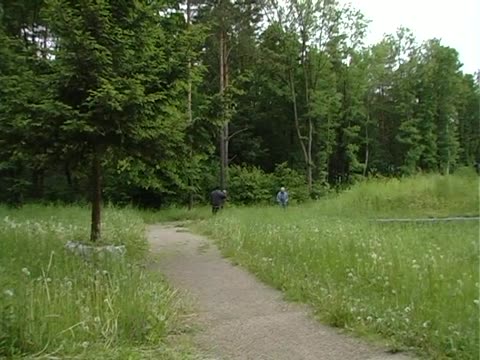
This tape begins at a Holocaust monument in a forest or park near Khmil'nyk.
From the machine transcript
Opening at a memorial site near Khmil'nyk; the speech is largely garbled, with a Russian remark about burial places and an unclear exchange about the Nazi period and evacuation.
Little can be made out beyond a Russian comment on burial places.
The tape cuts to the cemetery in Medzhibozh and the grave of the Besht.
The tape then cuts to the home of Aba Davidovich Kaviner (b. 1921, Derazhnya). The researchers and Kaviner greet each other warmly. Professor Kerler gives Kaviner a few books in Yiddish. Kaviner reports that he read the book by Yoysef Kerler that Professor Kerler gave him in the previous interview already numerous times and cried while reading it. Kaviner offers a brief analysis of Yoysef Kerler’s work. He also gives updates on past AHEYM interviewees in the area and discusses the difficulty of finding new people to interview among the “Jews who don’t want to know they are Jews,” and the intermarried Jews that remain.
From the machine transcript
Warm greetings at Kaviner's home. Kerler gives him Yiddish books, and Kaviner says he has read the book by Yoysef Kerler several times and wept over it, commenting on the writer's fate under the party. He asks after earlier interviewees; Kerler and Kaviner discuss how few people in the region still speak Yiddish. Kaviner says many Jews do not want to know they are Jews and stresses the importance of keeping Jewish identity.
Also covers the death of a former interviewee and which nearby towns still have Yiddish speakers.
Kaviner tells a story about an encounter he once had with an old Jew who intermarried and who was later disowned by his children in his later years.
From the machine transcript
Kaviner tells of an old Jew who brought goods to his workplace and wept that his gentile wife and children had thrown him out in old age. Kerler and Kaviner then discuss sending publications, Kaviner's address, and the name of the town Khmel'nyts'kyy in Yiddish and Russian. Lemster asks about the places the team has visited.
Adds an exchange about sending journals and the address, and the Yiddish and Russian names of the city.
The research team discusses their route, the people and the communities with whom they have come into contact on their expeditions.
From the machine transcript
Kerler, Lemster and Kaviner talk about the places the team has visited and the Jews found there, including Bershad', Odesa, Balta and Nikolaev. They discuss who still speaks Yiddish and mention Chabad and yeshivas. A woman in Khmel'nyts'kyy is described who read Yiddish and whose daughter speaks it.
Kaviner reports that his daughter, who lives in Khmel'nyts'kyy, understands, but doesn’t speak Yiddish.
From the machine transcript
Kaviner says his daughter, who lives with him, understands Yiddish but does not speak it, which he regrets. He mentions that he was taught Jewishness by his rabbi.
Kaviner shares his attitudes towards different dialects of Yiddish and discusses a work by Soviet Yiddish author Dovid Bergelson: “Der toyber” (The Deaf).
From the machine transcript
Kerler asks about the Yiddish dialect in Derazhnya, such as forms of address and 'thanks', and Kaviner contrasts it with Belarusian and Polish dialects and gives examples of pronunciation. They then discuss Dovid Bergelson's story "Der toyber" and its stage adaptation.
Includes dialect questions on forms of address and word pronunciation.
Kaviner talks about the death of Shloyme Mikhoels, and about how people suspected that he was murdered. He also recalls Mikhoels’ funeral and his eventual rehabilitation. Kaviner also speaks about numerous other Soviet Yiddish writers and cultural figures.
From the machine transcript
Kaviner talks about Mikhoels's death, saying he was murdered in a staged accident after being sent to Belarus, and about his lying in state at the Yiddish theatre. He recalls his rehabilitation and that of Yiddish writers, and names writers from the region, including some from near Medzhibozh and Starokostyantyniv. He also says Sholem Aleichem stayed in Derazhnya and wrote there, and mentions Mendele.
Adds Sholem Aleichem in Derazhnya and writers from nearby villages.
Kaviner shares his views on “Di klasiker,” the three classic Yiddish writers in Yiddish literature, as well as his analysis of the history and development of Yiddish literature.
From the machine transcript
Kaviner and the interviewers discuss the three Yiddish classic writers, Mendele, Peretz and Sholem Aleichem, and the earlier history of Hebrew and Yiddish writing. Kaviner notes that Hebrew words filled their works. He says he read Eliezer Steinberg before the war but cannot recall it, and begins a story about a neighbour's library.
Kaviner tells the story of one of his most memorable reading experiences: When he was twelve years old he visited a local rich man’s large library from where he obtained Avraham Mapu’s “Ahaves Tsiyen" (Love of Zion) in “loshn-koydesh” (Hebrew). He remembers hiding in the attic in the summertime to hide from his father in order to read it. Kaviner further discusses “Di klasiker” and the Soviet Yiddish writers that he read in his youth.
From the machine transcript
Kaviner tells how at about twelve he borrowed a Hebrew book by Avraham Mapu from a rich neighbour's library and read it hidden in the attic from his father. Kerler and Kaviner then discuss Mendele's beginnings in Hebrew and name Soviet Yiddish writers he read.
Adds Mendele's Hebrew beginnings and a list of Soviet writers.
He recites a poem by Itsik Fefer.
From the machine transcript
Kaviner recites from memory part of a poem about the civil war by Itsik Fefer, at Kerler's request, and comments on Fefer's participation in the war and his execution.
He recites poetry by Osher Shvartsman.
From the machine transcript
Kaviner recites a poem by Osher Shvartsman and says the poet was killed at the front in the civil war at age twenty-six.
He recites a fragment from Dovid Hofshteyn and discusses his life and work, including the work of his sister Shifre Kholodenko.
From the machine transcript
Kaviner speaks of Dovid Hofshteyn as a great classic poet and mentions his sister, also a poet. Lemster asks about a Russian poem and whether it was sung, and Kerler asks about a song about green trees, which Kerler identifies as Bialik's.
Kaviner states that Bialik was a writer of incomparable talent and discusses his work and biography with Professor Kerler.
From the machine transcript
Kaviner says that no writer can be compared to Bialik and mentions Bialik's translation of the Bible into Yiddish with Ravnitsky and his commentary on the Torah. Kerler asks about Bialik's poems; Kaviner finds them hard to read. They discuss Bialik's Yiddish poems, his Hebrew writing and his study at the yeshiva in Volozhin.
Kaviner also talks about Shimon Frug's works and biography.
From the machine transcript
Kaviner talks about Shimon Frug, whom Gorky called another Pushkin, saying he died poor and in hunger in Odesa, having married a gentile woman. Lemster asks about Yankev Fikhman, and the speakers discuss whether he was in Soviet Yiddish schools and his anthology.
Adds Lemster's question about Yankev Fikhman and Yiddish school curricula.
Kaviner discusses how the curriculum of Soviet Yiddish schools was decided, and lists writers who lived outside the Soviet Union who were read and not repressed like many of those who stayed behind.
From the machine transcript
Kaviner explains that writers who praised Soviet power were still shot, while others were labelled reactionary and not published. He lists writers who fled and survived, such as Bialik, Maurice Winchevsky and Maurice Rosenfeld, and says those who stayed were destroyed. Itsik Manger is mentioned as read in Soviet literature.
Adds the list of writers who emigrated and survived.
Itsik Manger, according to Kaviner, was part of the Soviet Yiddish literary curriculum in the 1930s because he wrote “simply about Jewish life”.
From the machine transcript
Kaviner and the interviewers discuss whether Itsik Manger was part of Soviet Yiddish literature in the 1930s. Kaviner says writers who left wrote simply about Jewish life, and that is why they were published then.
Kaviner states that he has read the complete works of Yekhiel Shraybman and comments on several other postwar Soviet Yiddish writers whose works he has enjoyed. Kaviner speaks about the history of the journal Sovetish Heymland and its editor Arn Vergelis. Kaviner states that he met several times with Khayim Beyder. Although he does not hold the latter’s work in high regard, he knew his family well, having served in the military with his brother. Kaviner talks about his meeting with Soviet Yiddish writer Shmuel Halkin in 1948 and recites some of his poetry.
From the machine transcript
Kaviner says he read the complete works of Yekhiel Shraybman and discusses other postwar Soviet Yiddish writers and the journal Sovetish Heymland and its editors, including Arn Vergelis. He met Khayim Beyder several times, thinks little of his poetry, and knew his family. He served in the army from 1939, met Shmuel Halkin after the war, and recites lines about mass graves.
Adds Beyder's two wives and Kaviner's army service from 1939.
Kaviner comments on his life today, focusing on his health problems, his daughter’s career and his pride in his grandson, who used to work in Hesed (elderly welfare organization), but now works in a Ukrainian government agency.
From the machine transcript
Kaviner talks about his present life: failing legs and eyes, his daughter's broken leg and her work as a doctor, and his one grandson. The grandson finished school with a gold medal and an institute with distinction, worked in computing and administration, and now works at a state inspection agency.
Adds Kerler's promise to send publications and the grandson's career details.
Kaviner reports that before the war, he published a few poems in the journal “Der Shtern.” After the war, he also wrote two novels about Jewish life before the war and during the evacuation, but later burned these works as he feared the consequences if someone found that he was writing in Yiddish.
From the machine transcript
Kaviner says he printed several poems in the newspaper Shtern before the war under his family name. After the war he wrote two Yiddish novels, one on prewar Jewish life and one on life in evacuation, and burned them out of fear of arrest. Kerler offers to find his poems and they briefly discuss Russian.
Adds Kerler's offer to find the printed poems and the novel title borrowed from Bergelson.
Kaviner briefly comments on his relations with non-Jews throughout his life and in the army.
From the machine transcript
Kaviner briefly recalls army years and how non-Jewish comrades reacted when they asked about his name and he said he was Jewish; Lemster then asks about lesser-known local writers.
Adds Lemster's question about little-known local writers.
Kaviner speaks about the lesser known Soviet Yiddish writers he knew personally, including his friend Itsik Sokol, who published a book of poetry after the war, and Moyshe Zibnberg, who published in the school newspaper before the war. Kaviner also briefly comments on Yiddish and drama circles in his town before the war.
From the machine transcript
Kaviner names lesser-known local writers: Itsik Sokol, a Yiddish teacher who published a book after the war, and Moyshe Zibnberg, who wrote in the school newspaper and was killed during the occupation. Lemster asks about culture leagues, and Kaviner says there was a Yiddish theatre and Jewish circles in the town.
Adds the question about culture leagues.