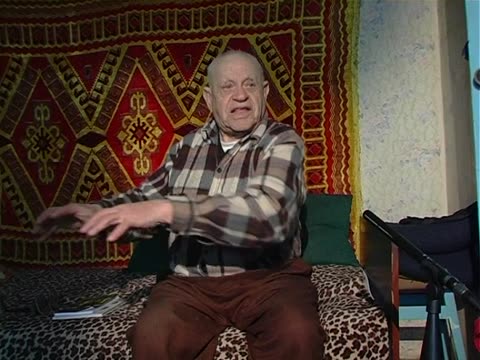
This tape is a continuation of a formal interview with Aba Davidovich Kaviner (b. 1921 in Derazhnya). He continues a story about a “lomed-vuvnik” (one of the thirty-six righteous figures hidden among the Jewish people in any generation) he once met. He recalls seeing one of his town’s “crazy” residents who once brought a girl back to life and then disappeared by morning.
From the machine transcript
Kaviner finishes the story of a local holy madman in Derazhnya, seen as a boy on his way to yeshiva, whom children mocked. He tells how the man revived a watchmaker's dying daughter, who had a bridegroom from another town. The man vanished by morning, leaving only his tracks.
The transcript shows the revived girl was a watchmaker's daughter with a bridegroom, and that the madman vanished the next morning.
Kaviner begins to tell a story about how his father once saw Eliyahu haNuvi (Elijah the Prophet).
From the machine transcript
Kaviner says his father saw Elijah the Prophet and that he knows two stories of Elijah being seen. He begins the first, which is set in Bessarabia.
Kaviner takes a break
From the machine transcript
Short pause in the interview while Kerler suggests a break. The informant remarks on the strain, and Kerler asks him to return to the story of his father and Elijah.
Kaviner continues the story about his father and Eliyahu haNuvi as well as another tale by Avrom Reyzen that he read in Sovetish Heymland.
From the machine transcript
Kaviner tells the story of his father, a cooper who made barrels in Bessarabia. A beggar who orders dumplings at the home of a kind householder vanishes, and a rabbi tells the couple they have seen Elijah. He then tells a second story, from a poem by Avrom Reyzen that he read in Sovetish Heymland, of Reyzen's Passover seder in Warsaw after the war, where a stranger guest vanishes. Kerler asks whether Kaviner read Reyzen.
The transcript gives the father's cooper's trade in Bessarabia and a first Elijah story before the Reyzen poem.
Kaviner comments on the work of Soviet Yiddish writer Eli Shekhtman and also talks about the content of his own novels, one of which, entitled “Erev,” had the same title as one of Shekhtman’s works.
From the machine transcript
Kaviner talks about the Soviet Yiddish prose writer Eli Shekhtman and about his own novels, which he wrote after the war. He says he borrowed the title of one, "Erev", from Shekhtman, and the other title from David Bergelson (?). Lemster asks about the novels' heroes and prototypes; Kaviner says they are ordinary petty-bourgeois Jews in the shtetl before and after the war. Kerler then asks about a tombstone in Kopaygorod and the Ludmir maid.
The transcript shows the novels cover the prewar shtetl, evacuation and the postwar years, and that Kerler asks about the Ludmir maid.
Kaviner speaks briefly about wedding customs and terminology.
From the machine transcript
Kerler asks how Derazhnya Jews spoke of an engagement party and the wedding gift ceremony. Kaviner says he was too young to attend one but knows it preceded the betrothal contract, and names the gift custom. Kerler also asks about a song sung at the bride's seating.
He also describes how Purim was celebrated in his town with “sholekh-hamunes,” (traditional Purim gifts), drinking, dancing, singing, and noise-makers (“gragers”).
From the machine transcript
Kaviner describes how Purim was celebrated in Derazhnya: sending gifts of food, eating and drinking well, dancing and singing, and exchanging good wishes. Children sang songs and rattled noisemakers. Kerler recalls a Purim song, and the two mention Sholem Aleichem.
Kaviner comments that “upshpreykhers,” or woman folk-healers were on almost every street in his town. He then mentions some of their different healing customs.
From the machine transcript
Kerler asks about women folk healers, and Kaviner says almost every street had one. He describes some forms of the cure: spoken in verse or in prose, with coals quenched in a bowl of water and the face smeared. He cannot recall the words said.
The transcript shows the cure involved quenching coals in a bowl of water.
Kaviner tells a short story about the town of Satanov, a shtetl named for Satan and the dibek (dybbuk).
From the machine transcript
Asked about a dybbuk story in Derazhnya, Kaviner talks instead about the nearby town of Satanov. A synagogue fortress there stands to this day as four walls, and he explains the town's name through Satan and the dybbuk. Kerler asks whether he knows An-sky's play about the dybbuk.
Kaviner remembers seeing Yiddish theater performances in Derazhnya before the war, including plays by Goldfaden and Sholem Aleichem, performed by visiting troupes as well as local actors. In the postwar period, Kaviner saw performances by famous touring actors and singers, such as Sidi Tal and others.
From the machine transcript
Kaviner recalls Yiddish theater in Derazhnya before the war: plays by Goldfaden and Sholem Aleichem put on by visiting professional troupes and by local amateurs. He names several touring actors and companies. Kaviner also describes postwar performances in Khmel'nyts'kyy by touring singers and cantors such as Sidi Tal.
The transcript shows postwar concerts by singers and cantors in Khmel'nyts'kyy and names several touring troupes.
Kaviner comments on the various shtetl types and characters in his town, including scholars, rich and poor people, actors, card players and water carriers.
From the machine transcript
Lemster and Kerler ask about Jewish types in his shtetl. Kaviner talks about the wealthy and the poor, a learned man who worked as an employee (Moyshe Zilberman, as the transcript has it), a professional actor, card players and the water carrier.
Kaviner reports that mixed marriages between Jews and non-Jews happened before the war, but were much more rare than they became during and after the war.
From the machine transcript
Answering Lemster, Kaviner says marriages between Jews and non-Jews did occur before the war but were rare. They became common during and after the war.
Kaviner briefly describes postwar Khmel'nyts'kyy where he settled in 1947. He comments that Jews from shtetlekh moved to bigger cities after the war seeking economic opportunities. Since mass emigration was allowed, there are few Jews left, only “narunim, kaptsunim in goyishe makhetunim” (lit., fools, paupers, and non-Jewish relatives).
From the machine transcript
Kaviner says he settled in Khmel'nyts'kyy after the war and the army. He explains that many Jews came there from the shtetlekh, which were emptied, and then emigrated when it became allowed, some fleeing to Bessarabia, Chernivtsi and America. Nobody returned, and only a few remain.
The transcript shows some left for Chernivtsi and Bessarabia and only a few remained, with no one returning.
Kaviner and the researchers briefly discuss issues related to sociolinguistics and dialectology.
From the machine transcript
Kerler and Kaviner discuss Yiddish dialect points. Kerler asks about the Podolian word for "back" and the forms for "hither" and "thither". They discuss the Podolian dialect area, the boundary with Polish Yiddish, and the Litvish forms for "bread" and "small".
Kaviner discusses being Jewish in the Soviet army and encountering anti-Semitism there. He also details the scope of Jewish service in the Red Army during the war.
From the machine transcript
Lemster and Kerler ask whether Kaviner, serving in the Soviet army, felt his Jewishness. He says he did, and he met antisemitism there, with soldiers openly voicing it. They discuss Jewish officers and generals, including Moshe Zilyankin (?), who served with him, and Soviet Jewish heroes. Kerler promises him an almanac article. Kerler then asks him to sing a song he remembers, and he starts on a ghetto hymn.
The transcript shows talk of Jewish generals and Soviet heroes, then a request for a song.
Kaviner sings the song “Avek di yinge yurn” in Yiddish, and then in a mixed Yiddish/Ukrainian version.
From the machine transcript
Kaviner sings the Yiddish song "Avek di yunge yorn", then a mixed Yiddish and Ukrainian version of it. Kerler comments that he finds it well adapted and that it stuck deeply in memory.
The transcript shows two versions: one Yiddish and one mixed with Ukrainian.
Kaviner talks about and sings the song “Afn pripetshik.” He discusses the relationship between Sholem Aleichem and Mark Varshavski and the “folklorization” of the latter’s oeuvre with Professor Kerler.
From the machine transcript
Kaviner recites and sings the song "Afn pripetshik" by Mark Varshavski. He and Kerler argue over whether Varshavski performed with Sholem Aleichem and over the folklorization of his songs. Kerler says Varshavski's songs came out in a volume.
The transcript shows a recited and sung version of the song and the argument over whether Varshavski performed with Sholem Aleichem.
Kaviner explains the lack of love stories or conversion tales in Soviet Yiddish literature and folklore.
From the machine transcript
Kerler and Lemster ask for a love or romantic story. Kaviner says Soviet Yiddish literature has no significant love stories, and he explains conversion to Christianity before the war. The two ask about town legends. The tape winds down with talk of further interviews, a telephone number and travel plans.
The transcript shows the passage ends with talk of the phone number and travel plans.