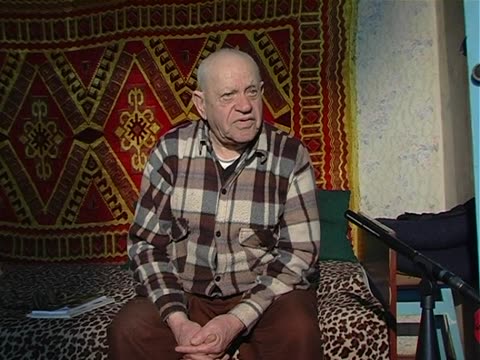
This tape is a continuation of a formal interview with Aba Davidovich Kaviner (b. 1921, Derazhnya). Kaviner comments on how the documents pertaining to prewar Yiddish institutional life in the Soviet Union were likely burned or lost. He also briefly discusses the curriculum at his Soviet Yiddish school, and the two minor local Yiddish writers he knew, Moyshe Zibnberg and Itsik Sokol.
From the machine transcript
Kaviner says that documents of the Derazhnya Yiddish school were probably thrown out or burned during the occupation after the school was converted to a Russian one, along with books and textbooks. He recalls Yiddish literature and the local Yiddish writers Zibnberg (?) and Sokol, who settled in Khmel'nyts'kyy after the war. He then names a gifted teacher at his school, Tentsermann (?).
adds the fate of the school's books and the teacher Tentsermann
Kaviner talks about his Yiddish school teachers as well as the science and mathematics curriculum in those institutions. At the request of the research team, he shares the terminology used in these classes for mathematical concepts.
From the machine transcript
Kaviner recalls his teachers, including a teacher who went to Odessa to take external exams and a physics teacher named Tayman (?), and says science was taught in Yiddish. Asked by Lemster and Kerler, he gives the Yiddish mathematical and physical terminology, such as the definition of electrical voltage and arithmetic terms for plus, minus and fractions, and notes numerals in several languages.
Kaviner comments further on the Soviet Yiddish school curriculum as it pertained to literature and language, explains the logistics in obtaining enough books for all the students, and notes the storyteller-performers who would come visit the school. Kaviner shares his mostly negative attitude towards Israeli Hebrew. He recites the lyrics of “HaTivka” (The Hope) in Ashkenazi Hebrew pronunciation, then sings the song.
From the machine transcript
Kaviner describes the Yiddish grammar and literature reader in his school, how every pupil got a textbook free from the school, and the reciter Vinogradski who visited and performed Sholem Aleichem from memory. They discuss other writers who visited. He says he dislikes Israeli Hebrew, then recites and sings Hatikva.
adds Vinogradski the reciter, other visiting writers and the Hebrew text of Hatikva
Kaviner shares a folktale-style story about the Jewish shepherd boy who wrote HaTikva and how it became the Jewish national hymn.
From the machine transcript
Kaviner tells a folktale about a Jewish shepherd boy in the Diaspora, beaten by his Arab master, who composed Hatikva on his pipe, and how it became the Jewish anthem. He and Kerler talk about Jewish pride and striving toward Zion. He then mentions Mark Varshavski as another composer.
adds the discussion of Jewish pride and Zion
Kaviner talks about Mark Varshavski and Sholem Aleichem, and the genesis of the song “Afn pripetshik”. Speaking of other contemporary composers, Kaviner talks about the nature of Jewish identity in those people, such as Vladimir Vysotskii, who do not outwardly express their Jewishness.
From the machine transcript
Kaviner says Mark Varshavski, a trained jurist, wrote "Afn pripetshik" and that Sholem Aleichem took it from him and published it. They discuss contemporary singer-songwriters such as Aleksandr Rozenbaum and Vladimir Vysotskii, whom Kaviner learned was partly Jewish and did not deny it, though not observant. Kerler then asks how long Kaviner attended the yeshiva (to age nineteen).
adds the yeshiva question at the end
Kaviner recalls the anti-religious propaganda and actions that were promoted in the Soviet Yiddish School as well as the “openly secret” nature of the yeshiva he also attended.
From the machine transcript
Answering Kerler, Kaviner says there was constant anti-religious propaganda and that Jews themselves closed synagogues. His yeshiva was half legal and half illegal; the authorities knew of it, then ordered it closed in 1937–38. Lemster asks about repression of Yiddish school teachers, and Kaviner says they were mostly not repressed but went into Soviet service jobs, such as the yeshiva head becoming chief accountant at the state bank.
Kaviner shares his memories of prewar Jewish weddings that were celebrated in a traditional manner. The town’s rabbi was Mikhl Rozhanski, a very learned and handsome man, who spoke several languages and played the fiddle. He was arrested three times by Soviet authorities, but always quickly released. He was later killed during the war. The rabbi’s children went to the Ukrainian-language school instead of the Yiddish school because of a wider conflict within the town’s Jewish community. Kaviner states that he remembers many anti-religious songs from those years, but would prefer not to sing them.
From the machine transcript
Kaviner recalls prewar weddings with a huppah and the rabbi Mikhl Rozhanski, a handsome, learned man who spoke Russian and German, played the violin, was jailed several times and released, and was killed by the Germans. His children attended the Ukrainian school because of a quarrel with the director of the Yiddish school. Kerler asks about anti-religious songs and the red Haggadah; Kaviner does not want to recall them but starts reciting the song about Rebbe Reb Shneyer.
adds the Rozhanski children's school change and the red Haggadah question
Kaviner recites the words to the anti-religious Soviet Yiddish song “Rebbe Reb Shneyer”.
From the machine transcript
Kaviner recites the text of the anti-religious Soviet Yiddish song about Rebbe Reb Shneyer, in which a rabbi gives absurd rulings on a non-kosher knife. He comments that such propaganda mocked Jewish belief.
Kaviner reports that there were no Yiddish-language religious songs taught in his yeshiva, but he did participate in the choir in his Yiddish school, which sang patriotic Soviet songs.
From the machine transcript
Kaviner says no Yiddish religious songs were taught in the yeshiva or in Soviet times. In his school choir they sang Soviet patriotic songs on Yiddish texts by poets such as Pfeffer, Bukhshteyn and Grubian. Kerler asks about a Sevastopol song and a Yiddish song by Itsik Pfeffer, which Kaviner does not recall.
Kaviner states that he met with writer Hershl Polyanker in Kyiv after the war. After briefly discussing his works, Kaviner tells a story about the writer’s release from prison and induction into the Ukrainian Union of Writers.
From the machine transcript
Asked about meetings with writers after the war, Kaviner says he once met Hershl Polyanker in Kyiv, a hard man, and mentions his books. He tells how Polyanker, freed from prison, went in his prison clothes to a Ukrainian writers' union congress and was reinstated while his denouncers stood by.
Kaviner returns to the subject of prewar Jewish weddings, commenting on the dances, religious ceremony, and role of the "bodkhn" (master of ceremonies and jester). He then tells a short story about the folk-hero Hershele Ostropolyer as a “bodkhn”.
From the machine transcript
Kerler and Lemster ask about wedding customs, and Kaviner says a high round loaf was called a "malkhes broyt" (?). They discuss the badkhn who led the wedding, naming Shmuel Moyshe and Penia Sinderovich as badkhonim in Derazhnya. He then tells a short story about Hershele Ostropolyer as badkhn of a rebbe.
adds the naming of the badkhonim and the malkhes broyt (?)
Kaviner then tells three longer Hershele Ostropolyer stories. He reports that he read these stories in books, but that people would also tell such tales all the time, even in synagogue during services.
From the machine transcript
Kaviner tells several Hershele Ostropolyer stories, including one where he tricks a peasant woman over Passover honey, one about a night at an inn with varenikes, and one about a peasant selling chaff at the mikveh. He says he read these in books and that such stories were told everywhere, even in synagogue during services. Kerler and Lemster also ask about the idiom "to lead someone into a bud" and about Chelm stories.
Kaviner also shares a folktale from the town of Chelm.
From the machine transcript
Kaviner tells a Chelm tale about a rabbi who was thought to have no head, since no one could say whether he had one.
When asked about the stories and folktales about the Jews of his shtetl, Kaviner recalls the tales about the great peasant thief Karmaliuk, who would hide from the authorities in Jewish homes. The Jews of Derazhnya were thus call “Karmalyukes.”
From the machine transcript
Asked about stories on the local Jews, Kaviner explains that Derazhnya Jews were nicknamed Karmaliukes after the peasant robber Karmaliuk, who hid in Jewish houses and the forest. He tells of the Santes family in Litychiv, whose house was burned when the authorities searched for him. Kerler asks whether the robber spoke Yiddish.
Kaviner states that every Jew in his town had a nickname and shares several examples.
From the machine transcript
Kaviner says every Jew had a nickname and gives examples, such as his great-grandfather called Tarlivke and a clever man called Khayl Mat. He discusses the word "mat" (clever, sharp) with Kerler, who asks about its origin. Lemster then asks about the town madman.
Kaviner briefly discusses Nakhmen Bratslaver and his influence in the history and development of Hasidism.
From the machine transcript
After mentioning the town madman Khaim and legends about the Derazhnya rabbi, Kaviner answers Lemster and Kerler about Rebbe Nakhmen of Bratslav, great-grandson of the Besht, buried in Uman, a great theorist and philosopher of Hasidism. His secretary Nosn was also discussed. He says his daughter has a Russian book of Nakhmen's tales, and says he once saw a lamed-vovnik.
adds the rabbi legends and the secretary Nosn
Kaviner mentions that he once met a “lomed-vuvnik” (one of the thirty-six righteous figures hidden among the Jewish people in any generation). He begins the story describing one of his town’s mentally-handicapped residents; the tape cuts off the story in mid-sentence.
From the machine transcript
Kerler asks how one can see a lamed-vovnik, and Kaviner begins a story about a madman in his town who wore ragged clothes and sang, danced and jumped while small children gathered. The tape ends mid-sentence.
adds Kerler's question on recognizing a lamed-vovnik