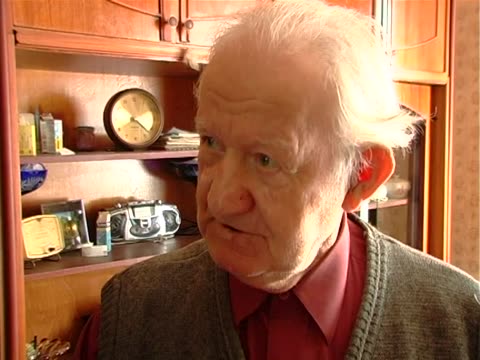
This tape consists of a formal interview with Semyon (Yisrul) Aronovich Vaisblai (b. 1930 in Chemerivtsi). The interview begins with Vaisblai sharing his basic biographical information and speaking briefly about his experiences during the war. The researchers also briefly explain the mission and methodology behind the AHEYM Project.
From the machine transcript
Introductions and first questions: Kerler asks about names and who speaks Yiddish. Vaisblai says he is from Chemerivtsi, near Kam''yanets'-Podil's'kyy, and was in the ghetto as an eleven-year-old (?), where he saw what the Germans did to the Jews. Kerler explains the project and asks whether he was recorded earlier for the Spielberg project.
Gives the project explanation, the earlier Spielberg interview question and the Chemerivtsi location in detail.
Vaisblai states that there was a synagogue in his family’s home when he was growing up before the war and that he has worked as “gobe” (administrator) in Khmel'nyts'kyy’s contemporary synagogue for many years. His father Avrum (known more commonly as “Umenyu”) worked as a cap-maker who was paid in potatoes for his work. His mother Nunye worked as a housewife until her death in 1937. Vaisblai’s paternal grandparents, Pesye-Rokhl and Biumen had thirteen children.
From the machine transcript
Vaisblai says he has been gabbai in the Khmel'nyts'kyy synagogue for eighteen years, and that his health keeps him home now. He gives his birthplace Chemerivtsi, his father Avrum (nicknamed Umenyu) and his mother Nunye, his Russian patronymic, and his grandmother Pesye-Rokhl and grandfather Biumen. His father reused old caps and was paid in potatoes; his mother was a housewife and died in 1937.
Gives details of the parents' names, his father's nickname and Russian name; the claim of thirteen children does not appear clearly.
Vaisblai then describes his hometown of Chemerivtsi in the years before the war. According to Vaisblai, there was a synagogue in his family’s house because his father was crippled by an injury he received in a Petliura-led pogrom. Vaisblai describes the poverty and hardships of his youth, stating that although his father remarried a rich woman who bought food for shabes (the Sabbath), he and his two siblings often went hungry.
From the machine transcript
Vaisblai describes prewar Chemerivtsi, mostly Jewish, and says a prayer room was in their house because his father was injured in a pogrom. The family was very poor and the father's second wife, a rich woman from a nearby village, cooked for Sabbath but did not feed the children, who ate potatoes. He names his brother Bersh and sister Keytl, and mentions going hungry at school.
Adds the stepmother, the brother and sister's names and school hunger; the catalogue's claim that he had two siblings is not clear.
Vaisblai discusses the education he received in his childhood, emphasizing the fact that when the other children played, he stole their food and ate their scraps as he was so poor and hungry. Vaisblai tells a more detailed story about how he used to steal food.
From the machine transcript
Vaisblai tells how, as a hungry schoolboy, he stole other children's bread and butter and once climbed through a window to eat food cooking in someone's house. His father beat him for it. He then began working in the Jewish kolkhoz in Chemerivtsi.
Gives the window episode and his father's beating.
There was a Jewish kolkhoz (called “Karl Marx Kolkhoz”) in Chemerivtsi where Vaisblai worked in the fields to get extra food. Non-Jews also worked in the fields in the place of those Jews who did not want to work or were physically unable to do so.
From the machine transcript
Vaisblai describes working in the fields and driving a horse at haymaking so that a non-Jewish farmer would feed him. Lemster asks about the kolkhoz name, which is not clear in the transcript. He says it was Jewish, with Jewish brigades and work-teams, and that non-Jews worked there too. He begins to describe the town's rich men.
Gives the kolkhoz name as unclear; the catalogue says Karl Marx.
Vaisblai discusses the different types of people in his town and the class differences between them. He also comments on the education he received before the war. A religious teacher named Dudye would come to his home to teach him “alef-beys” (the Hebrew alphabet) and other traditional subjects, but the teacher would often fall asleep during the lessons and Vaisblai would run off to go find food. Vaisblai learned formally in Soviet Yiddish school as well.
From the machine transcript
Vaisblai speaks of the rich men and the many poor people in town. He says a melamed named Dudye taught him Hebrew at home but would oversleep, so he ran off to find food. Lemster asks which school he attended; Vaisblai says it was under the Soviets and breaks off at the war's start.
When Germans entered Chemerivtsi, Vaisblai reports that the town’s rabbi said the Jews had to “go to the slaughter” because they had sinned. Vaisblai states that when the Germans came to his town, they first took all the Jews’ money and then forced the Jews, including his family, into a ghetto in Kam”yanets’-Podil’s’kyy. Vaisblai describes the hardships and the hunger in this ghetto. He states that there were in fact two ghettos set up: an “Old Ghetto” for “undesirables” such as the elderly and the infirm, and a “New Ghetto” for those who were healthy and able-bodied. Vaisblai then begins the complicated narrative of his wartime experiences. Initially, Vaisblai would escape the ghetto during the day in search of food, but would spend the night there. Vaisblai details how he eventually left the ghetto and fled from town to town, encountering and receiving help from Jews and non-Jews across the region.
From the machine transcript
Vaisblai recounts the German occupation of Chemerivtsi. The rabbi says the Jews must go to the slaughter for their sins, though Kerler's question shows it was unclear who said it. A man took Jews' gold, and his family was driven on foot fifty kilometres to the Kam''yanets'-Podil's'kyy ghetto. He describes hunger, an old and a new ghetto, escapes by day for food, narrow escapes and hiding, and flight to Dunaivtsi and beyond.
Adds Kerler's challenge on who said 'the slaughter' and the exact order of the ghetto escape and flight narrative.
Vaisblai eventually reached the town of Kupyn, but, as he relates in great detail, kept on moving from village to village, helped mostly by non-Jews and surviving through a series of narrow escapes.
From the machine transcript
Vaisblai continues his escape narrative, moving from Kupyn and the surrounding district from village to village. He passes as a non-Jew, is tested by a drunk, is sheltered by peasants, and hides in barns and on stoves. Some are kind, others turn him away or threaten to denounce him; he meets a few Jews and narrowly escapes. Finally he gets back to Chemerivtsi, where a gendarme makes him clean his boots.
The catalogue summarises; the transcript is a long detailed series of encounters and the return to Chemerivtsi at the end.
Vaisblai eventually returned to Chemerivtsi, where he personally served a German soldier. He was then placed in a ghetto in the town of Smotrich, staying there briefly until he was forcibly returned to the ghetto in Kam”yanets’-Podil’s’kyy. Vaisblai was able to escape the ghetto again, returning to some of the towns he had visited previously. He describes how various people helped him survive and the harrowing conditions and circumstances under which he lived. Continually fleeing, Vaisblai eventually reached a kolkhoz in the village of Dubinka. There he was caught as a thief, but a couple of non-Jews who knew him from Chemerivtsi falsely testified that he was their nephew so that he would able to stay there. Vaisblai remained in the kolkhoz until 1945.
From the machine transcript
Vaisblai is taken to Smotrich, where Jews with beards are tortured for gold, and then marched to the Kam''yanets'-Podil's'kyy ghetto. He describes a cell where Jews were thrown in and his escape. He then flees on, mentions Poltava, and reaches a kolkhoz village where he is suspected of theft; two people from Chemerivtsi, who knew him, vouch for him. He stays in hiding until 1945.
Adds the mistreatment of bearded Jews and the cell; the Dubinka name and 1945 date rest on unclear passages.
After the war, Vaisblai returned to Chemerivtsi. With the exception of two families, none of the kolkhoz residents knew Vaisblai was in reality a Jew. Once he returned to his hometown, Vaisblai’s former neighbors allowed him to live in his grandmother’s old house. Vaisblai then describes his life in the postwar period, working various jobs in different towns.
From the machine transcript
Vaisblai recounts his return to Chemerivtsi and says only two families on the kolkhoz knew he was Jewish. He lived in his grandmother's old house. He then describes postwar work in several places, including a trip to Chernivtsi (?), as a shop manager and trader, and a stay in Zakupne (?), with brushes with the militia and officials over theft and goods.
Details the postwar jobs, a letter to his sister in the army and the militia episode.
Vaisblai returns to the subject of prewar Chemerivtsi, describing the town's butchers, synagogues, rabbis and teachers, as well as its Yiddish School. Vaisblai also briefly describes his childhood home life and how his family spoke Yiddish at home.
From the machine transcript
Lemster and Kerler ask about prewar Chemerivtsi. Vaisblai says there was one shoykhet, two synagogues, and two rabbis, one teacher named Dudye (?). He says the Yiddish school had many pupils and a few non-Jewish children, that Yiddish was spoken at home, and that after the war Jewish officers spoke Yiddish. He mentions that he can sing.
Vaisblai states that he knows many songs, some of which he learned before the war from his father and others which he learned after the war from demobilized Jewish soldiers.
From the machine transcript
Vaisblai says he knows many Yiddish songs, learned before the war from his father and after the war from Jewish officers returning from the army. Interviewers ask who sang in the town; he says they sang at prayer.
Vaisblai states that it was Rabbi Dudye who said that the Jews of Chemerivtsi “must go to the slaughter” (“me darf geyn af der shkhite”) for their sins.
From the machine transcript
Kerler returns to the rabbi's words. Vaisblai says the rabbi, Dudye, told the Jews of Chemerivtsi that they must go to the slaughter for their sins, and that he heard it himself. They discuss people's faith in the rabbi, who was consulted in quarrels. Vaisblai ends with the cell in the Kam''yanets'-Podil's'kyy ghetto, where one man refused to go.
Gives the rabbi's name and the discussion with Kerler; the catalogue's attribution is clearer than the earlier passage.
Vaisblai briefly describes holiday celebrations from before the war.
From the machine transcript
Lemster and Kerler ask about prewar holidays. Vaisblai says that at Passover no bread was eaten and the poor tried to get some meat. At Purim they prayed and heard the megillah; he thinks the rabbi dressed up and people wore masks, though he knows this only from his father. He cannot recall a Purim song and begins to sing a Friday-night song.
He sings “Fraytik af der nakht” (Friday Evening) and “Oy iz dus a Rebenyu” (Oh is that a Rabbi) and “Rebe Reb Shneyer” (Rebbe Reb Shneyer).
From the machine transcript
Vaisblai sings a Friday-night song, then a song about a rebbe and Hasidim, and part of a comic song about a neighbour. Kerler asks for more; Vaisblai says he is not supposed to sing some of them.
The third song, with the neighbour and the kosher verse, is not clearly identified in the transcript.