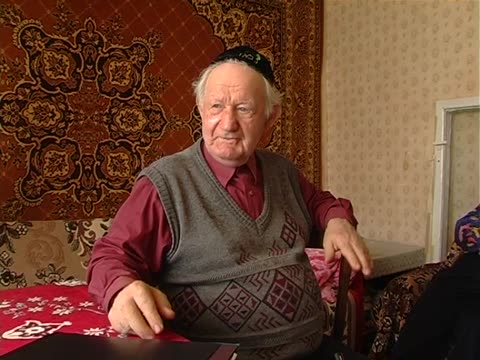
This tape is a continuation of a formal interview with Semyon (Yisrul) Aronovich Vaisblai (b. 1930 in Chemerivtsi). He sings “Tsen kopeks” (Ten Kopeks) followed by a long nign (wordless melody) and then repeats the same song in Ukrainian.
From the machine transcript
Vaisblai tries to recall a song, then sings 'Ten Kopeks' in Yiddish and Russian/Ukrainian after Kerler and Lemster ask for a song that works in both languages.
Shows interviewers requesting a bilingual song.
He sings “Nokhemke mayn zin” (Nokhemke My Son). Vaisblai then comments on the state of the contemporary Jewish community in Khmel'nyts'kyy and shares his views on emigration to Israel and Germany.
From the machine transcript
Vaisblai sings 'Nokhemke mayn zin'. Kerler asks for rarer songs, including one about a wagoner. Vaisblai then comments on the dwindling of Jewish life in Khmel'nyts'kyy, with many Jews dead or gone to Israel and Germany. His son is in Israel and his daughter in Germany, and he mentions a grandson who could not join the German army. He also tells of his wartime ability to understand German.
Includes his wartime encounters with German speakers.
Vaisblai briefly recalls the end of the war and the day he was liberated by the Red Army.
From the machine transcript
Kerler asks whether Vaisblai remembers the day of his liberation. He recalls the arrival of the Red Army in 1944, with a cavalry scout, wagons and tanks. He did not return to Chemerivtsi at once because he had been advised against going.
Vaisblai discusses Khmel'nyts'kyy’s remaining Yiddish speakers and other Jews. He also talks about life in the postwar Soviet Union, specifically detailing the troubles he had with housing. Vaisblai also comments on his contemporary health and financial problems.
From the machine transcript
Vaisblai names the few Jews left in Khmel'nyts'kyy who know Yiddish (one who studied at a yeshiva, and a Jew named Burshtein who understands but is ashamed to speak). He then tells at length of his difficulties in the Soviet period over housing: building a house, the kolkhoz, officials, an anonymous denunciation, and money for buying a house. He ends with remarks on his health, his wife and where she and her parents come from.
Adds the denunciation and legal tangle over his housing.
Vaisblai briefly describes Jewish weddings from before the war, as well as Jewish social gatherings during the postwar period.
From the machine transcript
Asked about Jewish weddings, Vaisblai recalls a wedding of a man named Barukh, with klezmer music, dancing and singing, and notes he was later killed by the Germans. He then tells a story about a postwar gathering of Jews in Chemerivtsi, including a man from Chernivtsi and an anecdote about boots, and answers Lemster on whether a huppah was set up.
Adds postwar Jewish gatherings and the boot anecdote.
He further recalls prewar wedding music and dances.
From the machine transcript
Answering Lemster and Kerler, Vaisblai recalls that prewar weddings had Jewish songs and dances, with klezmer from Chemerivtsi. Kerler asks about a wedding master of ceremonies and dancing with a tart, but Vaisblai does not remember or know the custom.
The research team begins their survey of sociolinguistic and dialectological questions, asking about terms such as “dibek,” “goylem” and others.
From the machine transcript
Lemster and Kerler begin questionnaire items. Vaisblai explains the terms dibek, goylem, meshumed and gshmadte (a Jew who becomes a non-Jew), and the Messiah is mentioned in passing.
Vaisblai shares his views on the afterlife and G-d, and on morality and sin with statements such as “der malekh hamuves iz elter fun got” (“The angel of death is older than G-d”) and “A yid a parekh iz erger vi a goy a gozlen” (“A nasty Jew is worse than a thieving non-Jew”).
From the machine transcript
Vaisblai talks about the angel of death, God and sin. He says the angel of death is older than God, describes God as something in the human heart, and tells of a man imprisoned for hoarding gold. He ends with a saying comparing a bad Jew with a thieving non-Jew.
Includes the story of the confiscated gold.
The team returns to their linguistics questionnaire.
From the machine transcript
The interviewers return to the questionnaire, asking how Vaisblai says 'thank you' and terms for a pious person and for being ill, and how a number phrase would be put. He mostly gives Russian-influenced or uncertain answers. They then ask him for another song.
Vaisblai sings a few more songs, including “Itsik hot shoyn khasene gehat” and another song about a bride.
From the machine transcript
Vaisblai sings a few more songs, including 'Itsik hot shoyn khasene gehat' and one about a bride. Kerler asks where old Jews remain with whom one can speak Yiddish, and Vaisblai says there are none in nearby towns such as Lyubar, only one non-Jewish woman who knows it. He mentions grandchildren in Israel and America.
Adds Kerler's questions about places with remaining Yiddish speakers.
Vaisblai shares his views on Israel and talks about his previous visits to the country.
From the machine transcript
Vaisblai recalls his 1996 trip to Israel, travelling widely with his son, finding few Yiddish speakers and meeting a Jew from Germany. He tells of a woman from Zhytomyr who regretted her move after her husband's suicide. The interviewers introduce themselves as coming from Israel, America, Poland and Belarus. They talk about Yiddish as an international language and ask if he knows Romanian from Chernivtsi.
Includes Kerler's remarks on Yiddish internationalism and a question about Romanian.
He sings the shabes (Sabbath) song “sholem-aleykhem” and discusses his various forms of employment in the postwar period.
From the machine transcript
Kerler asks whether Vaisblai knows the name Sholem Aleichem and the Sabbath song 'Sholem-aleykhem', and Vaisblai describes himself as a good Jew. He lists his postwar work in trade, directing and cooperatives, totalling 45 years, and says he receives a pension. Kerler thanks him and asks the next person's name.
Adds Kerler's thanks and Vaisblai's pension.
The camera then cuts to the Jewish community center where a formal interview is conducted with Ilia (Elye) Zelmanovich Kramer (b. 1927, Berezdov). He shares his basic biographical information and speaks about his experiences during the war years as well as his family life.
From the machine transcript
At the community center, Kramer gives his name and birthplace Berezdov, discussed with Kerler as a Yiddish place-name. He states his full name, his father Zelman, and his birth year and current address in Khmel'nyts'kyy. Kramer recalls living in Berezdov until the war, evacuation to Kazakhstan, return in 1944 to Slavuta, and the family's flight on foot with others. He names his siblings: two sisters and two brothers.
Adds the Yiddish-name discussion for Berezdov and the escape on foot.
He expands on the latter topic, stating that his father worked on a Jewish kolkhoz; there were two kolkhozy in the town, according to Kramer, one Jewish and one Ukrainian. Kramer’s sisters also worked on the kolkhoz, and he himself worked there from the age of fourteen onwards.
From the machine transcript
Kramer talks about his father's work in the Jewish kolkhoz, of which there was one beside a Ukrainian one in Berezdov, and compares them. He names his mother Leah, says he and his sisters also worked in the kolkhoz from age fifteen, and mentions evacuation to Kazakhstan and return to Slavuta in 1944. He also speaks of an uncle, Leybl, and his children.
Adds his mother's name, the uncle Leybl, and the evacuation details.
Kramer describes prewar Berezdov. He mentions that his father worked in a brick factory. Describing his prewar educations, Kramer states that he finished four years in a Yiddish school before attending a Ukrainian-language institution. He describes the town’s butchers, its rabbi, and the town synagogue that operated until 1939.
From the machine transcript
Kramer describes prewar Berezdov, saying his father worked in a brick factory. He attended a Yiddish school for four years before it was closed, then a Ukrainian school. He recalls two ritual slaughterers, a rabbi and a synagogue that functioned until 1939, with a discussion of a wooden synagogue in Slavuta and a brick prayer house. Lemster asks about his postwar work.
In the postwar period, Kramer served in the army until 1951, moving to Khmel'nyts'kyy in 1955, while his family lived in Slavuta. Kramer worked as an engineer in a factory until 1992.
From the machine transcript
Kramer says he served in the army until about 1951 and then studied. In 1955 he came to Khmel'nyts'kyy, while his parents, sister and brother lived in Slavuta. He worked in a factory as a constructor and technologist, finishing as an engineer and head of an instrument shop, until 1992.
Kramer returns to the subject of his youth, focusing of the hardships that he and his family faced. In 1933, for example, his family lost their house because the deed of sale was written by a rabbi and thus unrecognized by the Soviet government. Kramer recalls his family’s connections to relatives in America and to the Joint.
From the machine transcript
Asked about childhood, Kramer recalls that the family was thrown out of their house when he was about five because the purchase deed had been drawn up by a rabbi and was not recognised, in 1933. His father later obtained voting rights, though as an American-born man he had been denied them. He tells of relatives in America and Argentina who were discovered in the 1980s, the Joint's help, and his father's English that helped him with horse purchases and later work in a shop.
Adds relatives in America and Argentina, the Joint, and the father's English.