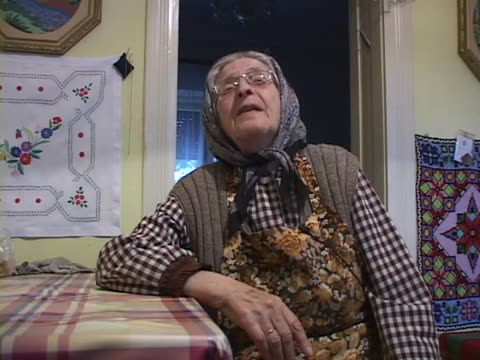
Kerler asks about the village life of Snook's parents. She answers briefly that her parents were killed, and that they kept a cow, observed Passover and the festivals, and describes Yom Kippur as a holy day. She tells how she dressed up on Purim and went from house to house for money, and Kerler asks her repeatedly for Purim sayings, which she does not recall. Kerler mentions his own life in the US, and she recites the morning prayer on waking. They also talk about Hasidim in the village, visits to rebbes, and a visit of her son to the Rybnitser (?) rebbe, whose photograph she has.
also covers Kerler's own background and the visit of her son to a rebbe
Snook talks about her religious education; she studied with an unemployed teacher for three years together with some other girls. She remembers Passover celebrations before the war, as well as other religious customs to avert the evil eye. Snook then talks about her family.
Snook talks about her limited religious education: a few years in a cheder-like setting for girls, so that she can read and pray a little but cannot write Yiddish. Asked by Kerler, she describes the Passover seder, gefilte fish and a ritual of pouring out coals to cure the evil eye, and a practice with an egg to make hens lay more. She recalls her grandmother Sarah and grandfather, who had sons in America and Vienna and who died at ninety, and the children asking him for coins.
includes the folk practice with an egg and details of the grandfather's family abroad
Snook discusses prewar religious life, when services were held in a “shtiebel” (a little room). She also discusses her family and holiday celebration, including food customs. Her grandchildren and great-grandchildren live in Israel.
Snook describes the small prayer room in the village, with three Torah scrolls, and the dwindling Jewish community in Khust today. She tells of her siblings (six children, her father in the First World War), who led the seder, and her son, daughter-in-law and grandchildren, with five grandchildren and great-grandchildren in Israel who speak Yiddish and Russian. Kerler asks about Sukkot, Shavuot and Simchat Torah, and she tells how betrothals were arranged at Simchat Torah. She also exchanges words with Katz about his age and home in America, and she mentions knowing Hungarian and Russian, though only Yiddish was spoken at home.
covers Sukkot, Shavuot and Simchat Torah customs, and her languages
Snook says that non-Jewish neighbours knew Yiddish and recalls one, Mikhail, a simple non-Jew who even prayed in Yiddish. She recalls baking hamantashn with preserves for the neighbours and discusses the terms for the filling and for potatoes, sending Purim gifts, and drinking at Purim. She tells of her husband Biel, who died fifteen years earlier, and who could lead prayers. Kerler also asks about Sabbath songs.
adds words for filling and potatoes and her husband Biel
Snook sings a long Yiddish Hasidic song in which a speaker pleads to be a good Hasid, and answers Kerler's questions about where she knew it from. She says she learned it long ago, perhaps from her father. Kerler explains the recording will help young learners of Yiddish, and she comments on young people who want to learn it.
the transcript shows a Hasidic song rather than just zemirot
Snook discusses life after World War II. Shloyme, Snook’s son, explains that they owned animals. She then talks about Jewish life of the 1950s in Khust.
Snook describes the hardship of life after the war, working at whatever she could, and her marriage and move to Drahovo (?). She gives her son's birth year, 1946 (?). She mentions emigration to America in the 1950s, the surviving minyan in Khust and the old synagogue, which has been repaired with American help. Kerler asks about the synagogue under Soviet rule, and he asks again for songs and prayers; she recites a prayer for the parents.
the transcript does not clearly show the son speaking; also shows the synagogue's repair and emigration
Snook recites the prayer 'God of Abraham' for the end of the Sabbath at Kerler's request, and she remarks on Kerler's colleague as a young man who can write Yiddish. Kerler compares life in America and under the Soviets. They discuss whether the synagogue in Khust stayed open under communism and Sabbath observance. Kerler then asks about Purim performances after the war and Passover songs, and she mentions children noisemaking on Purim.
adds Purim customs after the war and the question about Passover songs
Snook talks about her family, in particular her son, born in 1946. He attended religious school (cheder) in Drahovo. Snook describes her daily routine and tells about holiday songs.
Snook talks about her son (Katz and others say he knows Hebrew and Yiddish), her own advanced age, her health and her daily routine. She describes the hired help. She was not able to visit her grandchildren in Israel. Katz and Kerler press her for old Passover songs, including Chad Gadya, which she remembers from childhood but declines to sing, and a counting song, and she tells about the counting of the Omer. They ask her to repeat the song sung earlier.
the transcript shows the daily routine and the request for Passover songs more than her son's cheder in Drahovo