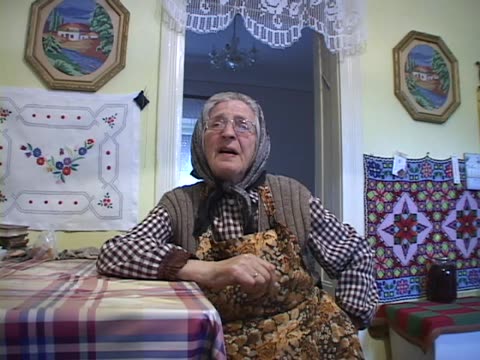
Snook sings a Hasidic song remembered from childhood. In it a devoted follower of the rebbe wears a heavy long kaftan in summer heat and immerses in the cold mikveh in winter. Kerler thanks her, she addresses a wish to American Jews, and Kerler then asks her to show villages and towns on a map.
Besides the song, Snook addresses American Jews, and Kerler introduces the map request.
The interviewees look for places on a map, with Snook's son (probably) doing most of the talking. They try to locate Kolochava, where the mother lived, and the neighboring villages, with Kerler helping. They go over Rakhiv, Solotvyno and Bila Tserkva, and remark on which places still have Jews and which do not. Kerler asks how Bila Tserkva was called in Yiddish. At the end they turn to Moshe Katz and prepare for the next interview. Much of the exchange is garbled.
Besides the mother's birthplace, they discuss Rakhiv, Solotvyno, the remaining Jews in some places, and the Yiddish name of Bila Tserkva.
The camera cuts to the next formal interview with Moisei Usherovich Katz, born in Koshelovo in 1926. After the team greets him in his apartment, they set up the interview.
The team greets Katz in his apartment and is introduced. Kerler explains that they want to record how he speaks Yiddish and remembers the old way of life, and gives the date, 6 July 2005, and the place, Khust. Katz is from the village of Koshelovo near Khust.
Katz provides personal information and talks about his family. He grew up with six siblings. His father was a coachman with two horses. Katz then talks about prewar Jewish life and childhood memories. He attended religious school (cheder) until his bar mitzvah. Katz then discusses his father’s work as a coachman, transporting wood. Katz supported his father’s work during vacation. In 1939, when his father was "drafted" into the Hungarian army forced labor battalion, Katz continued his father’s work with the help of an assistant. His parents received a plot of land after their marriage.
Katz gives his personal details: village near Khust, 8 km away; his names in Russian, Czech and Hungarian; his father Usher; and his birth in December 1926 in Czechoslovakia. His father was a coachman with two horses. He was the eldest of seven children; his mother was a housewife with the maiden name Lazarovich. He names the cheder teachers, the grandparents and the siblings. He describes transporting timber to the Khust station for a factory in Danzig, and helping his father. His father was taken to a labor battalion in 1941 (as heard), and he carried on the work alone. His maternal grandfather Leyzer later died in the Iza ghetto. Both grandmothers were named Etie.
Names the siblings and grandparents and the Danzig timber business, and dates the father's call-up to 1941 rather than 1939.
Katz recalls childhood memories in a town of roughly sixty Jewish families. Katz attended cheder in the mornings and afternoons. Katz then remembers a wedding and discusses Sabbath celebrations at home.
Katz recalls his childhood in a village of about sixty Jewish families (heard as 'sixty tallisim'), with two synagogues; Khust had eleven. He describes his daily routine of cheder in the morning and afternoon, with the state school in between, and what was taught in cheder. He answers Kerler's questions about a village wedding: the engagement, the chuppah and the dance with the kerchief. He describes Sabbath meals, cooking cholent and kugel in the clay oven, challah and candles. The passage ends as Kerler asks about the kaddish.
Adds the village school and the village's synagogues and Sabbath cooking.
Katz recites kaddish and discusses holiday celebration of Passover and Purim at home. He then talks about his father’s hard work as a coachman. Katz then explains how children celebrated Purim before the war. Katz was not able to participate in the Purim shpiels because he had to help out with his parents.
The passage opens with unclear side talk, partly in Russian, about a book in the room. Katz then describes baking matzo and the seder at home, including the four questions and a Chad Gadya song. He talks about his father's exhausting coachman work. He answers questions about Purim: the reading of the megillah, children going from house to house, and why he himself did not go (he was busy helping at home). He also touches on the decline of Jewish life today and the difference between a town and a shtetl. At the end he turns to the deportation of his family, the camps and the burning of what was left.
Adds the Passover seder, a shift to life today, and the first mention of the camps.
Katz talks about life during and after the war. He was sent to different concentration camps, including Auschwitz, Buchenwald, and Monowitz. After the war, he was drafted into the Red army labor battalion and was assigned to build aerodromes. Katz recalls the terrible conditions during his military service from 1947 through 1950.
Katz tells of the camps: Buchenwald, Auschwitz, Monowitz and Birkenau. After liberation he was drafted into a labor battalion (construction) under Stalin, and served for about three years, until the end of 1950, building airfields in Abkhazia, around Novy Afon. He describes the mountain terrain, the monastery and the dacha built for Stalin, and the hard conditions and food. Kerler then asks him to tell what happened to him before the camps, and Katz returns to his father's call-up.
Katz discusses life during the war, after his father was drafted into the Hungarian army in 1939. Katz continued his father’s work as a coachman until 1943. He then talks about his experience delivering wood. His father returned from the army in 1943 due to health reasons and took up his previous work as a coachman. Katz then explains that his uncle and cousin were ultimately taken to the railway station in Khust by the Hungarian police in 1941. The train was headed to Ivano-Frankivsk, before moving further to Khust. Katz explains that they were deported from Khust to the Iza ghetto in 1944 and stayed there for three weeks. He recalls the hardships of acquiring food. After three weeks, Katz continues, they were sent to a brickworks in Khust, going through health check and selection for three days. Katz was then deported to Auschwitz. Katz recalls the first days of undressing/showering and selection at the concentration camp. Katz spent two days in Auschwitz and was then sent to a sub-camp of Auschwitz, Monowitz. Katz worked at a factory there.
Katz describes the war years. After his father was called up, he did the coachman work himself, carrying timber and hauling boards, until his father was released ill in 1943. In 1941 Hungarian gendarmes took Jews from the village, and a train went toward Stanislav, where the Poles were said to have been killed. Katz then recalls the Iza ghetto in 1944 (about three weeks), hunger, and how he slipped home at night for food. The family was then taken to the Khust brickworks, with beatings and searches, and sent by train to Auschwitz. He describes the selection, shaving, shower and clothing, then Birkenau, where he received a number, and then Monowitz with his father and the factory work.
The transcript has the family itself taken in 1941, rather than an uncle and cousin, and adds Katz's trips home from Iza for food and the Khust brickworks.