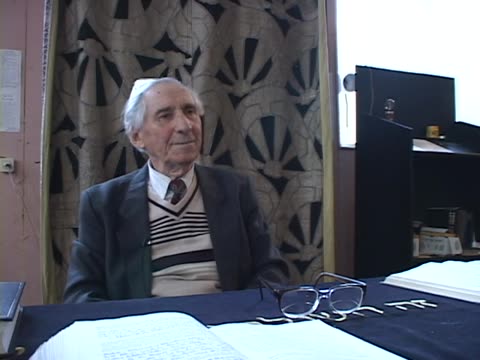
This tape is a continuation of a formal interview with Semyon Semyonovich Krotsh (b. 1922 in Stefanesti). Another AHEYM interviewee, David Abramovich Vider (b. 1922 in Sighetu Marmatiei), is also present. Krotsh discusses prewar Passover observances and celebrations, including a description of the dishes that were used and the foods that were eaten. Krotsh and Vider discuss the nuances of the differences between the terms "erlikh” and "frim”.
Krotsh first mentions meeting a stranger who spoke Yiddish, then recalls prewar Passover: his mother's latkes, bringing Passover dishes down from the attic, matzo and matzo meal, and going to synagogue. He worked for a tailor who stopped work for the eight days of the holiday. Kerler, Katz and a second man then discuss the distinction between the Yiddish words for 'erlikh' (honest) and 'frum/frim' (pious), with examples such as helping the poor and learning Torah day and night.
Opens with an anecdote about a Yiddish-speaking stranger and covers the Passover items in more detail than the catalogue states.
Krotsh is asked for the Passover song and sings 'Ekhod mi yoydeyo' (Who Knows One), with some hesitation about remembering it. Afterwards he says it was sung in Hebrew rather than Yiddish, and there is talk about a prayer book and the Passover home.
Adds the exchange afterward about whether the song was sung in Yiddish.
Krotsh sings another loshn-koydesh (the Hebrew-Aramaic language of traditional Jewish texts) song and describes how he learned the nign (melody) from the tailor with whom he apprenticed.
Krotsh sings a Hebrew song and says the tune came from the tailor he worked for. He tells a story about a bearded Jewish tailor who was called up in the First World War and was released after the rebbe's prediction when two generals quarrelled. Kerler asks about the Romanian phrases in the story and then about the Stefanester rebbe's miracles.
Adds the story of the tailor released from army service through the rebbe's blessing.
Krotsh says that non-Jews never converted to Judaism in his town because Jews lived apart from their neighbors, but that many Romanians spoke Yiddish. Jews were the great majority in Stefanesti. He read in Yiddish and Hebrew in school, including Sholem Aleichem and religious books, and went to yeshiva while also working as a tailor from a young age.
Covers his reading and yeshiva/work as a child, not only relations with non-Jews.
Krotsh discusses the Yiddish songs his parents would sing. Vider and Krotsh then sing a fragment from a song about a Ukrainian shtetl. Krotsh then sings a short Modern Hebrew song to the tune of the Yiddish song "ele-bele”. While there were no Yiddish newspapers in his shtetl, Krotsh notes that there was a rich Jewish organizational life, which included many Zionist groups.
Krotsh cannot recall the songs his parents sang, and a second man tells a song about a poor tailor in a Ukrainian shtetl, after which Krotsh talks about pogroms in Ukraine. He sings a Hebrew song to a Yiddish melody. He says there were no Yiddish newspapers in the Romanian-ruled town, only Romanian ones, and that Jewish organizations existed.
The newspapers and Romanian prohibition are covered, plus talk about Ukrainian pogroms.
Krotsh begins answering questions about terminology: the words for a cemetery (including a non-Jewish cemetery), and what 'a good Jew' (a gutn yid) means. He explains that a tsadik is not necessarily a good Jew and that people were sent to a good Jew, the rebbe, for advice with problems such as a daughter's marriage.
Includes the explanation of 'a good Jew' and visits to the rebbe.
Krotsh recounts stories he heard from his employer about the Stefanester rebbe's miracles, chiefly a tailor ordered to make a coat for a general who warned him by the rebbe's advice, and a prisoner who came to the rebbe. Kerler asks about dybbuks and Krotsh says only that he remembers hearing of them being exorcised.
The tailor/general story is the main narrative; the dybbuk question gets only a vague answer.
Krotsh discusses prewar Jewish life in his shtetl, describing the Rebbe’s court and the town’s synagogues. He relates how the Rebbe solved the town’s problems and disputes, and recalls prewar Jewish wedding customs.
Krotsh describes the town as pious, with no unbelievers, and the rebbe's court with a garden and the rebbe's own room for prayer. He names eight prayer houses, including a beit midrash, the high synagogue, the tailors' synagogue and the rebbe's kloyz, and tells how the rebbe settled a cantor dispute. He answers questions about weddings, the badkhn/'gramer', the klezmer musician Khaim Berder (?) and songs.
Krotsh talks about different holiday foods and shares his attitudes towards Yiddish dialects. He then continues with the sociolinguistic and dialectology questionnaire, during which time he also sings the song "Freyen zikh iz git” (Being Happy is Good).
Krotsh answers questions about holiday food, such as Hanukkah foods and Passover latkes, and about differences between Yiddish in Romania, Moldova and Ukraine. Kerler then puts questionnaire items with Russian prompts, such as greetings, thanks, a big and small word for a person, a house, a cut, windows, and Krotsh gives Yiddish equivalents and notes loanwords.
Includes the attitudes toward dialects and the questionnaire items.
Krotsh sings a song he knows from Moldova, after which Kerler continues the questionnaire with Russian prompts: words such as pot, gray, healthy as a house, kissel, ear, deaf, then comparatives (earlier, colder, higher, faster, nearer), 'he knows everything', 'listen to me', roof, ill and sentences about liking and not liking. Krotsh gives the Yiddish forms and comments on Moldavian and Ukrainian loanwords.
Most of the passage is questionnaire work; the song is only at the start.