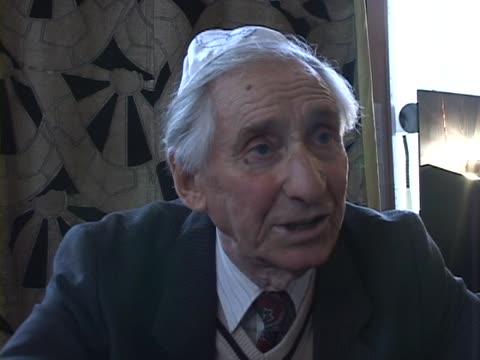
This tape is a continuation of a formal interview with Semyon Semyonovich Krotsh (b. 1922 in Stefanesti). Another AHEYM interviewee, David Abramovich Vider (b. 1922 in Sighetu Marmatiei), is also present. Krotsh discusses his contemporary health problems, as well as the state of Yiddish in the Kolomyya present-day Jewish community. Krotsh speaks about his marriage and three sons of whom only one is now alive. Krotsh moved to Kolomyya in 1949.
Krotsh says he is unwell and talks about having been in the hospital. He mentions a friend who urged him to rest, and a woman he spoke to who could not talk Yiddish, and says few people speak Yiddish today. He laments the destruction of Yiddish and Yiddish books in Poland and elsewhere, and says he teaches himself to read Yiddish. He mentions three years in Israel, his marriage and three sons, only one of whom is still alive, and a son who was a doctor and was killed. Kerler asks when he came to Kolomyya, and Krotsh says 1949.
Also covers Krotsh's views on the loss of Yiddish culture, his time in Israel and the death of his wife.
Krotsh details his experiences during the war years: he went to the Soviet Union and was evacuated from the town of Rîbnita to the Caucasus region of Russia, where he worked on a kolkhoz (collective farm). From there, he was evacuated further into Azerbaijan, and then drafted into the Red Army from 1942 to 1947. Krotsh went to Kolomyya after the war at the suggestion of a friend from the army since it was near Romania, but by the time he got there the border was closed and so he stayed in the town. Krotsh then briefly comments on postwar Jewish life in Kolomyya and how the town’s synagogue was repaired in the 1990s.
Krotsh tells of the start of the war in Moldova, flight past Soroca to Rîbnita and evacuation to the Krasnodar region, where he worked on a kolkhoz. He fled further to the Stavropol region and Azerbaijan, then served in the army at Baku until 1947. A friend from Kolomyya persuaded him to go there; he found the border closed and stayed. He recalls the synagogue still marked with Hebrew lettering in 1949, how it was later converted and repaired, and how few Jews remain in Kolomyya, many in mixed marriages. Kerler and Katz ask about the numbers and about some local Jews.
Adds the numbers of Jews now in Kolomyya, mixed marriages, and talk about local individuals.
Krotsh describes the atmosphere in prewar Stefanesti on shabes (the Sabbath) and on holidays. Asked about Purim celebrations, Krotsh twice sings the ditty "40 teg, 40 nakht” (40 Days, 40 Nights) and then a fragment of "shoshanes mordekhay.” He then sings the traditional shabes song "lekhu doydi” (Come My Beloved). Returning to the topic of Purim observances, he sings a fragment of another ditty "vus zoln mir zingen bay deym balebus” (What Should We Sing for the Master) as well as another Purim song.
Returning to Stefanesti, Krotsh describes the town as a holy shtetl closed on the Sabbath and holidays, with the rebbe's influence. Asked about Purim, he recalls dressing up as a child and sings the Purim ditty about Moses forty days and nights twice. He sings Lekhu dodi in the way he remembers it. He tells how young men in disguise visited homes and sang for the host, describes mishloyekh-manes gifts, and begins a song about the Sabbath preparations of Jewish wives of long ago.
Adds the Purim visits by disguised young men, mishloyekh-manes gifts and a song about wives of the past.
Krotsh sings the song "Vi nemt men di vaybelekh fin amul” (Where Can You Get a Wife Like the Ones From Back Then) and mentions the importance of Yiddish theater in his shtetl (town). He then sings a variant of the famous song "Lomir ale in eynem” (Let Us All Together), and also discusses Zionist activity in the town.
Krotsh sings the song about where one finds wives like those of long ago. He recalls Yiddish theater coming to Stefanesti, his mother's love of it and a famous actress who died in Chernivtsi, and answers Kerler's questions about plays such as Mekhires Yoysef and Akeydes Yitskhok, which he knows from his Bible study rather than from the stage. He sings a variant of Lomir ale in eynem. Asked about Zionist activity, he says halutsim passed through, names several Jewish youth groups, and says there was no Bund or socialist party under the rebbe's influence.
Krotsh sings a Modern Hebrew song about Chanukah, and notes the observances for this and other holidays. He then sings fragments from the "kol nidre” (All Vows) service and the High Holiday liturgy.
Asked about Hanukkah, Krotsh talks about dreidels made of lead, a holiday he calls beautiful, and how Rosh Hashanah and Yom Kippur emptied the town streets. He sings or recites fragments of Kol nidre and High Holiday liturgy at Kerler's request. He says he learned Hebrew and could speak with visitors from Israel and America. The passage includes informal exchange with the team and a break, and ends with a High Holiday melody he begins to recall.
Adds a Hanukkah song attempt, talk about Hebrew, and informal chatter about the recording.
The camera cuts to the team talking informally with the interviewees. Vider sings "Ven indzer futer yakoyv iz geleygn afn shteyn” (When Our Father Jacob Laid Down on the Stone).
The team talks informally with Krotsh and another man, who may be Vider, about the recording and about preserving what he remembers. They ask about a song on Moses and the other man sings the song about Jacob lying on the stone, which a young cantor performed in concerts. Kerler asks how it was sung, and they discuss making a break and a visit in the evening.
The camera cuts back to a formal interview with Krotsh, who sings more of liturgy, describes holiday customs, describes his shtetl’s public baths, and relates an experience he had speaking Yiddish while travelling in Israel.
Back in the formal interview, Krotsh sings more liturgy and describes the Sukkot custom of eating and sleeping in the sukkah. He tells how he sold shmoes for money and how the sexton knocked on shutters to wake people for selikhes. Kerler asks about the bathhouse and mikveh, and Krotsh describes the bath and ritual bath of his shtetl. He tells how he spoke Yiddish at a government office in Israel when the clerk spoke Hebrew.
Adds Sukkot, shmoes-selling and selikhes customs, bathhouse and mikveh, and Krotsh's Israeli office anecdote.