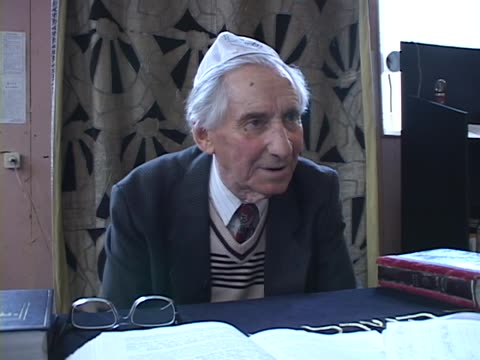
This tape is a continuation of a formal interview with Semyon Semyonovich Krotsh (b. 1922 in Stefanesti). Another AHEYM interviewee, David Abramovich Vider (b. 1922 in Sighetu Marmatiei), is also present. Krotsh answers questions from the AHEYM sociolinguistic and dialectological survey.
Questionnaire work with the elderly Yiddish speaker: Kerler gives words and short sentences, often in Russian, and asks how they were said in his Yiddish. Items include 'to run away', honest, pious or holy person, the sign of the cross and crossing oneself, non-Jew, 'my head hurts', 'where are you from', 'please', a bouquet or garden of flowers, vodka versus brandy, 'in three days', 'you are right', 'to pray', and 'grandmother/midwife'. The speaker also says which words they did or did not use at home.
Gives the actual items of the questionnaire (religious terms, body ache, directions, midwife) rather than just calling it a survey.
Krotsh discusses folk medicine and tells a personal story from his childhood of how his leg was healed by a blind folk healer woman named Molke Spodik.
The speaker explains that an old midwife-healer in his home town could say a charm or cure ('apshprekhenish') and describes how, as a boy of about thirteen, he hurt his leg while sledding down a hill near the town. After doctors, plaster and other treatments had not helped, his father took him to a blind folk healer named Molke Spodik (?). She felt the leg, heated it with hot water, and set it, after which he could walk. Kerler comments on the story and asks about the healer's name.
The healer is blind and the injury happened while sledding; also mentions an older woman healer (Rivke) and the doctors who failed to cure him.
The questionnaire continues, with Kerler and then Katz giving Russian and Yiddish prompts. Items include prepositions and pronoun sentences ('I speak with mother', 'I see her badly', 'I don't hear him'), words for well, potato, flowers, fence, attic, bridge, and a face; 'suddenly', 'someone', 'then', 'enemy', and the plural of 'wagon'; and a few phrases such as 'in the street' and 'five persons'. The speaker comments on which variants were used in Stefanesti and Moldova. Katz also asks about burrs thrown at girls' hair and about a death phrase. At the end Kerler thanks the speaker, and the passage runs into the start of the Russian interview.
The camera cuts to a formal interview conducted in Russian with Roman Bileichuk (b. 1963 in Kolomyya), an aspiring convert to Judaism. Bileichuk shares his basic biographical information, describing his childhood without a father, and his education and early career path. After an extended period of religious exploration, Bileichuk recalls how one sleepless night after reading the Torah he somehow wandered three kilometers to Kolomyya’s synagogue, a place he was totally unfamiliar with before, and joined the Rosh Hashone (New Years) services that were then taking place. Despite conflict with his family, Biliechuk has been attending the services at the synagogue and observing Judaism for about 2.5 years, and has written to several rabbis in Kyiv about the possibility of formal conversion. Meanwhile, he states that he is trying to follow all Jewish religious laws and reads Jewish journals and traditional texts, trying, "like everybody else” to find Truth in the world.
Roman Bileichuk, interviewed in Russian, gives his surname and says he is from Kolomyya. He grew up without a father, with his mother working shifts in a weaving factory, and spent time in a boarding school. He finished eight classes and became a shoemaker at a shoe factory at about 17. He was an Orthodox Christian who obeyed his parents. After reading the Bible he began to doubt and read the Torah. One sleepless night he walked about three kilometres to the Kolomyya synagogue on Rosh Hashanah, where the gabbai Sasha received him. He has attended for two and a half years despite quarrels with his mother, and has written to Kyiv about conversion. He tries to keep Sabbath and the laws and reads Jewish papers and a prayer book.
Gives his birthplace, upbringing without father, work as shoemaker, Rosh Hashanah visit, plus his reading of Jewish press and prayer book.
Bileichuk discusses his family life and shares his attitudes towards Subbotniki, Christian Protestant sects and other faiths. He also discusses why he sees as the inherent truth in Judaism, the "stealing” of its principles by other faiths and his personal religious journey.
Bileichuk speaks about his mother's Christian confession and his own earlier interest in Sabbatarian (Subbotniki) and other Protestant groups. He says he read their literature and concluded that they take from the Torah and misuse it, including tithing, and he describes arguments with them. He mentions studying with Sasha Babichenko and Kolesnikov at the synagogue, reading the weekly Torah portion, and feeling that he as a non-Jew has no right yet to teach others. He answers Kerler's questions about the Subbotniki, the New Testament and the groups he met.
Covers his mother's Christian confession and a detailed account of his own reading of Subbotnik literature and Torah study.
Bileichuk states that he knows how to pray Jewishly and does so at home when there are not services in the synagogue. Bileichuk also shares his attitudes toward Israel, noting that "New” Israel is not as good as "Old” Israel, since the new state lacks the Temple in addition to being filled with morally questionable people and problems, such as unbelievers and prostitution.
Bileichuk says he prays at home and wants the camera to tell people to look for truth in the God of the Jews. He prays for the Temple and for the sick and comments on 'old' and 'new' Israel. He values the old Israel with its Temple and finds the new one troubled by doubts, mosques, terrorism, and the lack of morality, including prostitution and the behaviour of rabbis and officials. He comes back to one God and to the binding of Isaac.
Includes his general call to the world to seek truth in Judaism and a critical view of Israeli officials.
Bileichuk further details the conflict he has had with his family over his new faith and notes the paradox of how the commandment to "honor thy mother and father” in this case would compromise his faith. He also describes how he prays at home with a homemade "bima” (prayer lectern). Bileichuk states that he keeps all commandments to the extent possible, and reports on what he calls the deceptive nature of the Catholic and Christian Bible, wanting the world to recognize the truth in Judaism. Bileichuk began his religious journey 4-5 years ago starting asking these religious questions, noting that he had a very Christian upbringing and was always of a very spiritual orientation. He also comments on his relations within the community, and, comparing himself to Abraham who took on G-d’s covenant at a late age, states that he will let no one deny him his right to convert. Bileichuk mentions his relationship with a non-Jewish woman who is also an aspiring convert and with whom he has a son. Bileichuk also complains about the politics of conversion and its connection to bribery in Israel.
Bileichuk describes the war in his family over his new faith: his mother observes Sunday, he cleans on Thursday for Sabbath, and he makes havdalah and prays alone at a small homemade bima facing Jerusalem, with a compass. He says the Christian Bible is distorted and wants the world to read the Torah. He dates his search to four or five years ago and recalls how a friend's New Testament and the Sabbatarians led him to the Torah. He says nobody may forbid his conversion, compares himself to Abraham, and mentions a woman partner and their wish to have a son. He criticizes conversion in Israel as a matter of money and bribery, and Kerler thanks him at the end.
Gives the early Christian and Sabbatarian steps of his search, a partner and planned son, and the criticism of rabbis taking money for conversion.