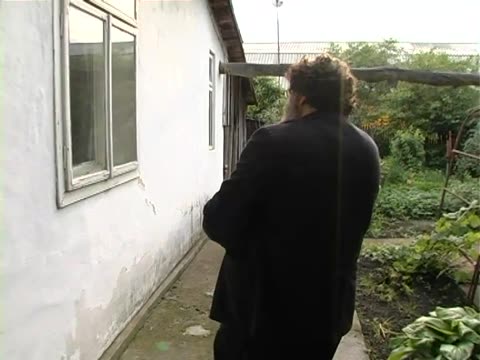
Town footage and talk at a house door as the group tries to reach someone, with Russian phone-number dictation. Kerler says in English that they will keep calling and that he will buy beer for everyone. The Yiddish exchange with the people at the door is largely unintelligible.
Krotsh and Kerler discuss a young Russian man who has become religious and wants to convert, and who travels to the rebbe. Krotsh recalls the Ştefăneşti rebbe's descendant and a visit years earlier. He mentions saying psalms while waiting for visitors who did not come at the expected time.
The transcript shows talk of a Russian would-be convert and a visiting group, not a general account of religious life.
Krotsh speaks about his yeshiva education in Ştefăneşti, where he lived until 1940. He also addresses his language education and mentions that students from surrounding towns attended the yeshiva.
Krotsh says he studied at the yeshiva in Ştefăneşti until 1940. Kerler asks about a word for studying, and Krotsh recalls being chosen to show off the students' learning to visitors. He talks about learning Romanian more poorly than Yiddish and remembers tractates of Talmud he studied. He says boys from nearby towns came to the yeshiva, then mentions an uncle's family who were killed.
Kerler asks about a Yiddish term for studying, and Krotsh mentions an uncle's family killed.
Krotsh speaks about his family's life during World War II. His parents were imprisoned in the Botoșani ghetto. He then speaks about his life during the war. Krotsh joined the Red Army with his younger brother. He grew up with three sisters and two brothers. Krotsh's older brother served in the Romanian army.
Krotsh recalls that his parents' town was wiped out and the Jews were driven to Botoşani. He had by then crossed over to the Russians, with his middle brother Michl. He names his sisters and brothers, and says his older brother served in the Romanian army or gendarmerie. He also mentions a cousin or niece now living in Israel.
The transcript also shows a relative in Israel and the older brother's service, which is unclear whether army or gendarmerie.
Krotsh discusses his childhood memories. He then speaks about prewar Jewish life in Ştefăneşti. Krotsh describes how the community remembers the victims of World War I and repeats the story about Kroth's master craftsman's encounter with the Ştefăneşti rebbe.
Krotsh says he spoke only Yiddish with friends and at home, and knew some Romanian. He describes the town's many synagogues and the rebbe's large court, which drew visitors from abroad. He retells a story from his master tailor about a Jew drafted in the First World War whom the rebbe said would not be taken. Two Romanian generals then picked other men to take him as an orderly, and he was sent home.
Most of the passage is the master tailor's story about the rebbe and the draft, and it also covers language use at home.
Krotsh describes the rebbe's court, with rooms for guests and for horses. He recalls that matzo was not baked there but special shmura matzo was. He tells of a Rosh Hashanah when the cantor overslept and the rebbe proposed Gedaliye, a singer who drew people from far away. He then names a great tsadik of Iași (?) and his father.
The passage's holiday content is mainly Passover shmura matzo and Rosh Hashanah, with no Purim in the transcript.
Krotsh speaks about his family. His mother was born in Săveni. Krotsh describes how his mother sought advice with the Ştefăneşti rebbe. He then speaks about contemporary life.
Krotsh tells how his father had siblings in America and went there alone, while his mother did not want to leave her family. The rebbe told her they would not go and the father would return. He and Kerler talk about a visitor who died a year earlier and the widow's yahrzeit. They also discuss the would-be convert and his plans to travel to Kyiv.
The transcript shows the father's trip to America and return, and talk of a deceased visitor's widow.
Krotsh speaks about his education. He attended a religious school (cheder) until he was seven years old. He then studied at a Romanian Jewish school, before learning at a yeshiva. Krotsh recalls a rabbi's speech on Sabbath and speaks about his tailor apprenticeship.
Krotsh answers questions about his schooling. He attended cheder from about age three, then a Romanian school where half the day was Romanian and half Hebrew, then the yeshiva. He mentions the free bread and milk the school gave poor children and where out-of-town yeshiva boys lodged. He describes the rabbi's Sabbath speeches urging observance and the kosher food his master tailor insisted on for workers.
The transcript also covers the school meals for poor children and the kosher rules in his master's workshop.
Krotsh recalls non-Jews who spoke Yiddish and addresses prewar religious life. He also speaks about the yeshiva students and mentions story about the Ştefăneşti rebbe and a military tailor. Krotsh recalls the story from his master craftsman.
Krotsh recalls non-Jews who spoke Yiddish so well that one could not tell them apart from Jews. He discusses the difference between a rav and a rebbe, the memorial yeshiva in Israel, and a rabbi's descendant who claimed to be a rebbe in America. He also tells at length the story from his master tailor: a poor military tailor makes a cloak for a general and the rebbe advises him. Kerler and Krotsh then discuss the Romanian word for a gift or tip and Russian equivalents, and Kerler introduces the topic of a Purim play.
Beyond non-Jews who spoke Yiddish, the transcript shows a long tailor story and a discussion of a Romanian-origin word.
Krotsh speaks about prewar Purim celebrations. He sings a couple of Purim songs in Yiddish and Hebrew. The first one is about non-Jews not understanding conversations among Jews.
Krotsh recalls dressing up as a child at Purim in costume and singing. He sings a Yiddish Purim song about non-Jews not understanding what Jews say among themselves. He says such songs were not sung at Shavuot, and recalls school outings to the forest. He then sings a Hebrew-and-Yiddish song, mostly garbled, and remarks on a man in Israel putting on a tallit and going to synagogue.