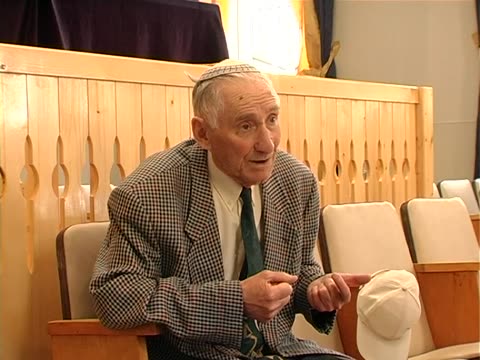
Krotsh sings again the song about non-Jews not understanding conversations among Jews. He then speaks about prewar religious life in the region, as well as his life before the war. Krotsh also mentions how his father decided for him to drop out of the yeshiva.
Krotsh repeats a Yiddish song about the Jews at Sinai, whom the non-Jews could not understand. Kerler then asks about the phrase 'good Jews' for rebbes' followers and about rebbes, including the Podolier rebbe, whom crowds went out of town to welcome. Krotsh says he studied at a yeshiva for half the day and learned a trade for the other half. He was about thirteen when his father, advised by an older man, decided he should leave the yeshiva for tailoring.
Also covers the term 'good Jews' for hasidim and the rebbes' visits.
Krotsh speaks about his life during World War II, particularly the time he was drafted into the Red Army in Kirovabad (today: Ganja). Krotsh also describes the work in military construction and then as tailor. Krotsh maintains that he survived the war due to his profession.
Krotsh describes the war years, when he was drafted into the Red Army at Kirovabad. He did heavy military construction work there, with hunger and thin soup, and was then put to work as a tailor. He tells of meeting a Jewish workshop head, getting a sewing machine, and being helped by a senior party woman, so that tailoring saved him. Kerler asks whether he went to a rebbe, and Krotsh answers that perhaps his father's blessing helped.
Also includes the encounter with a Jewish workshop head and Kerler's question about rebbes' blessings.
Krotsh speaks about his father's visits to rebbes, mentioning the Podolier rebbe. Kerler asks when he last saw his father and the family, and they place it in the 1950s–60s. Kerler then asks Krotsh to sing something, perhaps a Romanian song.
Krotsh sings a Yiddish song about a good homemaker. He then speaks about prewar Yiddish culture, particularly theater performances. Krotsh remembers a tailor who became an actor.
Krotsh sings a humorous Yiddish song about a housewife and women who cook on the Sabbath. Kerler asks whether Yiddish theater visited, and Krotsh recalls touring troupes, posters and street advertising, and actors coming from other towns. He also tells of a tailor mistaken for an actor who was taken to the front as one.
Also includes the story of a tailor taken for an actor.
Krotsh recites a Hebrew poem or school text he learned at school and describes its content. He explains how Purim singers visited householders and received money, and discusses the word for money used in these songs.
Krotsh talks about his tailor master, who worked for wealthy Romanian clients such as lawyers and a prefect. Krotsh went along and interpreted for the master, who knew Romanian but did not want to speak it.
Krotsh tells of an Orthodox priest and his son, in which Romanian words insulting Jews turned up in a note. He then reflects that life under Romanian rule was very hard, though good for the rich.
Krotsh discusses reading Sholem Aleichem and the story of the little knife (?) in Yiddish. He tells a long story of a village blacksmith whose son was apprenticed to a tailor, and the boy's mother, who came to the shop. A visitor interrupts in Russian for a stretch. Kerler asks about a dialect word for beating.
Also includes Russian talk with a visitor and the word for beating.
Krotsh talks about his year in Bessarabia, where Moldovan girls laughed at his Romanian greeting. He explains local Moldovan expressions and what he learned from them. Kerler asks about Yiddish words such as 'tsunoyfshpaden' (?), which Krotsh links to Russian and to his tailoring.
Also includes questions on the word 'tsunoyfshpaden' (?).
Krotsh recites a Romanian song and explains its words with Kerler. He then gives a short Purim-shpiel scene about a couple who come home late and find that the Megillah has already been read. They discuss when such pieces were sung.
Krotsh describes how, in the synagogue today, non-Jews and others leave slips with names and money, in the belief that it helps, and he wonders whether this is permitted. They talk about visitors from America who come for the holidays and send photographs, and Krotsh mentions two visitors named Mendel (?) and Nachman (?). Kerler then asks for another song and Krotsh begins a drinking song.
Krotsh sings a Yiddish song about a drunkard in a tavern, to whom the streets seem drunk. He says he remembers more verses and other songs only partly. They talk about songs that tailors sang while sewing.