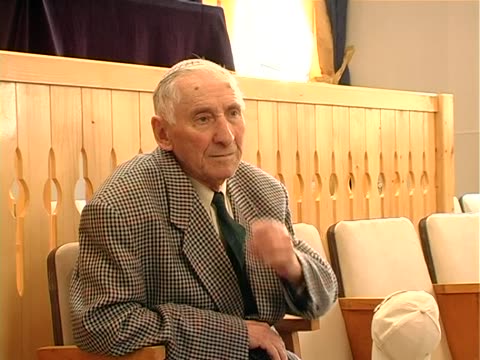
Krotsh begins by performing a song in Romanian, saying he does not remember it in full. Kerler then talks with him about fieldwork in Romanian Moldavia and Bukovina. They discuss the few Yiddish speakers found there, the town's Jewish committee head, the synagogue in Rădăuţi (?), and an older woman who would not give her age.
Most of the passage is Kerler's account of his fieldwork in Romania and the Rădăuţi synagogue, rather than Krotsh's own contemporary Jewish life.
Krotsh recalls visiting Rădăuţi as a boy (about ten or twelve years old) and attending the synagogue there on a Sabbath with a yahrzeit. He describes the old, heavy prayer shawls, the building and his wish to see it once more. Kerler then tells of Mykhailenets, a border village where he found a non-Jewish woman who speaks fluent Yiddish learned from Jewish neighbours.
Krotsh answers questions about how things were said in Ştefăneşti Yiddish, including words for going, a person who is weak or ill, and a pious or honest person, with forms of 'we go' compared to Bessarabia and Lithuanian Yiddish. Kerler also asks about verb forms (broken, brought) and kin words such as father and mother. Krotsh says he now has no one to speak Yiddish with.
The passage is a questionnaire on word forms, and the regional comparison (Bessarabia, Lithuanian Yiddish) is a side topic.
Krotsh says that no one is left with whom to speak Yiddish. He tells of an acquaintance who has died and others who emigrated to Israel, and says he now talks to himself at home. Kerler jokes about this and asks whether he read Yiddish booklets in Ştefăneşti.
Krotsh addresses his life before the war and contacts with local Communists. He then speaks about his work life after the war, particularly communicating in Yiddish in Mukachevo, Ukraine, early 1950s. Krotsh went to further training in military tailoring in Moscow in the early 1950s.
Krotsh recalls that before the war his father and family had no dealings with Communists, and tells how Bessarabian youth later asked whether he had done 'political work'. He says that after the war he spoke Yiddish at work even with some non-Jews, and tells a long story from Mukachevo about a man called Menashe who fled from Czechoslovakia and was caught. He mentions that he went to Moscow around 1952–53 for training in cutting, military tailoring. He says that for decades he saw no Torah and lost his religious practice.
The passage also contains an extended anecdote about a man named Menashe, a Yiddish-speaking workmate's name story, and the loss of Jewish observance in Soviet decades.
Krotsh speaks about postwar Jewish life, including a brief history on synagogue buildings. He states that the synagogue the interview is conducted in was used as gymnasium.
Krotsh says he came to Kolomyya in 1949 and describes what happened to the town's synagogues, saying the large synagogue was broken up and turned into a club or sports hall. He recalls that the word 'Jerusalem' stayed painted on the building through German and Soviet times. He and Kerler discuss the building's renovation, its windows and women's gallery, and compare it with the synagogue in Mukachevo.
The passage also covers women's galleries and Kerler's comparison with Mukachevo's synagogue, and Jewish emigration from Mukachevo.
Krotsh describes going back to Ştefăneşti, where the town has been largely wiped away except for the school and the area by the rebbe's house, and explains the term for the surrounding quarter (a Turkish-derived word). Kerler asks about a Turkish-origin word in Yiddish, and they mention an English-language ethnographic booklet and a Yiddish book on Ştefăneşti's Jewish history, which a relative in Israel has.
Krotsh says his son lives in Kolomyya and does not know Yiddish, and tells an anecdote about being asked whom he was talking to at home. Kerler asks about people he spoke Yiddish with after the war. Krotsh recalls a Jewish workmate in Baku, the Russian-speaking environment there, and his team of workers; Kerler asks about a song, which Krotsh does not know.
Krotsh speaks about postwar Jewish life in Kolomyya. Krotsh moved to Kolomyya in 1949. In particular, he describes secret Purim services and mentions Yiddish theater performances.
Krotsh describes Jewish life in Kolomyya after he came in 1949, with many returning Polish Jews, Bessarabian Jews and others from evacuation and no open synagogue. He tells of secret gatherings in a private home for Yom Kippur memorial prayers and a Purim reading of the Megillah, held in fear of the authorities. He also mentions a covert Yiddish theatre that visitors from Chernivtsi (?) staged, until it was closed.
Krotsh describes postwar Jewish weddings in Kolomyya, which had klezmer and Yiddish songs but no rabbi or religious ceremony. Kerler then speaks of Jews who came to Chernivtsi and of the one remaining synagogue there, and they discuss Stanislav (Ivano-Frankivsk) and a Jew from Romania who has died. Krotsh answers questions about reading the Soviet Yiddish journal and 'Birobidzhaner Shtern', and agrees to read Yiddish materials Kerler will send.
The passage also covers Soviet Yiddish periodicals (the Birobidzhan paper) and Krotsh's willingness to read Yiddish mail.
The conversation turns to the interviewers' onward travel. Kerler explains the route by way of Vinnytsia, Berdychiv and Kyiv, and the two exchange farewells and hope to meet again. Krotsh also mentions a periodical, and Kerler mentions something he has published for reading.