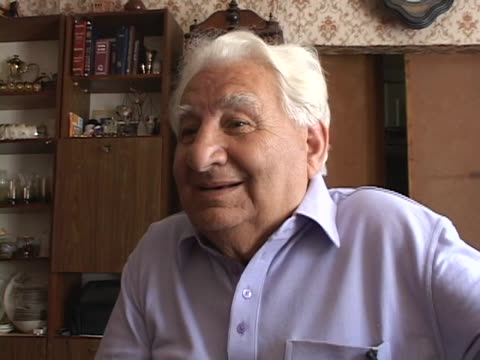
Groysman talks about his work as a watchmaker and mentions watchmaking terms in Yiddish. He then talks about prewar Jewish life, in particular occupations and literature.
Groysman answers Kerler's questions about learning his father's watchmaking trade and gives Yiddish terms for watch parts and mechanisms. Kerler asks about the dialect of Lithuanian Jews and about the ethnic groups Groysman worked with. Groysman then lists the artisans of Tarashcha before the war (shoemakers, tailors, harness makers and others) and says which books he loved to read.
adds Kerler's questions about Lithuanian Jewish dialect and Groysman's prewar reading
Groysman speaks about his family, mentioning his parents and sister and a postwar position held by his mother. Kerler asks about Jewish weddings in Tarashcha. Groysman recalls a prewar Jewish wedding in the courtyard of a tailor family, with a woman who sang Yiddish songs; he does not know the term badkhn. Kerler then announces a set of Russian words to translate.
adds the courtyard wedding and the badkhn question
Long dialectological questionnaire in which Kerler gives Russian words and phrases and Groysman supplies Yiddish equivalents. Items include greetings and thanks, household and everyday objects, adjectives, adverbs of time and place, verbs, numerals, kinship and family terms, and words for a pious man, a wealthy man and a midwife. Several sentences are translated, and Kerler and the others occasionally comment. Groysman has difficulty hearing and seeing at points; the wife and others interject.
Kerler asks Groysman for childhood memories of Tarashcha and a song. Groysman recalls children's habits such as going barefoot in the rain and says he went to a Ukrainian school and learned Yiddish from his parents. His wife (probably) speaks of his devotion to his mother and to her, and the interview closes.
Camera footage of the town, with Groysman in front of his house, and then of the road to Uman. Kerler and several others talk, partly in Russian, about directions, a restaurant and streets; the Yiddish is mostly garbled. Kerler also describes a Yiddish novel in a few sentences.