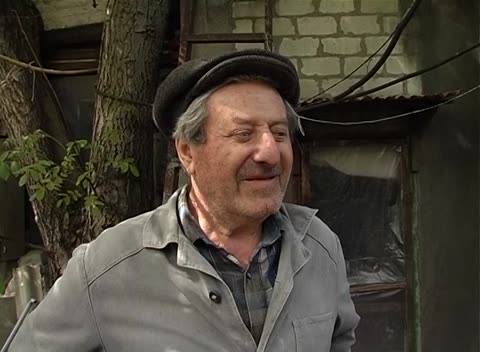
The team greets Obodovskii and Leiderman in their garden and sets up the interview with them. They provide personal information, before Leiderman talks about her life after the war. She lived in Pishchanka until the age of seven before her family moved to Rudnytsya. Leiderman worked as bookkeeper and Obodovskii as farmer after World War II. She spent the war years in evacuation 3:40 in Siberia and he spent the war years in evacuation in Siberia.
From the machine transcript
The interviewers greet the couple and settle names and place names, including the Yiddish and Russian forms of the name of Birzula/Kotovs'k, and the distance to Pishchanka. Leiderman says she worked 37 years in a bank as bookkeeper and was born in 1928. She lived in Pishchanka until about six or seven, then the family moved to Rudnytsya. Obodovskii worked in construction, and the couple were evacuated to Siberia (Altai region, near Barnaul), though the transcript is unclear about the places.
Adds the discussion of the Yiddish and Russian names of Birzula/Kotovs'k.
The formal interview begins. Obodovskii and Leiderman provide personal information and talk about their family. Obodovskii's father was born in Rîbnița, Moldova, and his mother was born in the village Korytne.
From the machine transcript
Formal interview begins with Kerler's questions on place names and on the Yiddish dictionary Obodovskii owns and the Yiddish alphabet he learned. He gives his mother's name as Sore. The couple give their surnames: Leiderman, and Obodovskii, which he says is Polish and derives from Obodovka. His mother came from the village of Korytne near Balta, and his father's origin is the subject of further questions.
Adds the discussion of the surnames and of the Yiddish dictionary.
Leiderman talks about prewar Jewish life in Pishchanka, as well as her family. Her father was born in Obodovka and was a laborer 9:58. Her mother was born in Sobolivka. Obodovskii also talks about his family and describes his parent's work on a kolkhoz near Kotovsk. His family moved to Kotovsk in 1939.
From the machine transcript
Lemster asks about the number of Jews and synagogues in Pishchanka, then about Leiderman's parents. Her father was from Obodovka (?), and her mother from Sobolivka (?), the villages named in the transcript. Obodovskii mentions a grandson who visited from abroad, which leads to talk of the laptop. He describes his father's limited schooling and his parents' work on a kolkhoz near Kotovs'k, in a village settled by Czech colonists, and the family's move to Kotovs'k in 1939.
Adds the grandson's visit and the laptop, and the Czech village near Kotovs'k.
Obodovskii talks about his life before the war. In particular, he discusses his school education at a Ukrainian school in Kotovsk, a Russian school in Siberia (during World War II) and a Russian school in Kotovsk after the war. He graduated after nine years. Leiderman then talks about her school education.
From the machine transcript
Obodovskii recalls his schooling: he first attended a Ukrainian school in Kotovs'k with only Yiddish and was laughed at, then a Russian school in Siberia, and after the war a Russian school in Kotovs'k, which he completed after nine years. Leiderman says that until about seven she knew only Yiddish and nothing of Russian or Ukrainian. Lemster asks whether a synagogue existed in Kotovs'k.
Obodovskii and Leiderman discuss postwar religious life in Kotovsk. Leiderman's family returned to Kotovsk in 1946. She describes how the older generation gathered for private services.
From the machine transcript
Kerler and Lemster ask about religious life. Obodovskii says he never entered a synagogue and knows tefillin only from television. Leiderman says the family returned from evacuation in 1946 and that, in Kotovs'k after the war, older Jews gathered in private homes for a minyan, with candles and brandy. They also mention Pishchanka as a Jewish town with a synagogue where her father prayed.
Leiderman talks about her family. Her mother was a homemaker and sewed. Obodovskii joins the conversation about his family and specifically recalls his grandfather.
From the machine transcript
Leiderman describes her mother as a seamstress who sewed for the family only. Obodovskii recalls his grandfather Khayim with a red beard, his grandmothers Anye and Gitl, and his paternal grandfather Yisroel, after whom he is named. He recounts the family's names, where the grandfather lived near Korytne, and that his grandfather ran a small shop in the NEP years. His maternal grandmother died around the Revolution. He then begins describing the 1941 departure from Kotovs'k in evacuation.
Adds the names of grandparents, relatives and the grandfathers' livelihoods.
Obodovskii talks about his life during World War II. His family evacuated to Rossosh, Russia and then to a town twenty-five kilometers south of Barnaul, Russia. Obodovskii then briefly describes his life in evacuation, before addressing his return to Kotovsk in May 1944, which was still under attack from the Germans.
From the machine transcript
Obodovskii recounts the wartime journey: leaving Kotovs'k in July 1941, going first to Voronezh province and then to the Altai region near Barnaul, where local Siberians took the evacuees into their homes without rent. He describes returning to Kotovs'k in 1944, with the town still bombed by German aircraft, and the dangers and nightly raids.
Adds the Voronezh stage and the bombing details.
Obodovskii talks about his family. He grew up with one sister and one brother, and his father died in combat in the Red Army. He then returns to his life in evacuation, as well as life in the immediately postwar period. Obodovskii states that his neighbor gave away his family's possessions and used their home, by cutting a doorway into the wall during the war. In 1959, Obodovskii's mother bought a house in the town's center. He then returns to discussing his family.
From the machine transcript
Obodovskii says his father died in the war as a signalman in the Red Army and is buried in a mass grave in the Luhansk region; he had five brothers, one of whom died in 1939. He grew up with two sisters. In Siberia his mother worked in the fields, and he describes prices for bread and potatoes. A neighbor gave back some belongings but made a doorway into their house; in 1959 his mother bought a house near the market. He also names his sister who died in 1955, his brother Misha in Odessa, and his nephew.
Adds the father's death at the front, the neighbor taking over the house and the purchase of a new house in 1959.
Leiderman talks about her family. She grew up with a brother and a sister. Leiderman then speaks about her life after the war. During the war, she worked in a military factory. Obodovskii and Leiderman then talk about how they met in 1962 and discuss the use of Yiddish at home.
From the machine transcript
Leiderman describes her siblings, a brother Lova and a sister Brane, and the brother's disappearance in the war. She says she worked in a military factory and was not allowed to leave, until a relative's invitation let the family return to Kotovs'k in 1946. The couple say they met in 1962. They speak of Yiddish at home and of the difficulty of speaking it, and Obodovskii discusses a Yiddish dictionary and Slavic and German words.
Adds the brother's disappearance in the army, the factory work and the discussion of Yiddish words and languages.
Leiderman returns to talking about her family, as well as her life after the war. She worked at a bank for thirty-seven years. Obodovskii was a construction worker. They also address Jewish and non-Jewish relations.
From the machine transcript
Leiderman tells of her sister, who finished Yiddish school in Pishchanka, and of her brother, who was refused entry to a medical school as a Jew. Obodovskii says he never heard antisemitic remarks from Russians or Moldovans on his building sites. He describes his work as a construction foreman, and the couple discuss the word for a Jewish and non-Jewish builder.
Adds the brother's refusal at medical school and the discussion on antisemitism.
Obodovskii talks about Yiddish songs, he heard in his family. He also talks about military achievements of his maternal uncle.
From the machine transcript
Obodovskii recalls a line of a Yiddish song his grandfather sang, and speaks about his mother's brother Yozke, who served through the whole war, was in Japan and was decorated. They discuss the surname Kolker, a Russian poet of that name, the uncle's drinking and stereotypes about Jews who drink and fight.
Obodovskii recalls a popular Yiddish drinking song. They then address life today, before Leiderman talks about her family. Leiderman also mentions their visits to Bershad.
From the machine transcript
Obodovskii sings and recalls a Yiddish children's song that his uncle used to sing, and says he cannot recall more. They discuss voices and the memory of tunes, and Leiderman remembers her father's songs. He also remembers his grandfather's Yiddish and Hebrew books and her father's death. Leiderman tells of her father's later life in Bershad, where he met an old man, and of Sabbath gatherings there.
Adds the visits to Bershad and the grandfather's Yiddish and Hebrew books.
Obodovskii and Leiderman discuss postwar and today's Yiddish press. They then answer dialectological questions from the AHEYM Yiddish linguistic questionnaire.
From the machine transcript
The couple discuss Yiddish periodicals: Soviet journals such as Birobidzhaner Shtern, and current papers brought from Odessa and Moscow. Kerler and Lemster then ask about words in the questionnaire style, such as the forms for 'thank you' and 'mother and father', for which the informants give the words they remember. Lemster asks if they remember more songs or jokes.
Adds the discussion of Yiddish newspapers, and terms such as thanks and mother and father.
Obodovskii speaks about prewar and postwar Jewish life in Kotovsk, as well his family. He recalls a small synagogue in 1944. They then address contemporary Jewish life and recall a kosher butcher after the war. Obodovskii also describes his work as construction worker.
From the machine transcript
Obodovskii says that few Jews lived in Kotovs'k, that at home only Yiddish was spoken, and that he knows several languages. He mentions a small synagogue opened after the Germans left in 1944. They say there are no old Jews who gather now. They recall a kosher butcher after the war and an uncertainty about the rabbi. Obodovskii returns to his work as a builder, his pension and the house improvements he made himself.
Adds the shoykhet, the languages he knows, and the details of his house improvements.
Obodovskii speaks about his life today.
From the machine transcript
Obodovskii talks about life today: his pension, a job with cement, and his opinions about Ukrainian politicians and about Hitler and the Jewish question.
Leiderman discusses her childhood memories of Pishchanka, including Passover celebrations at home. Obodovskii also adds his memories of Passover celebrations.
From the machine transcript
Kerler and Lemster ask Leiderman about her early memories of Pishchanka. She describes her mother baking matzo with neighbors and her father leading the seder, with four cups of wine and the four questions. Obodovskii adds his own memories of Passover, including the exodus story, matzo baked in the desert, and his naming after his grandfather Yisroel.
Leiderman addresses her mother's holiday cooking, particularly gefilte fish. She also describes her childhood home, where her mother kept animals.
From the machine transcript
Leiderman and Obodovskii speak about her mother's holiday cooking: gefilte fish, and her keeping geese and goats at home, with eggs and meat at Passover and a type of baked dish. Kerler asks about Purim food and the way Purim is named in different places, and mentions his Jerusalem visits.
Adds the exchange on Purim naming and food.
Obodovskii talks about his life after the war. He maintains that his family did not celebrate holidays.
From the machine transcript
Obodovskii says that postwar Jewish holidays such as Purim and the anniversary of the Revolution were hardly marked, because food was scarce and few Jews lived in the courtyard. He says he disliked going to parades.