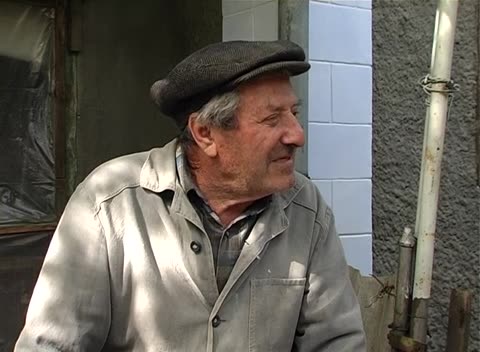
Obodovskii and Leiderman discuss contemporary Jewish life in Kotovsk. They then answer questions about cultural terminology. Obodovskii also talks about the Yiddish language and their life and cultural life after the war.
Obodovskii says that most of the old Jews of Kotovs'k have died and the young have left, so there is no one to talk to in Yiddish. He is asked about the word dibbuk (?) and other Yiddish terms he does not know, and says he knows colloquial Russian rather than literary language. He recalls speaking Yiddish with an acquaintance, and mentions his many books and journals left in a half of the house. They then discuss the Yiddish film about Jewish kolkhozes in Birobidzhan, which was shown at the stadium, and a visit by the singer Iosif Kobzon. He remembers the war starting as he finished third grade, with the rest of the answer running on into the next passage.
Adds the questions about Yiddish words, the Birobidzhan film and Kobzon's visit.
Obodovskii addresses his schooling before and during the war, including school excursion to the Grigori Kotovsky mausoleum. He then talks about his prewar non-Jewish neighbors, as well as prewar antisemitism.
Obodovskii recalls his school years in Siberia during the war and a class excursion to the Kotovsky mausoleum in Kotovs'k, describing the body displayed under a glass lid with his decorations and a sabre. He tells how the mausoleum was damaged in the German occupation and later restored, and that it is now closed. He then speaks of Polish neighbors, two brothers, one of whom was a lieutenant at the front and the other who gave away partisans to the Germans. Asked by Lemster, he says antisemitism existed in Kotovs'k, though not in his construction brigade, which was international.
Adds the long account of the Kotovsky mausoleum and the Polish neighbors during the war.
Obodovskii describes his construction brigade after the war, made up of several nationalities, including Poles, a Moldovan and Russians, of whom only two remain alive. He recalls building the large Kotovs'k wine factory, the plentiful drinking on the job, and the kinds of wine they drank. The last exchange with Lemster and Kerler about the wines runs on into the next passage.
Obodovskii answers dialectological questions from the AHEYM Yiddish linguistic questionnaire. He also describes his personal documents that were issued in Moldova.
Kerler elicits Yiddish translations of Russian sentences, such as drinking glasses and singing many songs, and Obodovskii answers with Yiddish equivalents. He discusses his own nationality, saying he is Jewish although he speaks Yiddish poorly, and that his birth record from the 1930s places him in Bessarabia/Moldova, with the place name Tiraspol and Balta mentioned. Lemster asks about words such as the Yiddish for 'floor' and 'earth', and 'road', and Obodovskii explains a distinction between the floor inside the house and the earth outside.
Adds the personal birth record, with Bessarabia/Moldova and Tiraspol, and the Russian-to-Yiddish sentences.
Obodovskii speaks about his working life after the war. Specifically, he describes his job in the fur business, as well as recalls a non-Jewish co-worker, who spoke Yiddish. Leiderman also remembers a non-Jewish woman communicating in Yiddish with her.
Obodovskii talks about work after the war: he trained for a year in a fur-procurement organization, then worked as a buyer of pelts such as rabbit, and also took bookkeeping courses. He recalls a Jewish warehouse manager, Shmukler (?), and a non-Jewish co-worker from a village near Balta who spoke good Yiddish, which he had learned among the many Jews there. Leiderman or another woman adds that she knew a non-Jewish woman who spoke to her in Yiddish. Kerler and Lemster end by urging the couple to speak Yiddish to each other.
Adds the fur-buying and bookkeeping details and the two Yiddish-speaking non-Jews, a man and a woman.
Leiderman speaks about prewar traditional weddings in Kotovsk. They also discuss wedding customs, before the team concludes the interview with Leiderman and Obodovskii.
A woman asks whether the other has been to a traditional Jewish wedding; she remembers one in Kotovs'k when her sister married, and the others ask about the chuppah and the custom of carrying a cake. They also ask about a wedding custom involving the mother (the word is unclear in the transcript) and dancing with the cake. A woman recalls dancing freylekhs herself, and Kerler thanks the couple to end the interview.
Adds the wedding details (chuppah, cake dance) and the closing thanks.
At the Vinnytsya community center a woman says that a concert is about to begin and that few young people there speak Yiddish. Kerler and Lemster explain their project of Yiddish interviews and look through their list of addresses for elderly Yiddish speakers with names such as Stinerman (?), Nesya Katz and Aron Khazin. They discuss whom to visit and which people may be too ill, mostly in Russian.
Adds the search for interviewees on the team's address list.
The camera collects footage of the center, while the team meets members and an unidentified woman gives a tour of the center in Russian. The woman also talks about her family.
A woman tours the center in Russian, showing a photo exhibition of Jewish faces and explaining that people gather for events there. The team discusses possible interviewees, among them a 103-year-old woman born in Vinnytsya whose daughter worries about her health, and a woman of 78 from the Kurylivtsi district. They mention an earlier American interviewer from the Joint who sought people remembering a pogrom, and the film 'Nedopetaya pesnya' made in Sharhorod with Baba Fanya. They also speak of Nesya's singing at the concert.
Adds the plans for further interviews, the 103-year-old and the film made in Sharhorod.
The members talk about Nesya Shulimovna Katz and show a photograph of her in army regalia. They then explain photographs and discuss the contemporary community.
The group talks about Nesya Katz, a nurse in the war, and looks at a photograph of her. They then explain other photographs on display: relatives from Baltic and Kharkiv, an elderly couple who lived together for 72 years, and a composer from Belentsy whose songs are sung in Ukraine. They also discuss the present community.
Adds the details of the other photographs and the composer.