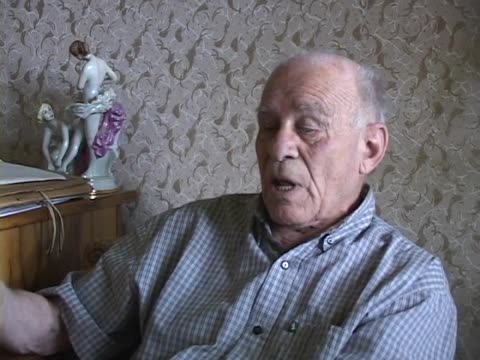
Vider remembers prewar celebrations of Purim. He remembers snippets of Purim shpiels, as well as a Hasidic anecdote about healing. He then talks about literature.
Vider describes how Purim was celebrated before the war: the megillah in the study house, a festive meal at home, singing, dancing and masks. He recalls scraps of purim-shpil lines and tells an anecdote about a Munkács rebbe's greetings. He also tells a story of a rabbi-physician during the Spanish Inquisition who identified a worm by a Torah law. He then talks about his reading (history, geography) and the languages he read in, Hungarian and Czech.
Adds the Inquisition-era doctor story and the languages he read in.
Vider remembers prewar Sabbath celebrations. He sings a Sabbath song in Hungarian. Vider learned some Hebrew from friends who attended the Hebrew school. He then describes prewar Jewish life. Vider explains that he had at one point joined the Mizrachi movement and later joined Betar, where he once saw Zeev Jabotinsky speak. He then joined the Hashomer Hatzair movement, thereby switching from the extreme right to the extreme left within the Zionist spectrum. He laughs that he went wherever the girls were.
Vider sings a Sabbath song, partly in Hungarian, that his father loved, and explains how songs were sung at home on Sabbath. He says he learned some Hebrew from friends at the Hebrew gymnasium. He describes moving from Mizrachi to Betar, where he heard Jabotinsky speak in German, and then to Hashomer Hatzair. He jokes that he followed the girls. There is also talk of caterers for weddings in Mukacheve, a brother in Toronto, and a Jew in Klechanove (Moshe Neiman) to visit.
Adds the Toronto brother's catering, the sarbers question and Moshe Neiman in Klechanove.
The camera records his family photographs. The team goes with Vider on a tour of the former Jewish neighborhood. They arrive at the former Jewish tekhnikum and go inside. Vider remembers Jewish football clubs before the war. Outside the former Jewish tekhnikum, Vider talks about prewar Jewish life.
The group looks at family photographs, then walks through the former Jewish quarter. They reach the building of the former Hebrew gymnasium and look inside; Vider recalls playing football there and the Jewish team Makabi, and the other local and Jewish teams from nearby towns. A tune of Hatikvah is mentioned. The passage ends with a remark that the Hasidim, and the Munkács rebbe in his sermons, opposed the Zionists.
Adds the Hasidic opposition to Zionism and the football teams of nearby towns.
Vider and the team are headed to a former synagogue. Vider explains former Jewish buildings. The next stop includes the old Jewish cemetery. They visit graves of rebbes.
On the walk toward a former synagogue, Vider points out former Jewish buildings, among them an orphanage with a menorah facade from the 1920s. He says the old Jewish cemetery has been built over and gravestones were stolen. Fragments of stones were walled in, and Americans paid to protect the site. He mentions the grave of Rabbi Chaim Elazar Shapira and rebbes' graves. Interspersed are a pharmacy aside and talk about Hungarian and Romanian words.
Adds the orphanage, the walled-in gravestones and the American Jews' payment for the site.
Vider and the team are headed to the new Jewish cemetery. At the cemetery, Vider talks about Jewish life today and visits several graves, including the structure housing the graves of the Shapiro family (the Hasidic rebbes of Mukacheve) and the monument for the Jews murdered during the Holocaust.
At the new Jewish cemetery, Vider and the team look at gravestones, some moved from the old cemetery, with names such as Chaim Yona and Meir Shteynberg (?). Photos on graves, which the Munkács rebbe forbade, are discussed. A mother's four children who died in Auschwitz in 1944 are named on a stone, and the stone of the Shapira family and the Holocaust memorial are mentioned. The place Benerikovitsh near Chernivtsi (?) comes up in connection with a rebbe's wife. There are Hungarian-language asides.
Adds the Auschwitz memorial inscription and the discussion of photographs on gravestones.
Vider and the team continue the formal interview at a restaurant. Vider remembers folk remedies. He talks about his return after World War II and postwar religious life. Vider attended privately organized prayer services and discusses how he would bake matzo at a Romanian Jew’s (Lebovich) house until 1953.
At the restaurant, Vider and Kerler exchange Yiddish farewell sayings. Vider says he returned in December 1946, after his brother's return in 1945, to a few remaining Jews; there was still a shoykhet. He describes meeting for prayer in a Romanian Jew's house (Leybovitsh), baking matzo there until about 1953, and the Leybovitsh grandsons today. He then answers a question about the men who came back from labor in Siberia.
Adds the postwar shoykhet, and the Leybovitsh family and their grandsons.
Vider talks about his experience at the Vorkuta gulag. Vider worked ten to twelve hours a day of hard labor building the railroad tracks from Pechera to Vorkuta. Vider then talks about his family and childhood memories. His father was a commission merchant for two retail companies (metal and colonial goods) from Prague. Vider explains how well-off his family was because they owned a telephone.
Vider talks about the Vorkuta camp: ten to twelve hours of work a day, the mosquitoes, fellow Jewish prisoners including one who died, and singing to himself in the Gulag. He then speaks about his father, a commission agent for two Prague firms (metal goods and colonial goods) whose territory covered Subcarpathia and Slovakia as far as Košice. The family lived well, and in the 1920s they had a telephone. A brief break and a question about a man's name follow.
Adds the Jewish fellow prisoners and singing in the camp.