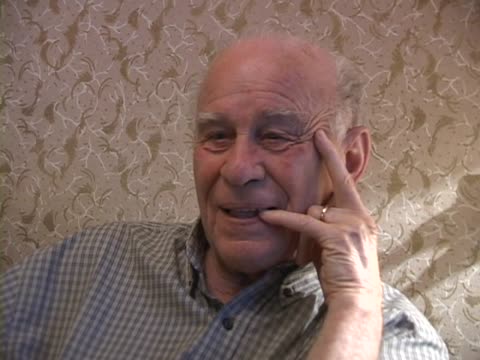
The first part of the tape is a continuation of a formal interview with Hershel Ylyevich Vider in Mukacheve. The team continues to ask a number of dialectological questions from the AHEYM Yiddish questionnaire.
Continuation of the dialectological questionnaire with Vider, with Kerler asking and Katz adding. The items include words for praying, painting oneself and a midwife, the taste of an apple, going on the street, potatoes, flowers and shops, the difference between a shop and a business, and verbs for digging. Other items cover words for people (rich man, strong man), the dreidel and Purim noisemaker, a prepositional phrase to translate, and expressions for 'probably' and 'return'. Vider says he has not spoken Yiddish for sixty years.
Many items covered, including lexical choice, grammatical forms and his own comments on how he has used Yiddish.
Vider tells an anecdote making fun of the Jews of Berehove, who tried to build a besmedresh. He then talks about the difference between a synagogue and a besmedresh. After concluding the official part of interview, the camera films photos and artifacts from Vider’s apartment.
Vider tells a joke at the expense of the Jews of Berehove, whom the Mukacheve Jews considered foolish, about carrying stones up and down a hill. He explains the difference between a shul and a besmedresh and the small kloyz and shtibl prayer houses of Mukacheve. He talks about Hasidic groups, Zionists and the Jewish street today, saying he is an honest Zionist and works for the Hesed and the community. Kerler then asks about people in Berehove and more stories, and Vider reads out items from the internet. The segment ends with talk about wild blueberries, coffee and Russian-language anecdotes about Mussolini and the 1944 front.
Beyond the Berehove anecdote and synagogue distinction, it covers Hasidim, Zionism, his community work, internet reading and a wartime coffee story.
Camera footage in Mukacheve showing the building where Vider's cheder was and the house where he was born, on the former Jewish street. Vider and Kerler talk about the age of the building and its inscription.
The team travels to the next interview in Khust. After the team arrives, they set up the formal interview with Malke Leybovna Snook, born in Kolochava in 1921.
The team arrives in Khust and meets Snook and others, with Kerler introducing himself and the team and explaining that they want an interview in Yiddish. The speakers check Snook's age and Kerler asks the Hungarian and Yiddish names of her village. Much of the opening is arrival chat, partly in Russian.
Snook discusses her family and Jewish life in her home town of roughly sixty families. Her father transported items with his horse. Snook grew up with five siblings, who were all killed in 1943 in Poland.
Snook says she was born in August 1921 in a village called Lazes (?), where about sixty or seventy Jewish families lived with a shul. Her father was named Leyb and worked with horses, and the family kept a cow and lived from the land. She had two brothers and three sisters who were taken away; she was already married by seventeen and living in another village.
Snook talks about Jewish life today, before she continues talking about her family. Snook got married at 17 and lived in Drahovo for forty years. In 1971, she moved to Khust with her family, where there was a more active religious community.
Snook says the minyan today meets only on Sabbath, then names her mother Esther Fuks and recalls her paternal grandfather David, who lived to ninety. Her father Leyb Abramovitsh was born around 1899, and she gives the names of the siblings who were killed. She married in 1939, lived in a nearby village for forty years and moved to Khust in 1971 for a minyan and Jewish life. Her first husband was killed, and she has a son, grandchildren and great-grandchildren.
Gives parents' and grandfather's names, siblings' names, her marriage in 1939 and the reason for moving to Khust.