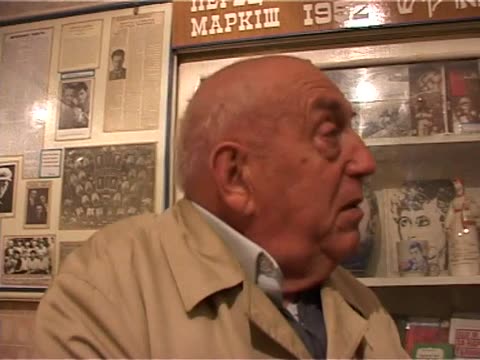
Bentsianov explains Markish's career in Moscow and his standing in Jewish literature. He lists his books, plays and translations into several languages, including Hebrew, English and Chuvash. He tells how he collected materials from many countries and how the Soviet-era ban on Markish's books affected Polonne. He describes the 1965 jubilee and the renaming of a street after Markish, with letters from writers, and shows the porcelain-factory items made for the museum. Kerler and Bentsianov discuss the postwar memorial to Jews killed in the war and the Polonne ghetto, and Bentsianov proposes to play a recording.
Besides the tour, it covers Markish's career, translations, the 1965 street renaming, and Bentsianov's own origins and Yiddish.
A Russian-language poem on the death of an actor and on the six million victims is read aloud, apparently from a recording of Markish's poetry. There is almost no discussion beyond it.
Kerler writes an entry in the museum's visitor's book, and the team reads other entries and press clippings. The clippings are from Moscow, Kyiv, regional, Lviv and Israeli papers and one from Krakow. Bentsianov comments on the authors, including a journalist who praised the museum, a critical remark about the synagogue being turned into a museum, and an English-language entry.
Gives the content of the visitor's book and clippings, not only the book.
Bentsianov and Kerler talk about the day's plan: the underground fighters' monument, Markish Street, the cemetery and the mass grave of ghetto victims, and a woman who might be interviewed. Kerler explains that the team needs Yiddish speakers and cannot afford to cover everything. A woman who attended the Jewish school is also mentioned.
Shows talk about planning the route and the interview budget rather than footage only.
Bentsianov points out memorials near the road. One is for those killed in the war. Another, for the Civil War, names revolutionary-committee members tortured by Petliura's men, among them a Jewish teacher and a Pole. Bentsianov and another voice read out the names and discuss how Petliura is now treated.
On the drive, Bentsianov points out old houses and Markish Street, formerly Naberezhna, near where Markish was born, with a plaque. Shevchenko Street could not be renamed. He mentions the river Khomora and that Germans forced Jews to destroy part of the cemetery. At the Jewish cemetery, which was locked, Bentsianov says he organised its upkeep. Kerler reads and explains tombstone inscriptions and abbreviations, including a rabbi's daughter and a woman's gravestone.
Back at the museum, Kerler asks to look at Bentsianov's publications. Bentsianov shows an article about a Jewish boy, a congratulation on his seventieth birthday, and a certificate from the Jewish community. The talk turns to his articles on Markish and those translated into Yiddish.