0:00
Entering apartment.
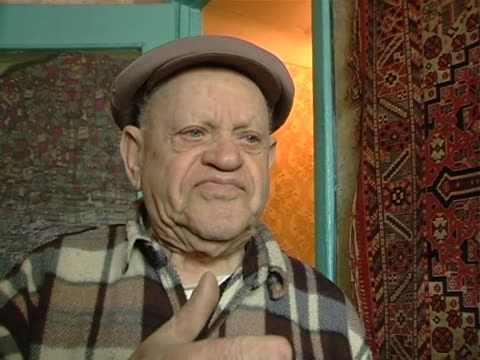
One conversation with Aba Davidovich Kaviner, continuing over MDV 471, MDV 472, MDV 473, MDV 674.
Entering apartment.
Education of the Jews.
Kaviner discusses how Jews entered higher education under the Tsarist regime. Admission was highly competitive, and some Jews, he says, converted to qualify. He names several well-known figures, among them Rubinstein and others, mentioning that one died abroad. He begins a story about Jewish converts who became priests in Khmel'nyts'kyy.
Names several Jews who converted in order to study.
Conversion today.
Kaviner talks about a priest of Jewish origin who comes to the Hesed and visits him, and about another convert whose father had hidden among non-Jews during the occupation and married a non-Jewish woman. Before death, the father told his sons they were Jews. Kerler and Lemster ask about the church and about the priest's languages. Kaviner says the priest knows Polish, English and Hebrew prayers and reads Scripture with him.
Concerns a priest of Jewish origin visiting Kaviner and the family story of a convert.
Showing book.
Kaviner and Kerler look at a book with Hebrew and Polish text, apparently a prayer book of 1929. Kerler comments that Jews who translated prayers into Polish were assimilating, as prayer in Hebrew was dying out. Kaviner then returns to how Jews obtained higher education under the Soviets.
Kerler comments on assimilation and Polish translation of prayers.
Education of the Jews.
Kaviner and Lemster discuss quotas for Jews in Soviet higher education, in the 1960s–70s especially in Moscow, versus easier admission elsewhere. Lemster asks if anyone in Starokostyantyniv can speak Yiddish. Kaviner mentions a man who survived the ghetto but would know little of Jewish tradition. They also touch on the songs Shalom Aleichem and Friday evening singing, and on his war service.
Raises potential Yiddish speakers in Starokostyantyniv.
War medals.
Kerler and Lemster give advice about taking a vitamin once a day after meals. Kaviner says the medals are still with him. Kerler suggests his daughter, a doctor, would explain.
The passage is mostly about health advice and vitamins, not medals as such.
Photographs and wife.
Kaviner recalls how Jews obtained education and shows a photograph of his wife. She died five years earlier and was from Kopayhorod. Kerler recalls that they visited Kopayhorod and asks about her Yiddish and her name, Khantshe.
Showing machzor and prayer.
Kaviner and Kerler look at a holiday prayer book (machzor) for Rosh Hashanah and Yom Kippur, which Kerler notes is printed in non-Hebrew letters. Kaviner then chants a prayer and explains it. He mentions that a grandson brought a cross and a relic from Moldova or Romania.
Kaviner chants a prayer from the book.
Artifacts and concluding the interview.
The team concludes the visit with Kaviner. Kerler sends greetings to Kaviner's daughter, and they discuss sending photographs taken during the visit.
Covers farewell and plans to send photographs.
General introduction.
Kerler opens the interview with Roza Klein, who gives the date and her name and her patronymic. She says her father was Shmuel, and the town is called Olt-Konstantin in Yiddish. She was born in 1923 and was evacuated during the war.
Childhood memories and education.
Klein recalls her school: a Yiddish school that became Russian, with the same teachers. She mentions the Yiddish literature taught — Sholem Aleichem, Mendele and Peretz — and Yiddish theater visiting the town. She mentions that non-Jews spoke Yiddish, and that only Jewish children attended the Yiddish school. She notes that about 20,000 Jews were killed in the town.
Adds the theater, literature taught, and non-Jewish Yiddish speakers.
Family.
Klein speaks about her family. Her father Shmuel, born in 1894, worked as a carpenter and furniture maker and later headed an artel. He was evacuated to Omsk as a specialist. She gives the names of her mother Rivke, grandmothers Mirl and Beyle, and her siblings, and describes their street, the synagogues and her grandmother's attendance at the Beys-Medresh. Kerler also asks about a Yiddish library before the war.
Covers her father's work and evacuation to Omsk, her grandmothers, siblings and the street.
Yiddish literature.
Klein talks about the library and about reading Yiddish after the war. She subscribed to Sovetish Heymland until it ceased in 1991 (?). Kerler mentions that he was an editor of a journal.
Adds Klein's subscription to Sovetish Heymland.
Family.
Klein and Kerler speak about Yiddish after the war: older people spoke it but children were raised in Russian. Kerler explains where he is from. Klein worries about how her words will be used, and Kerler says they are for learning about the town. She says there were two Yiddish schools, a seven-year and a ten-year one.
Family.
Klein explains why the Yiddish schools were closed, then speaks about the Yiddish press she read, her mother's piety (candle blessing until death), and Sabbath cooking such as cholent and gefilte fish. She says there was a rabbi's absence today but a synagogue and Hesed, and that the shoykhet died years ago. She notes that her parents were both from villages, Hrybenynka and Sakhnovtsy.
Covers the Yiddish press, her mother's observance and Sabbath food.
Hebrew.
Klein and Kerler discuss Yiddish classes in America and the Hebrew language. Klein says Hebrew was not needed, as few knew it and the Torah was only prayed.
Passover celebration.
Klein answers Kerler's questions about Passover: matzo baking, her father leading the seder, and kosher observance. She also answers about Purim, saying the children did not go to the synagogue, and about masked performances.
Prewar and postwar Jewish life and family.
Klein describes Olt-Konstantin as a Jewish town with a fortress and castle of the Ostrogski family. She recalls weddings she attended as a child, including customs involving the bride and a cake and the 'malke's broyt'. She also speaks about her mother lighting Sabbath candles until her death, going to the shoykhet, and her Yad Vashem testimony.
Covers the fortress, weddings, candle lighting and the shoykhet.
Prewar education and family.
Klein speaks about her schooling and examinations, and about her sister who married a Russian man who loved Jewish food. Their daughter lives in Israel and speaks Yiddish.
Adds the sister's family.
Life today.
Klein speaks with Kerler about the project: he explains the team has visited over sixty towns and collected memories. Klein mentions a book of testimonies from 6,000 people compiled for Yad Vashem and people searching for relatives. Kerler assures her that her recollections are valued.
Yiddish plays.
Klein and Kerler talk about the Yiddish plays shown in the town, performed by Moscow Yiddish theater. She names plays including 'Tkies-kaf' (?), and mentions that Goldfaden was born in Starokostyantyniv. They also discuss a street naming and a Soviet writer from the town.