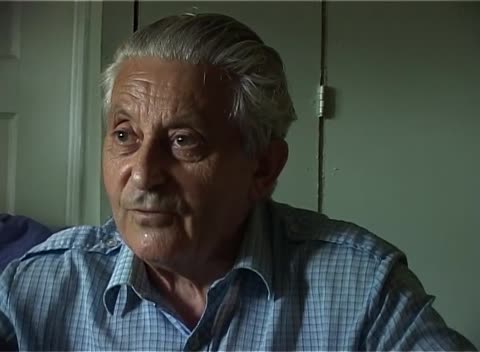
Burshtein answers dialectological questions from the AHEYM Yiddish linguistic questionnaire. He also recalls Polish Jewish refugees in his hometown Sobolivka during 1939. Burshtein then shares a prewar episode from Sobolivka about a man who was arrested.
Burshtein answers dialectological questions, including the meaning of a word for a young non-Jewish man. He recalls Yiddish-speaking Polish Jewish refugees who came to Sobolivka around 1939 and sold small tails (?) from a barrel. He then tells of a man from Sobolivka who was sentenced to four years and was allowed by the militiaman to say goodbye to his wife at home.
The prewar story ends with the wife's calm farewell.
Burshtein talks about prewar cultural life, as well as traditional weddings. He also briefly mentions Jewish life in Bershad and recalls a local musician.
Burshtein answers Kerler's questions about prewar entertainment in Sobolivka: songs, weddings with klezmer musicians brought from Bershad'. He says Bershad' was a ghetto in the war, and that Jews who escaped the killing went there. He also recalls a local violinist named Siame (?), his family, and a house connected to him.
Also covers Bershad' as a wartime ghetto and its Jews today.
Burshtein answers further questionnaire items: words for a stone-built house, what children threw at Hanukkah, expressions for a mistake and for luck, and terms such as tsadik and the face. He explains the difference between a rov and a rebbe. Kerler tells a joke about a pious child and the rabbi, and asks him to tell about Jewish weddings.
Burshtein answers Kerler's questions on childhood in Sobolivka. He recalls swimming in the river through the whole summer with boys and girls. He does not remember holiday songs or wedding jesters.
Burshtein talks about his life during World War II. He recalls the period after the Germans entered Sobolivka and gathered Jews to be taken to forced labor. Burshtein then describes the different kinds of labor he underwent. Burshtein continues that he was taken to the Raygorod ghetto and recalls a massacre in summer 1942 there. Burshtein was also imprisoned in the Bratslav, Mykhailivka and Haysyn ghettos later on. He then briefly describes the living and working conditions in the Mykhailivka ghetto.
Burshtein says his war story would take many days and then summarizes it. After the Germans entered Sobolivka, Jews were taken to forced labor, later driven by the Ukrainian police. He was held in the Raygorod camp, working on road building and stone breaking, and survived the shooting of about six hundred women and children there. He was moved to Bratslav and Mykhailivka, where he got one meal a day and worked full days, and he was in Haysyn at the pogrom of the ghetto in 1943.
Gives a figure of six hundred killed at Raygorod; the catalogue does not.
Burshtein speaks about his liberation by the Red Army in 1944. He then talks about his family's fate during the war and mentions that he visits Sobolivka every year. Burshtein then talks about his life and work during the postwar Soviet period. He worked in the Haysyn sewing factory until his retirement and as as chief engineer for thirty-seven years.
Burshtein says his mother, sister, brother and grandmother were killed in Sobolivka, where a mass grave holds several hundred Jews. He says life now is good. He worked many years at a factory in Haysyn, thirty-seven years as chief engineer, and received a house; his children now live in it.
Burshtein talks about his life today. The team then concludes the formal part of the interview with Burshtein. He also addresses Yiddish literature and Yiddish theater in Haysyn. Burshtein then recalls a Yiddish amateur theater in Sobolivka before the war.
Burshtein speaks about life today and the couple's pension, and Kerler thanks him and wishes him well. Burshtein says in Russian that he regrets losing Yiddish and never learned to read it; he read Sholem Aleichem and others in Russian. He recalls amateur Yiddish theater in Sobolivka and a visiting actress after the war, and Kerler mentions the visiting singer Horovits (?).
The transcript includes a reflection on losing Yiddish and his reading of Yiddish writers in Russian.
Burshtein briefly discusses theater, and the conversation turns to chat about English, Russian and Yiddish. Veidlinger asks whether Burshtein's companion understands Yiddish, and they talk about America and economic conditions. Kerler remarks that even Hasidic Jews now speak Russian.
The camera cuts outside and Burshtein provides information about the former Jewish neighborhood, before the team concludes the interview with him. The camera also collects town footage and the team chats with an unidentified community member in Russian.
The scene moves outdoors in Haysyn, where Burshtein points out the old Jewish houses, a former synagogue replaced by a sewing factory, and how few Jews remain. The team thanks him and takes leave. A local man discusses in Russian how the children of Yiddish speakers lost the language, and the team talks about a Lithuanian-Yiddish speaker.
Includes a Russian conversation with a local man about the loss of Yiddish across generations.
The team travels from Haysyn to Teplyk, while the camera collects town footage. After the team arrives, Boris Chechelnitskii, the mayor of the town, greets them on the streets of Teplyk. Chechelnitskii talks in Russian about contemporary Jewish life in Teplyk.
The team walks through Teplyk while a local man in Russian points out old Jewish houses and the former market square. They then meet the town mayor, who tells in Russian that he took office two months earlier and that only about forty Jews are in the community. He sends the team to a local man who knows the old residents.