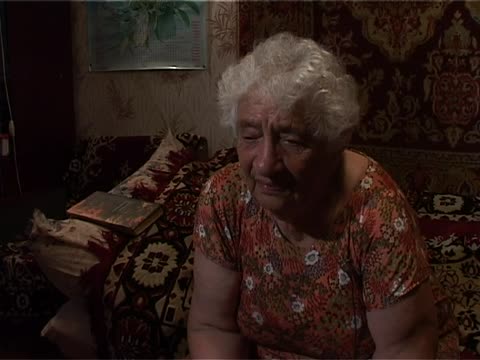
This tape is a continuation of a formal interview with Tatiana (Taybele) Moiseevna Marinina (née Palatnikov, b. 1921 in Teplyk) (part 2 of 2. See MDV 685). She describes Jewish life on the Lunacharka kolkhoz where she lived as a child, focusing on how holidays were celebrated. She briefly recalls the Passover “seyder” (Seder), detailing the various foods that were eaten then, including “keyzlekh” (dumplings).
Marinina lists the holidays kept on the kolkhoz (Rosh Hashanah, Yom Kippur fasting, Sukkot, Hanukkah, Passover, Purim). She describes the family seder, with her father's friends as guests, and the dishes her mother made, including matzo-meal dumplings (keyzlekh) and potato dishes. Kerler asks what keyzlekh are. She also mentions latkes at Hanukkah and Hanukkah money from her father.
Also covers Hanukkah latkes and Hanukkah money, and the other holidays kept.
Marinina talks about the “Gern” or “Subbotniki” (ethnic Russian converts to Judaism/practitioners of Jewish customs), that lived on or near the kolkhoz. According to the interviewee, they attended Yiddish schools and spoke Yiddish better than the Jews, some of them even registering as Jews in their internal passports. Marinina also comments on the generational differences within this group, noting that younger Gern (converts) spoke Yiddish better than their elders and were more likely to marry Jews.
Marinina talks about the Russian converts or Sabbath-keepers, called Gern or Subbotniki, who lived near the kolkhoz. She names a family (the name is unclear) and recalls one who learned at a Jewish technical school. Some were registered as Jews in their documents, and she tells an anecdote of a man declaring himself a Jew in court. Kerler asks how they spoke Yiddish: the older generation with a Russian accent, the younger ones better, and some married Jews.
The names of specific families and a court anecdote about declaring nationality; the catalogue's claim that the younger Gern married Jews is only loosely supported.
Marinina speaks about Jewish life in Teplyk before her family moved to Crimea, stating that she had both Jewish and non-Jewish friends. There were many non-Jews who spoke Yiddish well in the town, according to Marinina, and many of them were killed by the Germans during the war.
Marinina speaks about non-Jews in Teplyk who spoke Yiddish, among them her father's friend Kazarsky, who spoke better than Jews, and a fish dealer. She tells how, under the Germans, one man was beaten or taken after being taken for a Jew, and a villager's fate is told. Kerler asks whether they spoke with an accent. Her own Jewish and non-Jewish friends are touched on briefly.
Adds the specific non-Jews named (Kazarsky) and the wartime anecdotes.
Marinina shares her family’s traditional recipe for “gefilte fish,” stating that her daughter has already forgotten the tradition and makes her fish in a “non-Jewish” way. Marinina also notes some regional differences in how gefilte fish is prepared. She also briefly talks about the Passover seyder on the kolkhoz, stating that her father led the meal, despite the fact that he was not religious.
Marinina describes how she makes gefilte fish: fish stuffing with onion, egg and pepper, boiled for two hours, with only a little sugar. Her daughter makes it a non-Jewish way, and she compares other ways of making it. She then explains the Passover seder in her parents' home, with her father reading from the Haggadah and not being religious. Her grandfather and his brothers emigrated to America in 1924 (?).
Adds details of her father's family emigrating to America and a Torah booklet she owns.
Marinina answers questions from the research team's survey of dialectological and sociolinguistic inquiries. There is also a short discussion of Jewish funeral customs when Marinina asks the researchers if it is allowed in Judaism to repair a deceased relative's damaged gravestone.
Kerler puts dialectological questions: words for bed, a headache, crying, hunger, matzo, going out into the street, to baptize, to hear, vodka, cold, high, to come, people, mouse, later, a gravestone, greetings, non-Jew and peasant, vineyard and grapes, and others. Marinina answers each in Yiddish. Midway she asks whether Jewish law allows replacing her husband's cracked gravestone, and Kerler answers that it is a mitzvah to do so.
Adds the funeral-custom discussion about repairing the gravestone of her husband, whose son lives in Germany.
Marinina briefly comments on intermarriage and the contemporary situation of Yiddish in her town, stating that she has no one to talk to in the language. The rest of the tape consists of the interviewee answering more questions from the AHEYM dialectological survey. Cities and towns mentioned on this tape: Teplyk, Shchebetovka, Simferopol’, Uman’.
Marinina says she has no one to talk Yiddish with, mentions reading a Yiddish booklet, and notes that her granddaughter married a non-Jew, a militia officer. Kerler continues the questionnaire with words for book, pigeon, tooth, ten, a shed, to build, thousand, near, face, blue, green, yellow, and the Sabbath loaf (khale). She also recalls her father giving Hanukkah money and the size of her family.
Adds that the recorded speaker lives in a suburb of Teplyk and describes family details and a granddaughter's marriage.