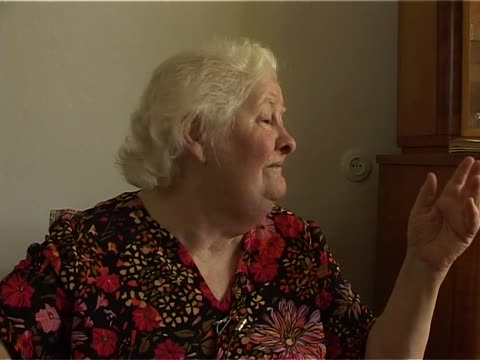
This tape is a continuation of a formal interview with Sofia (Sonye) Moiseevna Palatnikova (b. 1927 in Teplyk) (part 2 of 3. See MDV 687 and MDV 689). She discusses prewar Jewish life, noting that holiday celebrations did not take place in the synagogue, but rather at home. She remembers how Passover was strictly observed with a different set of dishes. Reflecting on her father’s work as a butcher, Palatnikova discusses the differences between Jewish and non-Jewish consumption of meat before the war as it related to the kosher status of the meat and different kinds of fasts that non-Jews observed. She also comments on contemporary eating practices of chicken.
After a short exchange in which Kerler explains where the visitors come from, Palatnikova recalls prewar Jewish holidays kept at home rather than in the synagogue, and strict Passover observance with separate dishes. She relays what a grandfather told about kosher meat, the shoykhet, and non-Jews who did not buy meat at certain times because of fasts. She says Jews sent meat to be sold, and she explains why she eats chicken today. At the end she says she remembers no Passover songs.
Opens with Kerler introducing the visiting group, and the passage ends with a question about Passover songs.
Palatnikova shares a recipe for “gefilte fish,” mentioning regional differences in preparing the dish. She talks about holiday foods for Chanukah, Purim and Passover.
Palatnikova explains how she makes gefilte fish: skinning the fish, mincing with onions, eggs and matzo meal or crackers, and cooking it for hours. She contrasts her way with how non-Jews make fish cutlets. She also talks about her mother's holiday cooking for Hanukkah, Purim (poppy-seed hamantashen) and Passover, and about latkes and potato dishes. Kerler asks about the Yiddish names for these foods.
Includes talk of her birthday and a discussion of the Yiddish terms for latkes and potatoes.
Palatnikova also talks about Jewish religious life in Crimea before the war. She describes the practices of the “Gern,” who were ethnic Russians who followed the Jewish religion and learned to speak Yiddish, although their outward appearance remained non-Jewish.
Palatnikova answers whether her father went to synagogue, then talks about non-Jews who followed the Jewish religion, took up Yiddish, and kept Jewish practice more strictly than Jews. She names one such family (?) and tells a story about one man questioned by the authorities. She also answers Kerler's questions about the word for a Friday loaf of bread baked by her mother.
Adds the story about a man questioned by the authorities and the question about a baked-bread term.
Palatnikova briefly touches on the topic of sickness and healing, and mentions the variant of “gehakte,” of chopped fish, in contrast to "gefilte fish".
Palatnikova answers briefly about doctors and healers in Teplyk before the war, Jewish and non-Jewish, including a dentist. Kerler then asks about terms for chopped versus stuffed fish. She names the fish dishes, and says her mother chopped the fish with a hatchet-like knife. Kerler announces he will move to Russian prompts.
Includes the discussion of doctors in Teplyk and the Yiddish terms for chopped and stuffed fish.
Dialectological questionnaire: Kerler gives Russian words and phrases and Palatnikova supplies Yiddish equivalents. The items include household and body words (bed, headache), emotions and states, directions and place words, and weather and temperature. They also cover greetings and thanks, words for non-Jews, luck and fate, building and house words, birds, and religious terms such as gravestone and havdalah. Palatnikova comments on Russian and Belarusian influence and on her own Yiddish.