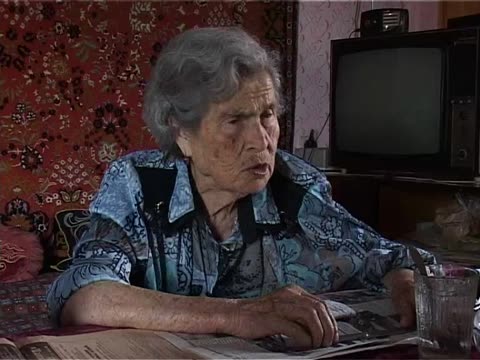
Questionnaire work with Tsila Borisovna. Kerler asks how Russian and Ukrainian words and sentences are said in Yiddish: words for pious and honest, the cross, mountain, sea, street, potatoes and flowers, shop, number of family members, 'other', and 'enemy'. He also asks about grammar forms (past tense, "I was", "you are right"), and local words for well, bathhouse and ritual bath, and floor. She also answers a question about whether she remembers ghetto songs.
Kerler meets Reznik at her home and explains the interview. She says she was born in a village near Tomashpol' (name unclear) and gives her maiden name, Kordonskaya, and her husband's family. She went to a Ukrainian school, took courses in Kyiv and worked as an economist and bookkeeper. She was evacuated in 1941 to the Urals and then to a kolkhoz, and returned in 1944, married and bought the house. She names her parents and where they came from.
Liza Petrunenko joins and gives her name and Yiddish name. The talk covers her parents and grandfather, and the family's work in the kolkhoz. Reznik and Petrunenko recall prayer in private houses, the many prayer houses of the town, and Sabbath and Passover customs. Reznik names her siblings and recalls childhood games. They discuss non-Jews who spoke Yiddish before the war and today, and Reznik shows the old mezuzahs on doors and windows and her old house.
Adds Petrunenko's own background, the question about singing, and the mezuzahs and house tour.