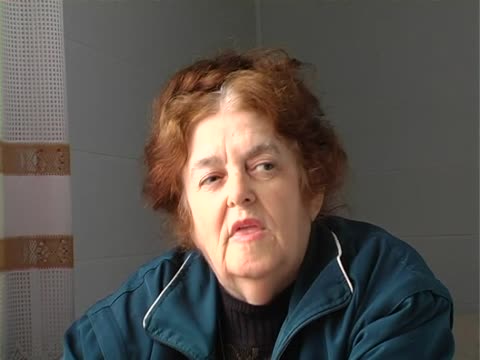
Shusterman talks with the interviewers before leading them to another informant. She discusses relatives and neighbours who speak Yiddish, and her poor health and dizziness. She also describes high prices, pensions, a bank loan for building work, and money sent from America. She mentions a relative in Israel who has had several operations. The interviewers ask how many Jews remain in Tomashpol', and the answer is seven.
Also covers prices, pensions, a bank loan and relatives abroad, and the remaining Jews.
The interview with Guzman begins with her name, birth in Tomashpol' and her family: her father Bentsion, a shop worker beaten by the gendarmerie, her mother, and her brother. She recalls Yiddish and Ukrainian schooling, prewar holidays (Purim, Passover, Sukkot), food, the synagogues and the shoykhet, weddings and the library. She describes the ghetto, where non-Jewish villagers brought food, and forced labour in the fields. She mentions the famine and her stay with an aunt and uncle, as well as work after the war, photographs, relatives in Odessa, America and Israel, and Tul'chyn. Roughly the last quarter is word elicitation: greetings, colours, adverbs, 'pigeon', 'ear' and other items, which Guzman answers with difficulty.
Beyond family and school, covers holidays, food, the ghetto, the shoykhet and a long word-elicitation section.