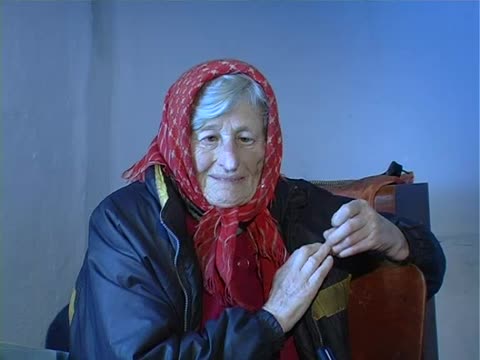
Continuation of the dialectological questionnaire, answered by a woman and an occasional second voice. Kerler asks how various Russian or Ukrainian items are said in Yiddish: sick, 'I like him', barely walks, run away, honest/pious person, cross oneself, ladder, attic, apostate, dybbuk, golem, comedy, 'you are right'. Further items are street, river, lake, potatoes, store, midwife, ceiling and beams, plus short sentences to translate, such as 'I don't see him', 'three people came' and 'we were seven in the family'. He also asks whether she knows certain words at all. He ends with thanks.
Concluding the interview with the woman. She asks where the team has been, and Kerler lists towns they have visited, such as Fastiv, Uman and Kyiv, over many Ukrainian towns, and says it is his fourth visit to the region. A few last questionnaire items are asked, but the transcript is unclear. Kerler thanks the group warmly and compliments her laugh.
The passage is less a dialectology item list than a conversation about the team's travels and thanks.
The team arrives at the house of Futiran, called Alyosha, and calls him out from the yard. After a greeting at the gate, and talk of his wife being in Israel while he is here, they say they cannot stay long. They go in and are offered drinks and food, including salo, in a mostly Russian exchange with a woman host and a Russian-speaking companion. There is banter about pork and kosher custom, and about coming again next year.
Short stretch of the van ride through town on the way to the next interview; only a few words of Kerler's remarks, partly in Russian, are audible, and the content is unclear.
Nothing in the transcript identifies the footage as Vinnytsia.
Informal meeting with Mukha. Kerler explains that the team has been looking for his house, and says they were pleased to find him after coming to Tomashpil' several times. Kerler says Mukha wants to learn Yiddish, asks how to say thank you in Yiddish, and the group notes that a woman, Galya, is ill. Mukha and a second voice remark that Yiddish has been lost in the town. At the end Kerler asks him to tell what he remembers of Jewish weddings.
Mukha recalls his Jewish friends and neighbours in Tomashpil' as all Jewish, names a few of them (garbled in the transcript), and mentions the games they played as children and a song. Kerler asks which friends he remembers and how they played. At the end Mukha points out where his house is, and the talk turns to livelihood.
Mukha speaks about his life today and before the war. He is on his own, and says his family have died, and that he misses his friends, who have scattered to Vinnytsia, Odesa, Kyiv, Israel, America, Zaporizhzhia and Moldova. He recalls that there was a Jewish school and a Jewish prayer house in Tomashpil' before the war, that Jews made a living there, and that older Jews prayed, though the transcript is unclear. He remembers the war as a hard time, with Jews sleeping in his house, and Kerler asks about a telephone to reach him.
Concluding the interview. Kerler thanks the interviewee and a woman present, a Lyudmila (?) Petrovna (name unclear), and says he hopes to meet again in a year. The informant says three years. Kerler urges him to learn and remember Yiddish. A small gift is mentioned, and Kerler closes with a parting wish.
Shveibish in Tul'chyn describes the present-day Jewish community: about 172 Jews, including children, many of them elderly, living on small pensions, with some 35 helped by Hesed and the Joint through patronage. She tells of old people and a man aged 91, and of lost state support and closed factories. She describes organising a bus trip and meeting at Pechera with former prisoners from Kyiv and a school group, with television and radio present, and how she raised money and food for it. She also speaks about relatives of acquaintances who emigrated to Israel or America, about antisemitism, distributing matzo, and says some thirty Pechera survivors remain.