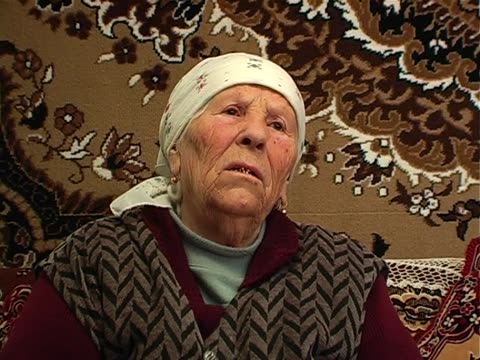
Kerler asks about Palestine and Israel; Pecherskaia talks about violence there and about her daughter's life in Israel. She recalls a visit to a small town, probably Bat Yam or Beit Shean (the name is unclear in the transcript), where she saw a river and the countryside, and says it was the only place she visited. She describes the ultra-Orthodox neighbours, their large families, and how the state pays them.
The catalogue does not mention her views on the Orthodox neighbours in Israel or her visit to a small town there.
Pecherskaia says she remembers no Yiddish or Gentile songs and thinks only of her children. She reflects on how hard it is to be a Jew and recounts a recent incident at an office in which she was insulted as a Jew; she says she no longer goes out and her son buys what she needs. She mentions that many Jews have left the building where she lives. She and Kerler then wish each other health and talk about Kerler's children, and Kerler starts to look for a photograph.
The catalogue does not mention the exchange about Kerler's own family, or her answer that she remembers no songs.
Pecherskaia shows the team family photographs, which were taken in Israel and America. She talks about her family. She was married in 1945. Pecherskaia has three half-sisters, who live in America. She then speaks about her life today and mentions towns she visited.
Pecherskaia shows Kerler photographs, apparently from Israel and America, including a photograph album her son-in-law made for her and a picture of her husband. She mentions her husband's death and gravestone, and says she married in 1945 when she was very poor. She names three half-sisters who share a father but not a mother and are in America, one of whom phoned her. She also mentions a visit to Vinnytsia where she had six operations, and says life is a dream.
The catalogue does not mention the six operations in Vinnytsia.